

Devices & setup
Which wearable for your sport? What to look for in running, swimming, cycling, strength and racket sports
The best watch for your sport has the sensors that sport demands: GPS for trail, a swim mode for the pool, a power meter for cycling, a chest strap for lifting. Start from the sport, not a brand ranking.
Written by MoveVitals Editorial Collective
Community-authored educational content. Individual clinical review is identified only when a named review is actually recorded.
Editorial standards & corrections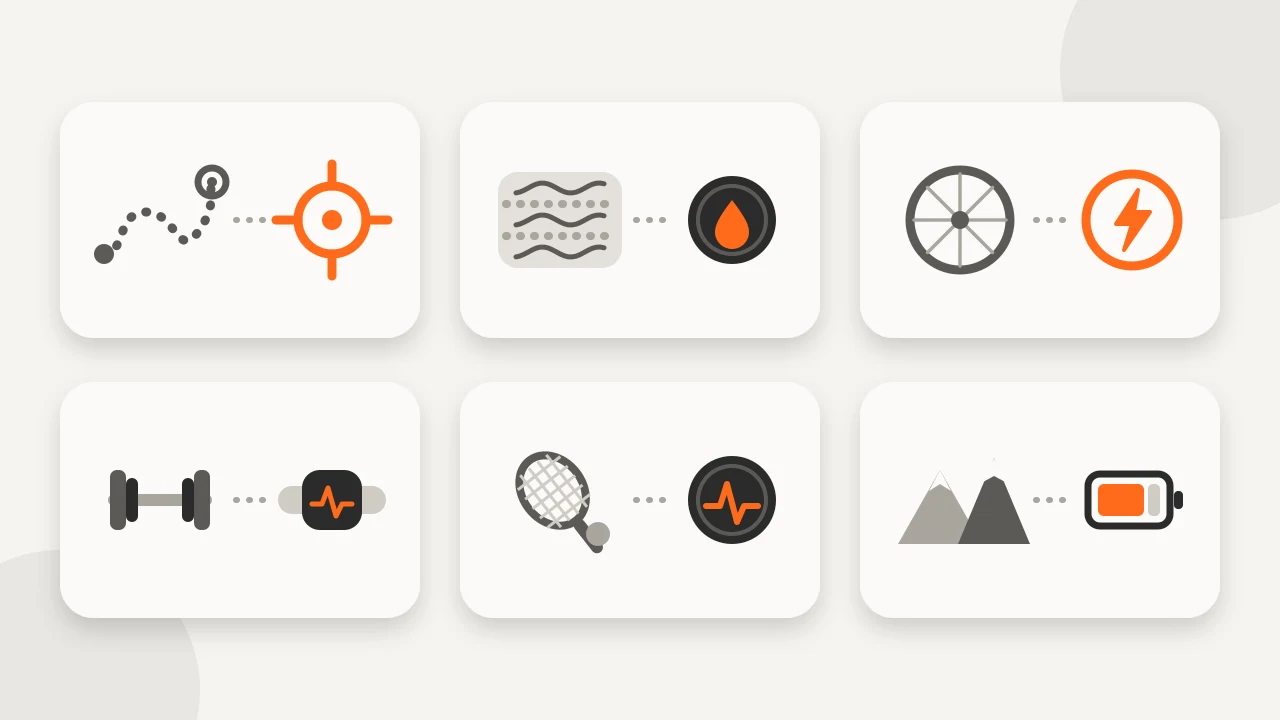
Key takeaways
- A watch alone gives no cycling power, and wrist heart rate suffers while gripping the bars, so cyclists need separate sensors.
- A swimming watch needs at least 5 ATM, a pool mode with lap and stroke counting, and an open-water mode if you swim outdoors; heart rate underwater is the usual weak spot.
- If wrist heart rate is the problem, a chest strap usually costs less than a flagship watch, so fix the weak spot before paying for a more expensive device.
- Compare battery life in the GPS mode you will use with your longest session, not with the headline number.
- A ring or band is good for sleep and recovery, but most have no GPS and few sport features.
Start from what your sport demands
Almost every modern sports watch has GPS, optical heart rate and a barometer, so the differences that matter are narrower than the marketing suggests. This table shows what to check first for each sport and where it usually goes wrong.
| Sport | What matters most | Typical weak spot |
|---|---|---|
| Running, walking | GPS pace and distance, wrist heart rate, battery for long outings | GPS drift between tall buildings; wrist heart rate in intervals |
| Cycling | Power, cadence, speed; screen and mount | Wrist heart rate while gripping the bars; no power from a watch alone |
| Pool swimming | Water rating, lap and stroke counting | Heart rate underwater; laps after drills or long rests |
| Open water, paddling | GPS fix, battery, water rating | GPS drops when the arm is underwater |
| Strength, HIIT, CrossFit | Fast heart-rate response, interval timer, set logging | Wrist heart rate under grip; rep counting; calories |
| Racket and team sports | Comfort, heart rate, sport profile | Flexing wrist; GPS adds little indoors |
| Hiking, trail, ski | Battery in GPS mode, barometric altimeter, maps or breadcrumb trail | Battery, cold, tree cover |
| Yoga, Pilates, mobility | Comfort, resting heart rate, sleep | Calorie estimates |
Running, walking and cycling: GPS, power and cadence
Steady running is the easy case for a wrist sensor: GPS gives pace and distance, and optical heart rate is generally accurate once you have warmed up. Cities are harder than parks, because tall buildings and tunnels can bend a GPS track, and watches with multi-band (dual-frequency) satellite reception generally cope better. On a treadmill the watch estimates pace from arm swing, so calibrate it against a known distance outdoors or add a foot pod. Wrist heart rate lags during intervals; a strap does not. See running pace and GPS accuracy and treadmill running.
Cycling needs different sensors. A watch can record speed and heart rate, but power, the number that tells you how hard you are really working, comes from a power meter in the pedals, crank, hub or smart trainer, and cadence from a crank or wheel sensor. Many riders wear a watch and mount a bike computer for the bigger screen and navigation. Gripping the bars flexes the wrist and can disturb optical heart rate, so use a strap on rides where you train by zones. Compare heart rate, power and pace, then read power meter types and accuracy and cycling power zones.
Best watch for swimming: the hardest place for a wrist sensor
For swimming, start with the water rating. Manufacturers generally treat 5 ATM (50 m) as the minimum for pool swimming, and you want a swim mode that lets you set the pool length and lock the screen. Accelerometers count laps and recognise strokes well in steady swimming, but they can miscount during drills, kick sets or long rests at the wall. Optical heart rate is unreliable underwater, so a swim-capable strap or armband that stores data in its own memory is the dependable route. See swimming heart rate and swim pace, CSS and SWOLF.
In open water, GPS can only fix your position while the watch is out of the water, so the track is smoothed and distance can be a little off. Wait for a satellite fix before you get in. For paddling and surfing, check the water rating, screen lock and saltwater care, and expect poor wrist heart rate when you grip a paddle. See open-water swimming, SUP and kayak and surfing.
Best watch for strength training, HIIT and racket sports: bring a chest strap
The best watch for strength training is rarely about the watch. Gripping a barbell or kettlebell flexes the wrist, optical heart rate then drifts, and automatic rep counting and exercise recognition are inconsistent. A chest strap or armband gives a steadier trace for HIIT, CrossFit and Hyrox, and a simple log of sets, reps and weight in an app says more about progress than any watch metric. Calories estimated at the wrist are rough in every sport; for comparisons across activities use calories burned by activity. See strength training heart rate, HIIT vs steady-state cardio and Hyrox training.
Racket and team sports add short bursts, sudden stops and a constantly flexing wrist, so wrist heart rate is often late or noisy. For the best watch for tennis and pickleball, choose something light and comfortable with a racket-sport profile, and pair a strap if heart rate matters. GPS adds little on an indoor court, and a watch is not a swing sensor. See pickleball, padel, tennis and team-sport load.
Best watch for hiking: battery, altitude and maps
For hiking, trail running and ski days, battery life comes first. Manufacturers quote battery in different modes, so look for the figure in the GPS mode you will actually use (multi-band, with maps or music, is shorter) and, as a rule of thumb, keep a margin of about double your longest outing. Cold shortens it further. A barometric altimeter generally gives more reliable ascent than GPS height, breadcrumb or map navigation matters when the trail forks, and multi-band GNSS helps under tree cover and in canyons. See hiking heart rate, trail running, ultramarathon training and alpine skiing and snowboarding.
Before you buy: five checks for any sport
- Fix the weak spot, not the watch. If wrist heart rate is the problem, a strap usually costs less than a flagship watch. Wrist vs chest-strap accuracy shows which sessions need one, and the Polar H10 guide covers fit.
- Check battery in your mode. Compare it with your longest session, not with the headline number.
- Ask where workouts can go. Prefer a device that syncs to a platform other apps can read, such as Garmin Connect, Polar Flow, COROS, Suunto, Wahoo or Strava, so your history survives a brand change. See the guides for Garmin, COROS, Polar, Suunto and Magene. Apple Health compatibility explains why a device that works with Apple Health is not automatically connected to MoveVitals.
- Test the fit. If it annoys you at night or in the gym, it will stay in a drawer. Wear it snug for workouts.
- Match the form to the job. A ring or band is good for sleep and recovery, but most have no GPS and few sport features. If steps and sleep are all you want, a light tracker is the best fitness tracker for you; if you train, a sports watch is the better base, with or without a ring.
Guides by sport
Each of these guides covers the metrics, wearable accuracy and training structure of one discipline.
- Running: Half marathon · 10K plan · Faster 5K · Trail running · Ultramarathon · Treadmill running · Running to lose weight · Running in the heat · Hitting the wall · Race-day nutrition · Norwegian double threshold
- Walking and hiking: Fitness walking · Japanese interval walking · 12-3-30 incline walking · Walking after meals · Nordic walking · Rucking · Hiking heart rate
- Swimming and water: Swimming heart rate · Swim pace, CSS and SWOLF · Open-water swimming · Swimming for fitness · Triathlon · SUP and kayak · Surfing
- Cycling: Cycling power zones · Road cycling plan · Mountain biking · Gravel · Indoor cycling classes · E-bike and commuting · Power meter types
- Strength, HIIT and hybrid: Strength training heart rate · Strength training recovery · Calisthenics · Core stability · CrossFit and functional fitness · Hyrox · Hybrid running and lifting · HIIT vs steady cardio · Jump rope · Elliptical and stair climber · Dance fitness
- Racket and team sports: Pickleball · Padel · Badminton · Tennis · Table tennis · Basketball · Soccer / football · Team-sport load · Golf
- Mind-body and mobility: Yoga · Pilates · Tai chi and qigong · Daily stretching
- Combat, climbing and snow: Boxing and kickboxing · BJJ and judo · Climbing and bouldering · Alpine skiing and snowboarding · Cross-country and ski touring · Skating
In MoveVitals
Workouts arrive from Garmin, Polar, COROS, Suunto, Wahoo, WHOOP, Oura and Strava, rowing sessions from Concept2, and Zwift and Magene rides via Strava. Apple Watch workouts arrive through Strava when they appear there; direct Apple Health sync is planned. Withings and Dexcom bring body, sleep and glucose data rather than workouts. MoveVitals maps each workout to one of its standard sport types (run, ride, swim, strength, racket, yoga, ski and others, with anything unrecognised filed as "other"), so check that your sport shows up where you expect. A strap paired to your watch or bike computer sends its heart rate through that platform. When the same workout comes from a watch and from Strava, MoveVitals groups records from different providers that overlap by at least 50 % of the shorter recording and keeps the originals. See how MoveVitals resolves conflicts.
Worked example
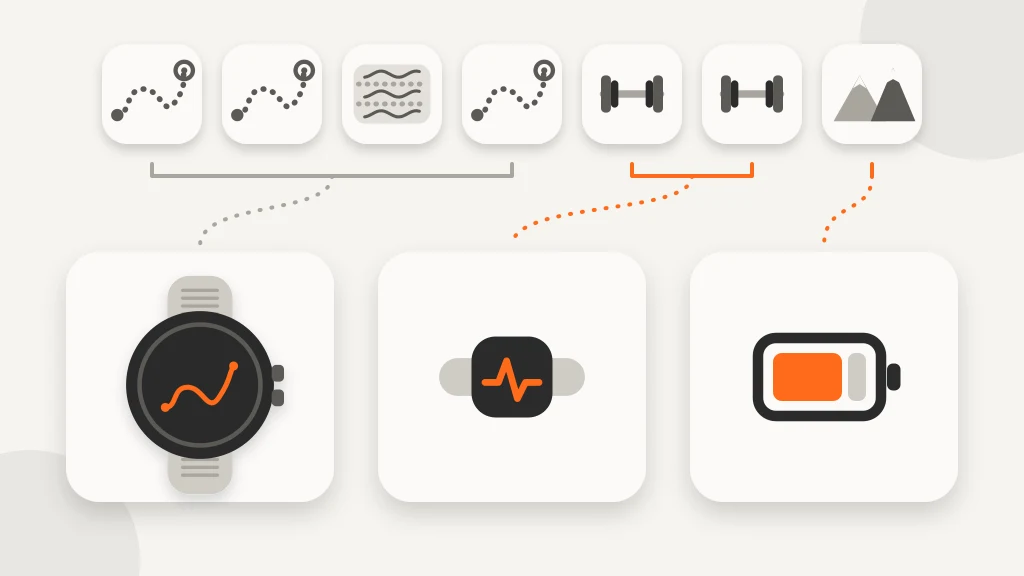
Illustrative scenario. Maya runs three times a week (45 minutes, steady), swims once (1,500 m), lifts twice and hikes one day a month (about 6 hours). She writes down the weak spot of each: GPS and battery for the hike, water rating for the pool, wrist heart rate for lifting. A watch with a 5 ATM rating and a swim mode covers the runs and the pool. For the hike she wants at least 12 hours of battery in the GPS mode she will use, double the longest outing as a rule of thumb. For lifting she adds a chest strap instead of upgrading the watch. In a test gym session the watch averaged 128 bpm while the strap read 141 bpm, so she uses the strap on lifting days and ignores the watch's gym calories. Figures are illustrative.
Action steps
- List your two or three main sports and your longest session in each.
- Use the table to find each sport's weak spot: grip, water, battery or satellite signal.
- Fix weak spots with a sensor (strap or armband, power meter, foot pod) before paying for a more expensive watch.
- Check battery in the GPS mode you will use, the water rating, and that workouts can sync to a platform you can connect elsewhere.
- Test during the return window: one session per sport against a strap or a known distance.
Related guides
- How accurate is wrist heart rate? Optical sensors vs chest straps, by sport
- Polar H10 chest strap with MoveVitals: accurate heart rate and HRV
- Apple Health compatible devices: what reaches MoveVitals?
- Calories burned by activity: MET values, per-hour tables and how wearables estimate them
- How MoveVitals handles multiple devices: provenance, duplicates and conflicts
FAQ
What is the best fitness tracker if I only want steps and sleep? A light band or ring is usually enough and more comfortable overnight. You give up GPS, a bright display and sport-specific data fields, so if you also train seriously, a sports watch is the better base.
What is the best watch for swimming? There is no single best: look for at least 5 ATM, a pool swim mode with lap and stroke counting, and an open-water mode if you swim outdoors. For heart rate, use a swim-capable strap or armband with its own memory.
What is the best watch for strength training? Any comfortable watch will do for timing and logging, but pair a chest strap if heart rate matters, and record sets, reps and weight in an app. Rep counting and calories from the wrist are rough.
Is there a ranked list of the best sports watches? Not here. Needs differ by sport and budget, and models change every year, so this guide shows what to check rather than naming a winner.
References
- Gillinov et al. (2017). Variable Accuracy of Wearable Heart Rate Monitors during Aerobic Exercise. Medicine & Science in Sports & Exercise. https://doi.org/10.1249/MSS.0000000000001284
- Bent et al. (2020). Investigating sources of inaccuracy in wearable optical heart rate sensors. npj Digital Medicine. https://doi.org/10.1038/s41746-020-0226-6
- Shcherbina et al. (2017). Accuracy in Wrist-Worn, Sensor-Based Measurements of Heart Rate and Energy Expenditure in a Diverse Cohort. Journal of Personalized Medicine. https://doi.org/10.3390/jpm7020003
For general information only. This is not medical advice — talk to a qualified professional about your health.
Keep reading
Metrics explained
VO2 max: what it means and how to improve it
4 min read
Metrics explained
Heart rate zones explained: how to set and use them
4 min read
Sports
Trail running with a watch: heart rate, climbs and pacing by effort
7 min read
Metrics explained
Resting heart rate: normal ranges and what changes it
4 min read
Sports
Hiking and trekking: heart rate on climbs, pacing and how to train for it
8 min read
Devices & setup
How MoveVitals handles multiple devices: provenance, duplicates and conflicts
5 min read