

Sports
Boxing and kickboxing: heart rate by round, calories and recovery
Boxing heart rate follows the rounds: it climbs through each round of two to three minutes and falls in the rest, so a workout draws a saw-tooth line. This guide covers what boxing heart rate and calories look like, why wrist sensors misread punching, and how to fit classes into your week.
Written by MoveVitals Editorial Collective
Community-authored educational content. Individual clinical review is identified only when a named review is actually recorded.
Editorial standards & corrections
Key takeaways
- In a boxing workout, each 3-minute round starts and peaks higher than the last, with peaks often at 80–90 % of max and one-minute rests that rarely return to the starting level.
- The useful boxing numbers are the peak of each round and heart rate at the end of each rest; stop early if rest values keep climbing or your form fades.
- Tight wraps, glove cuffs and a flexed wrist disturb optical sensors, which can lock onto a jab–cross rhythm instead of the pulse, so use a chest strap for hard sessions.
- The Compendium of Physical Activities lists punching-bag work at about 5.5 METs and a vigorous kickboxing class at about 10.3 METs, but rests pull a real session lower.
- Leave at least 48 hours between the hardest boxing sessions; sparring with head contact carries a concussion risk, so stop and get advice after a head blow with symptoms.
Boxing and kickboxing sessions are built from rounds: heavy bag, pads, shadow boxing and conditioning blocks, usually 2–3 minutes long with 30–60 seconds of rest. Amateur bouts use three-minute rounds with one-minute breaks. Wearables see that structure only if the heart rate trace is good, which in this sport takes some care.
Heart rate by round
Effort in a round is anaerobic and aerobic at once: bursts of punches and kicks on top of a high baseline, then a short rest. Reviews of amateur boxing report heart rates in competition and hard sparring at the top of the range, often above about 85–90 % of maximum late in rounds. Fitness classes and bag work are usually lower and depend on how hard you choose to work.
| Phase | What you do | What heart rate usually does |
|---|---|---|
| Warm-up, 8–10 min | Rope, shadow boxing, light footwork | Rises to about 60–70 % of max |
| Round 1 | 3 min at working pace | Climbs for the first minute, then plateaus around 70–85 % |
| One-minute rest | Breathe, sip water, walk | Falls part of the way, rarely back to the starting level |
| Rounds 2–5 | Same work | Each round starts and peaks higher; peaks often 80–90 % |
| Final round or finisher | All-out bag or pad work | Peaks at or near maximum for fit people |
| Cool-down, 5 min | Easy shadow boxing, stretching | Falls steadily; the first minute shows how fast (heart rate recovery) |
Shadow boxing heart rate depends on pace. Slow technique rounds sit around 60–75 % of maximum, close to easy aerobic work, while fast combinations with movement can reach 75–85 %. See heart rate zones for the five-zone bands.
The most useful numbers are the peak of each round and your heart rate at the end of each rest. If the rest value climbs round by round, recovery is shrinking, a sign to cut the session short or take an easier round.
Why wrist sensors misread punching
- Gloves and wraps squeeze the wrist. Tight wraps, glove cuffs and a flexed wrist change how the sensor sits on the skin.
- Gripping tightens the forearm tendons under the sensor and adds motion noise.
- Repetitive rhythm. Optical sensors can lock onto the cadence of repeated movement, such as jab–cross rhythm or skipping, instead of the pulse, so the line looks smooth and too low.
- Impact and sweat. Shocks and a slipping, wet strap cause dropouts and spikes.
Optical accuracy generally falls as movement increases (see wearable heart rate accuracy). A chest strap such as the Polar H10 is generally more accurate during vigorous arm movement, though a loose or dry strap can still drop out. Moisten the electrodes and wear it snug under the chest. An optical armband on the forearm or upper arm is a compromise. Take the watch off for pad work with a partner and for sparring, to protect both of you and the device.
Boxing workout calories and kickboxing calories
In the Compendium of Physical Activities, punching-bag work is about 5.5 METs and a vigorous martial arts or kickboxing class about 10.3 METs. At 75 kg, 5.5 METs is roughly 410 kcal per hour of sustained punching, and 10.3 METs roughly 770 kcal per hour of sustained effort. Almost nobody sustains that for a full hour: rests, instruction and warm-up bring the average down. The tables and method are in calories burned by activity.
Wrist estimates of energy use have large errors, particularly when the sensor misreads heart rate. For boxing for fat loss, the energy cost is substantial but total diet, sleep and consistency matter more; classes also work well alongside strength training and some easy aerobic work (HIIT vs steady-state cardio).
Fitting boxing into your week
Boxing HIIT, hard bag rounds and sparring are high-intensity days. A typical balanced week has two hard days at most, with easy aerobic work and strength in between (interval training and HIIT, zone 2 training).
| Session | Structure | Effort | Heart rate feel |
|---|---|---|---|
| Technique rounds | 6 × 2 min shadow boxing or light bag, 1 min rest | RPE 4–5 | About 60–75 % of max |
| Bag intervals | 6–8 × 3 min at a steady working pace, 1 min rest | RPE 7 | About 75–85 % of max |
| Boxing HIIT | 8–10 × 30 s hard / 30 s easy on the bag | RPE 9 in the work | Climbs toward 90 % or more by the end |
| Sparring | Only with a coach, light before hard | Varies | Often very high; take the watch off |
Keep at least 48 hours between the hardest sessions and take a lighter week every 4–8 weeks. For grappling arts see martial arts, BJJ and judo.
Recovery and injury notes
- What gets sore. Shoulders, wrists, hands, shins and hips. Wrap your hands, fit gloves properly and build up round length gradually.
- Whole-body recovery. Watch resting heart rate, HRV and sleep against your baseline in the days after hard sessions (overtraining).
- Concussion. Sparring with head contact carries a concussion risk. After a blow to the head, stop. Headache, dizziness, confusion, nausea or vision problems mean getting medical advice before you return.
- Fatigue and form. Sloppy technique late in a round is a reason to rest, not push through.
Common mistakes
- Trusting a smooth, low wrist trace during bag work.
- Judging a class by the calorie figure on the watch.
- Doing several hard classes back to back.
- Skipping hand wraps and warm-up.
- Wearing the watch for sparring.
In MoveVitals
Boxing and kickboxing workouts from Garmin, Apple Health, WHOOP, Polar, COROS, Suunto and Strava are filed under Martial arts, with duration, heart rate and energy where the device recorded them. Time in zone is calculated from the heart rate stream, and duplicates are removed when two devices recorded the same class (how conflicts are resolved). If you recorded with a chest strap, that heart rate is what you see. Resting heart rate, HRV and sleep sit beside your session days so you can compare how you recover from hard classes.
Worked example
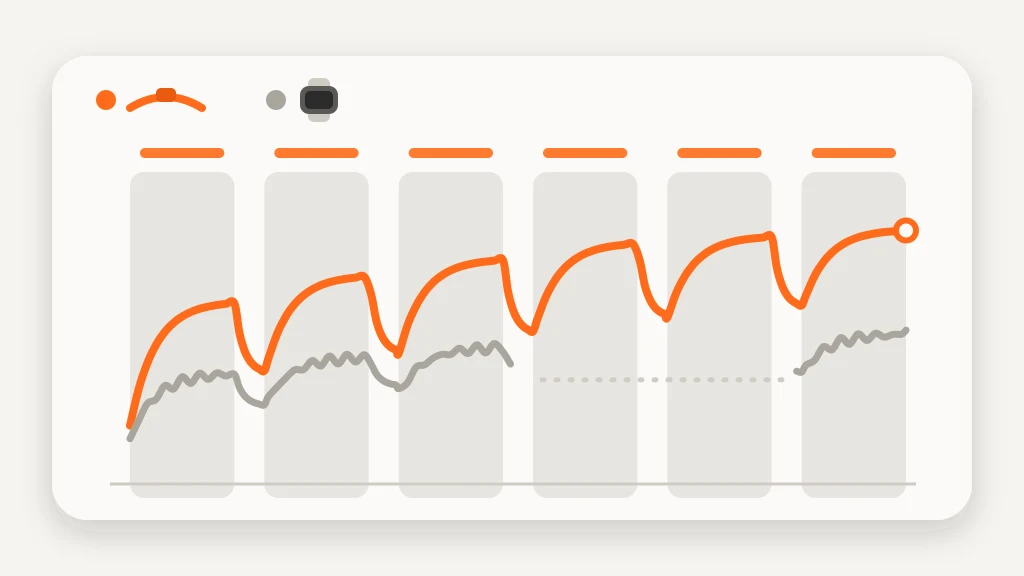
Illustrative scenario. Ivo, 34, weighs 78 kg and has an estimated maximum heart rate of 184 bpm (208 − 0.7 × 34). His class is 10 minutes of rope and shadow boxing, six 3-minute bag and pad rounds with 1-minute rests, and 6 minutes of core work. On the chest strap, round peaks climb from 150 to 172 bpm (about 82 % to 93 % of maximum), and his heart rate at the end of each rest rises from 128 to 150 bpm, so recovery shrinks as the rounds go on. His wrist watch averages 124 bpm against 141 on the strap, and drops out for two rounds. It reports 410 kcal. A Compendium-based estimate, using 5.5 METs for the 18 minutes of punching (5.5 × 78 × 18/60 ≈ 129 kcal) and lower values for rope, core work and rests, lands around 250–300 kcal, so the watch is on the high side. He uses the strap for hard classes and schedules a day off after the hardest one. Figures are illustrative.
Action steps
- Pick 2–3 minute rounds with 30–60 seconds of rest and log them as one boxing or kickboxing workout.
- Use a chest strap or forearm armband for hard sessions; keep wrist-only tracking for easy shadow rounds, and take the watch off for pads and sparring.
- Judge by round: peak heart rate, heart rate at the end of each rest, and how you feel. Stop early if rest values keep climbing or your form fades.
- Count hard classes as high-intensity days, leave 48 hours or more between them, and add easy aerobic work and one or two strength sessions.
- Wrap your hands, build up gradually, and stop and get advice after a head blow with symptoms.
- Follow resting heart rate and HRV trends, and take a lighter week every 4–8 weeks.
Related guides
- Interval training and HIIT: designing sessions that work
- Heart rate zones explained: how to set and use them
- Heart rate recovery: how fast your heart rate drops after exercise
- Polar H10 chest strap with MoveVitals: accurate heart rate and HRV
- Overreaching and overtraining: warning signs and what to do
- Martial arts, BJJ and judo: heart rate, grappling load and HRV recovery
FAQ
What is a normal boxing heart rate? It varies with intensity. Easy shadow boxing is around 60–75 % of maximum, hard bag rounds around 80–90 %, and sparring can be higher. The pattern, a rise in each round and a fall in the rest, matters more than one number.
How many calories does a boxing workout burn? The Compendium gives about 5.5 METs for punching-bag work and about 10.3 for a vigorous class. Rests and warm-up lower the real average, so a one-hour class burns less than the hourly figure.
Is boxing good for weight loss? It can help because the energy cost is high, but overall diet, sleep and consistency matter most. Pair classes with strength work and easy aerobic sessions.
How much recovery do I need after boxing? After a hard class, ease off the next day and leave at least 48 hours before another very hard session. Watch resting heart rate, HRV and sleep, and rest after any head blow with symptoms.
References
- Chaabène et al. (2015). Amateur boxing: physical and physiological attributes. Sports Medicine. https://doi.org/10.1007/s40279-014-0274-7
- Ainsworth et al. (2011). 2011 Compendium of Physical Activities: A Second Update of Codes and MET Values. Medicine & Science in Sports & Exercise. https://doi.org/10.1249/MSS.0b013e31821ece12
- Bent et al. (2020). Investigating sources of inaccuracy in wearable optical heart rate sensors. npj Digital Medicine. https://doi.org/10.1038/s41746-020-0226-6
- Shcherbina et al. (2017). Accuracy in wrist-worn, sensor-based measurements of heart rate and energy expenditure in a diverse cohort. Journal of Personalized Medicine. https://doi.org/10.3390/jpm7020003
- Buchheit and Laursen (2013). High-intensity interval training, solutions to the programming puzzle. Sports Medicine. https://doi.org/10.1007/s40279-013-0029-x
- McCrory et al. (2017). Consensus statement on concussion in sport: the 5th international conference on concussion in sport, Berlin, October 2016. British Journal of Sports Medicine. https://doi.org/10.1136/bjsports-2017-097699
For general information only. This is not medical advice — talk to a qualified professional about your health.
Keep reading
Training science
Zone 2 training: the science and how to do it right
4 min read
Sports
Walking for fitness and weight loss: pace, heart rate zones and how much is enough
9 min read
Training science
Polarized training (80/20): easy most of the time, hard some of the time
4 min read
Sports
Japanese interval walking: the 3-minute fast / 3-minute slow method, step by step
8 min read
Training science
Interval training and HIIT: designing sessions that work
4 min read
Sports
Trail running with a watch: heart rate, climbs and pacing by effort
7 min read