

Sports
Martial arts, BJJ and judo: heart rate, grappling load and HRV recovery
Grappling is hard to read on a wrist: grips, squeezes and long positional battles stress the body in ways heart rate alone misses. This guide shows how to read BJJ heart rate, judge weekly mat time and use HRV to decide when to roll hard.
Written by MoveVitals Editorial Collective
Community-authored educational content. Individual clinical review is identified only when a named review is actually recorded.
Editorial standards & corrections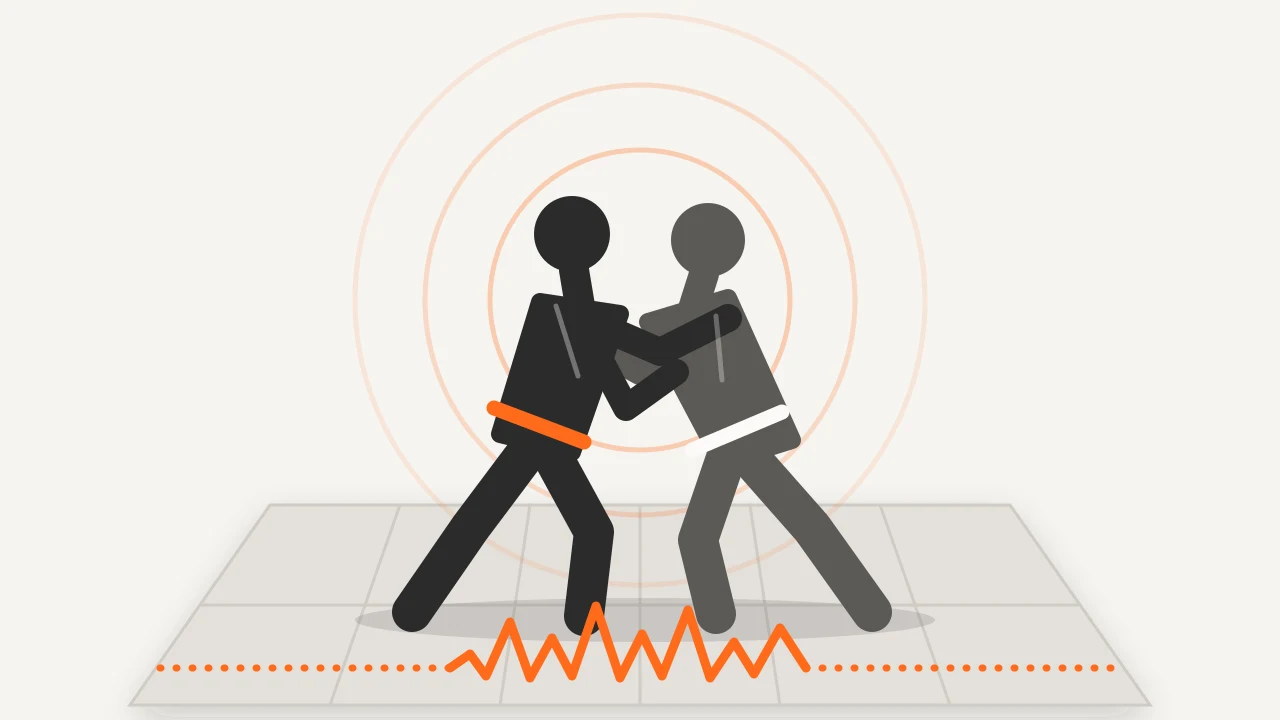
Key takeaways
- In a grappling class, drilling sits at roughly 50–70 % of max heart rate, while live rounds of 5–6 minutes climb fast and peak often in the 80s–90s %, with 1–2 minutes of rest between them.
- Gripping a sleeve, framing and squeezing a pin are largely isometric, so heart rate undercounts them; add a session rating of 1–10 × minutes to capture the load.
- Hard watches can hurt partners, so ask your coach first and choose a chest strap, a soft upper-arm sensor or no device on the mat.
- When HRV stays low for several days while mat time is high, trade live rounds for drilling or flow rolling and sleep more.
- Stop and seek medical care for chest pain or pressure, fainting, unusual breathlessness, or palpitations with dizziness.
"Martial arts" is a wide label. This guide focuses on grappling arts such as Brazilian jiu-jitsu (BJJ), judo and wrestling, where partners stay in contact for minutes at a time. Striking-heavy training is covered in boxing and kickboxing, and most of the same logic applies to the conditioning side of mixed martial arts (MMA).
What a grappling class looks like on a heart rate trace
A typical class has a warm-up, technique drilling with a cooperative partner, positional sparring from set starting points, and then live rounds, usually five to six minutes with a short rest. Reviews of judo and jiu-jitsu physiology describe the same picture: intermittent, high-intensity efforts on top of an aerobic base that helps you recover between exchanges, with heart rate often reaching a high share of maximum in sparring and competition.
| Phase | What happens | Typical heart rate pattern |
|---|---|---|
| Warm-up and drilling | Movement, repetitions, cooperative partner | Low to moderate, roughly 50–70 % of max |
| Positional sparring | Set starting position, rising resistance | Moderate to high, very variable |
| Live round (5–6 min) | Free sparring, scrambles, escapes | Climbs fast, peaks often in the 80s–90s % of max, rarely a clean plateau |
| Rest between rounds | 1–2 minutes | Falls part of the way, usually not back to the start; a bigger drop over time is a fitness sign (heart rate recovery) |
| Cool-down | Easy movement, light stretching | Falls over several minutes |
These are rule-of-thumb ranges, not measurements. Level, partner, grip fighting and who is on top change them a lot (heart rate zones).
Class energy is easy to overstate. The Compendium of Physical Activities lists about 5 METs for slow, novice martial arts practice and around 10 for a moderate-pace class that includes judo and jiu-jitsu. For a 70 kg adult that is roughly 350–700 kcal an hour if the whole hour were that hard, but a real class includes drilling and rest, so the average sits well below the top figure. Watches estimate from heart rate and motion and can be well off (calories burned by activity).
Wearing a device on the mat
Safety and club rules come first. Watch cases, buckles and bands can scratch or hook a training partner, and many clubs ask everyone to remove jewellery and wrist devices. Follow your coach's rule. If you are unsure which device suits which sport, see which wearable for your sport.
| Option | Works well for | Watch-outs |
|---|---|---|
| Wrist watch, where allowed | Convenience | Grip and wrist flexion add motion noise and the sensor shifts against the gi and mat, so optical heart rate is generally less reliable (wrist vs chest strap) |
| Chest strap | Generally the most accurate heart rate in bursty, high-motion work | Needs a receiver in range or a strap that stores a session in its own memory; check comfort under pressure and rinse it after class (Polar H10) |
| Soft upper-arm optical sensor | Sits away from the wrist and grips | Can shift under squeezing; accuracy varies by model |
| Nothing on the mat | No risk to partners | Rate the class afterwards and let overnight data tell the recovery story |
Isometric work: why heart rate undercounts grappling
Gripping a sleeve, framing, holding guard and squeezing a pin are largely isometric efforts. They tax forearms, hips and trunk and make breathing hard, but they move heart rate less than running at the same felt difficulty, and straining or holding your breath can make a trace jump about. A brutal round can therefore look moderate on a chart, and grip or forearm fatigue often ends a round before the heart does.
The fix is cheap: use a session RPE. Half an hour after class, rate the whole session from 1 to 10 and multiply by the minutes (75 min × RPE 8 = 600 arbitrary units). It is a widely used, practical measure of internal load across sports (RPE, training load). Add a line of notes on grip, neck or knees, which no sensor sees. The same "heart rate undercounts the work" logic applies in strength training.
Weekly mat time, HRV and recovery
Many people train three to five times a week, with one or two classes containing hard live rounds. Density matters more than any single class: three hard classes on consecutive days feel very different from three spread across a week.
Track the number of hard-round classes, the weekly total of minutes × RPE and your sleep. Overnight HRV and resting heart rate then show how the week landed: after heavy rolling or a tournament, HRV is often lower and resting heart rate higher for a day or two. Compare with your own range (personal baseline) and look at a multi-day trend, not one night.
If HRV stays below your range for several days, resting heart rate is up, sleep is short and mat time is high, swap a live-round class for drilling or flow rolling, protect sleep (sleep duration) and check for illness or alcohol. Most HRV-monitoring research comes from endurance athletes, and the evidence in combat sports is thinner, so use HRV as a trend signal next to how you feel. Weeks of heaviness, poor sleep and falling performance point toward overtraining.
Hard rounds, heat and safety
- Tap early and train with partners who control intensity. A high number on the screen is never a reason to push through.
- Gi, mats and sweat make classes hot. Drink before and during class (hydration and electrolytes).
- Stop and seek medical care for chest pain or pressure, fainting, unusual breathlessness, or palpitations with dizziness. For a suspected head injury, stop and get assessed. A watch cannot rule a heart problem in or out, and some medicines such as beta-blockers lower heart rate and make percent-of-max zones misleading (high heart rate during exercise).
- Rapid weight cutting before competition upends hydration, heart rate and HRV and is outside this guide; talk to a coach or clinician.
In MoveVitals
Judo, jiu-jitsu, karate, boxing, MMA and similar sessions arrive as ordinary workouts from whichever source recorded them: Garmin, Polar, COROS, Suunto or WHOOP through their direct connections, or Apple Watch sessions that reach your Strava account. MoveVitals reads the activity name the source sends and maps recognised names to a shared martial arts type; a generic label such as "training" may arrive as other. Duration, heart rate and calories are what the device supplied, and time in heart rate zones is calculated from the heart rate stream when the source provides one. If a watch and a chest strap both recorded the class, MoveVitals groups them as one session (how MoveVitals handles multiple devices). Overnight HRV, resting heart rate and sleep come from your ring or watch through its own connection, so you can read the night after next to the class. Effort ratings and notes on grip or joints sit outside the sensor data, so keep them in your own log. Direct Apple Health sync is planned, not available.
Worked example
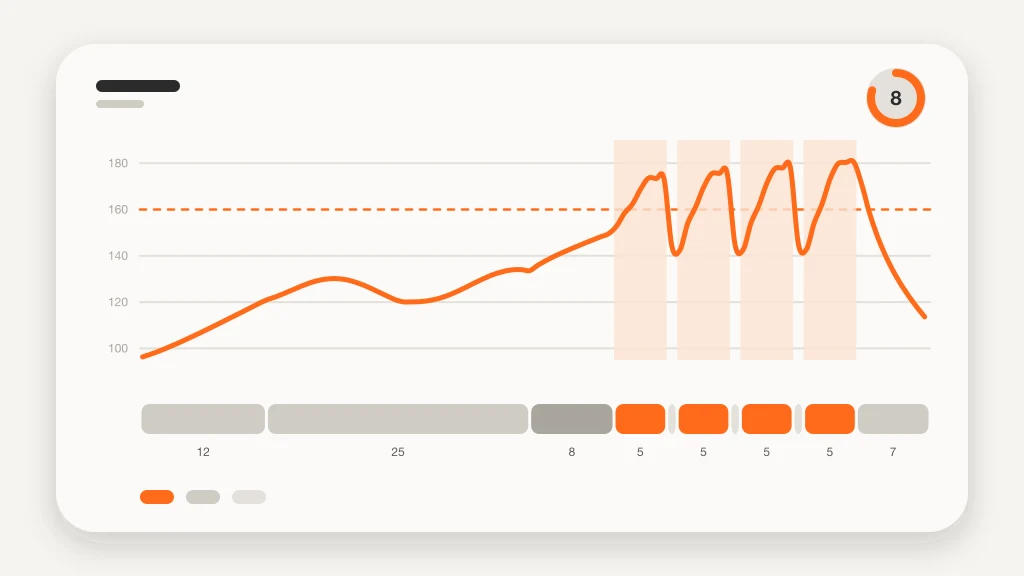
Illustrative scenario. Marco, 34, trains BJJ four times a week and wears a chest strap in class; his measured maximum is about 188 bpm. In a 75-minute class (12 minutes of warm-up, 25 of drilling, 8 of positional sparring, four 5-minute live rounds with 1-minute rests, then a short cool-down) the strap shows an average of 131 bpm (70 %), round averages of 158–166 bpm and peaks of 176–182 bpm. Between rounds his heart rate falls to about 135 bpm, not back to the start, and he spends roughly 14 minutes above 160 bpm (85 %). He rates the class 8 out of 10: 75 × 8 = 600 units. A normal four-class week comes to about 1,900 units, with overnight HRV in his usual 54–62 ms range. In a competition-prep week of six sessions (about 3,000 units) his 7-day HRV average falls to 49 ms and resting heart rate rises from 54 to 58 bpm, with sleep about 50 minutes shorter. He swaps Saturday's live rounds for drilling and flow rolling at RPE 4, and four days later his numbers are back in range. Numbers are illustrative.
Action steps
- Ask your coach what is allowed on the mat, then choose a chest strap, a soft upper-arm sensor or no device. Never wear anything hard that could hurt a partner.
- Judge a class by peaks, time at high heart rate and how far heart rate falls between rounds, not only by the average or the calorie total.
- Add a session rating (1–10 × minutes) and a short note on grip, neck or knees.
- Track hard-round classes, the weekly total and sleep, and compare overnight HRV and resting heart rate with your own range.
- When HRV stays low for several days while mat time is high, trade live rounds for drilling or flow rolling and sleep more.
Related guides
- Training load explained: TRIMP, TSS, strain and relative effort
- Normal heart rate variability (HRV) by age: RMSSD vs SDNN
- Overreaching and overtraining: warning signs and what to do
- Polar H10 chest strap with MoveVitals: accurate heart rate and HRV
- Boxing and kickboxing: heart rate by round, calories and recovery
FAQ
What is a normal heart rate in BJJ? Class averages often land in the moderate range, with peaks in live rounds close to maximum. Individual variation is large, so use your own zones.
Can I wear a smartwatch for jiu-jitsu? Often not on the mat: rules vary, and hard cases can hurt partners. Ask your coach, and consider a chest strap or no device plus a rating after class.
Does grappling count as cardio? Hard live rounds work like intervals and build aerobic fitness and repeated-effort capacity, but much of the strain is muscular (grip, hips, trunk), which heart rate does not show. Rate the class as well.
References
- Franchini et al. (2011). Physiological profiles of elite judo athletes. Sports Medicine. https://doi.org/10.2165/11538580-000000000-00000
- Andreato et al. (2017). Physical and physiological profiles of Brazilian jiu-jitsu athletes: a systematic review. Sports Medicine - Open. https://doi.org/10.1186/s40798-016-0069-5
- Foster et al. (2001). A new approach to monitoring exercise training. Journal of Strength and Conditioning Research. https://doi.org/10.1519/00124278-200102000-00019
- Plews et al. (2013). Training adaptation and heart rate variability in elite endurance athletes: opening the door to effective monitoring. Sports Medicine. https://doi.org/10.1007/s40279-013-0071-8
- Gillinov et al. (2017). Variable accuracy of wearable heart rate monitors during aerobic exercise. Medicine & Science in Sports & Exercise. https://doi.org/10.1249/mss.0000000000001284
- Herrmann et al. (2024). 2024 Adult Compendium of Physical Activities: a third update of the energy costs of human activities. Journal of Sport and Health Science. https://doi.org/10.1016/j.jshs.2023.10.010
For general information only. This is not medical advice — talk to a qualified professional about your health.
Keep reading
Training science
Zone 2 training: the science and how to do it right
4 min read
Sports
Japanese interval walking: the 3-minute fast / 3-minute slow method, step by step
8 min read
Metrics explained
Resting heart rate: normal ranges and what changes it
4 min read
Recovery & sleep
Overreaching and overtraining: warning signs and what to do
4 min read
Training science
Polarized training (80/20): easy most of the time, hard some of the time
4 min read
Recovery & sleep
Deload weeks: why planned easy weeks make you fitter
3 min read