

Mobility & stretching
The ideal warm-up: raise, activate, mobilise, potentiate
A good warm-up takes 10–20 minutes and improves performance while reducing injury risk. The RAMP framework makes it simple.
Written by MoveVitals Editorial Collective
Community-authored educational content. Individual clinical review is identified only when a named review is actually recorded.
Editorial standards & corrections
Key takeaways
- RAMP stands for raise (5–10 min), activate (2–3 min), mobilise (2–3 min) and potentiate (2–5 min).
- A 15-minute running warm-up is 8–10 minutes of easy jogging, leg swings, walking lunges, drills and 3–4 × 20 s strides building to race pace.
- A 15-minute cycling warm-up is 8 minutes of easy spinning, 3 × 1 min at 100–110 rpm, 2 × 30 s at target interval power and 2 minutes easy.
- Keep static holds under 30 s before power or sprint work, or move them to after training.
- Finish a race warm-up 5–10 minutes before the start, keep it shorter in heat, and expect to reach zone 2 by the end of the raise phase.
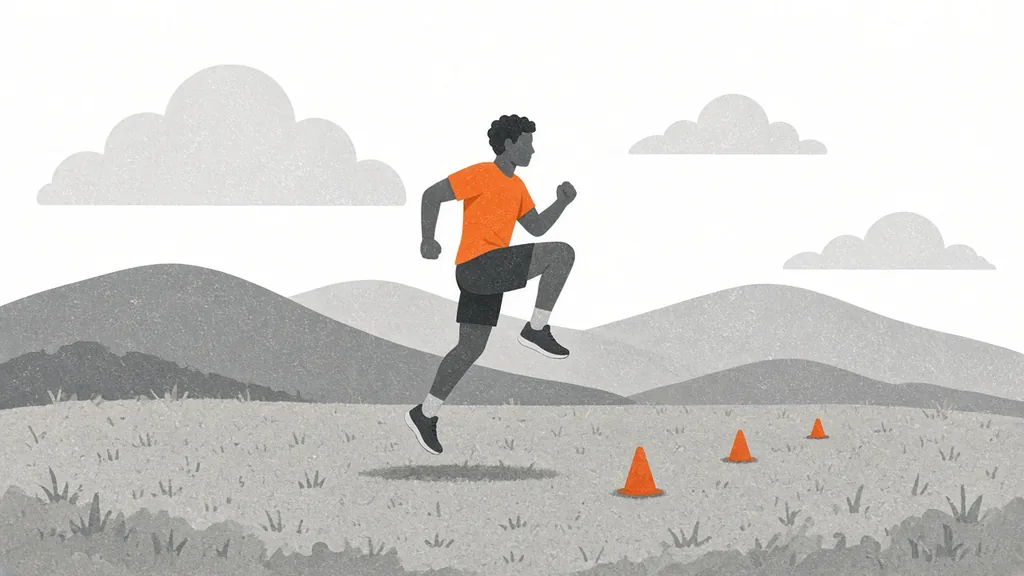
The RAMP framework
| Phase | Purpose | Examples | Time |
|---|---|---|---|
| Raise | Increase heart rate, temperature, blood flow | Easy jog or spin, skipping | 5–10 min |
| Activate | Switch on key muscles | Glute bridges, mini-band walks, calf raises | 2–3 min |
| Mobilise | Move joints through range | Leg swings, hip openers, thoracic rotations | 2–3 min |
| Potentiate | Prepare for the session's intensity | Strides, short build-ups, a few efforts at target pace | 2–5 min |
Runner's warm-up (15 min)
- 8–10 min easy jog
- Leg swings (front-back, side-side) × 10 each
- Walking lunges with rotation × 6 per side
- A-skips, B-skips, high knees, butt kicks × 20 m each
- 3–4 × 20 s strides building to race pace
Cyclist's warm-up (15 min)
- 8 min easy spin, gradually increasing cadence
- 3 × 1 min high cadence (100–110 rpm) / 1 min easy
- 2 × 30 s at target interval power
- 2 min easy before the main set
Warm-up rules
- Longer for hard sessions and races; shorter for easy runs.
- Heat: keep it shorter and stay cool.
- Static stretching before power/sprint work can slightly reduce performance if held long — keep holds under 30 s or move it to after training. See static vs dynamic stretching.
- Watch heart rate: you should be in zone 2 by the end of the "raise" phase.
Worked example
Illustrative scenario. Before Saturday football, Ollie's team uses a 15-minute warm-up based on the FIFA 11+ structure: 5 minutes of jogging with direction changes, 6 minutes of strength and balance drills (planks, single-leg balance, Nordic hamstring lowers), then 4 minutes of progressive sprints and cutting. Before a solo 5K run, he uses a shorter version: 5 minutes easy jog, leg swings, A-skips and 3 strides. Programs like FIFA 11+ have been associated with lower injury rates in team sports when used consistently. Details are illustrative.
Action steps
- Start with 5 minutes of easy cardio to raise body temperature.
- Add dynamic mobility for the joints you'll load (hips, ankles, shoulders).
- Include a few activation or balance drills.
- Finish with 2–4 progressive efforts that build toward session pace.
- Keep it to 10–15 minutes and use it before every session, not only hard ones.
Related guides
- Static vs dynamic stretching: which, when and how long?
- The cool-down: what it does (and doesn't do)
- Injury prevention for runners: load, strength and listening early
- Ankle mobility: the knee-to-wall test and exercises that work
- A daily stretching routine: 10 minutes, what to hold and what to skip
FAQ
Do I need to warm up for easy runs? Starting the run very slowly is a warm-up in itself.
How long before a race should I finish? Ideally 5–10 minutes before the start.
Do I need to warm up for an easy run? A few minutes of very easy running usually suffices; the first kilometre can act as the warm-up.
Should I warm up longer in cold weather? Often yes — a few extra minutes helps muscles and joints feel ready when it's cold.
References
- Soligard et al. (2016). How much is too much? (Part 1) International Olympic Committee consensus statement on load in sport and risk of injury. British Journal of Sports Medicine. https://doi.org/10.1136/bjsports-2016-096581
- Behm et al. (2016). Acute effects of muscle stretching on physical performance, range of motion, and injury incidence in healthy active individuals: a systematic review. Applied Physiology, Nutrition, and Metabolism. https://doi.org/10.1139/apnm-2015-0235
For general information only. This is not medical advice — talk to a qualified professional about your health.
Keep reading
Training science
Zone 2 training: the science and how to do it right
4 min read
Mobility & stretching
Mobility vs flexibility: what's the difference and what do you need?
3 min read
Training science
Polarized training (80/20): easy most of the time, hard some of the time
4 min read
Training science
Interval training and HIIT: designing sessions that work
4 min read
Devices & setup
Strava and MoveVitals: workouts, streams and devices that arrive via Strava
3 min read
Mobility & stretching
Hip mobility for runners and cyclists: a 10-minute routine
3 min read