

Mobility & stretching
A daily stretching routine: 10 minutes, what to hold and what to skip
A daily stretching routine works best when it is short and repeatable: about 10 minutes, ten stretches, roughly 30–60 seconds in total on each area, done after training or in the evening. Here is the full-body sequence, what the evidence says about flexibility and injury, and what to leave out.
Written by MoveVitals Editorial Collective
Community-authored educational content. Individual clinical review is identified only when a named review is actually recorded.
Editorial standards & corrections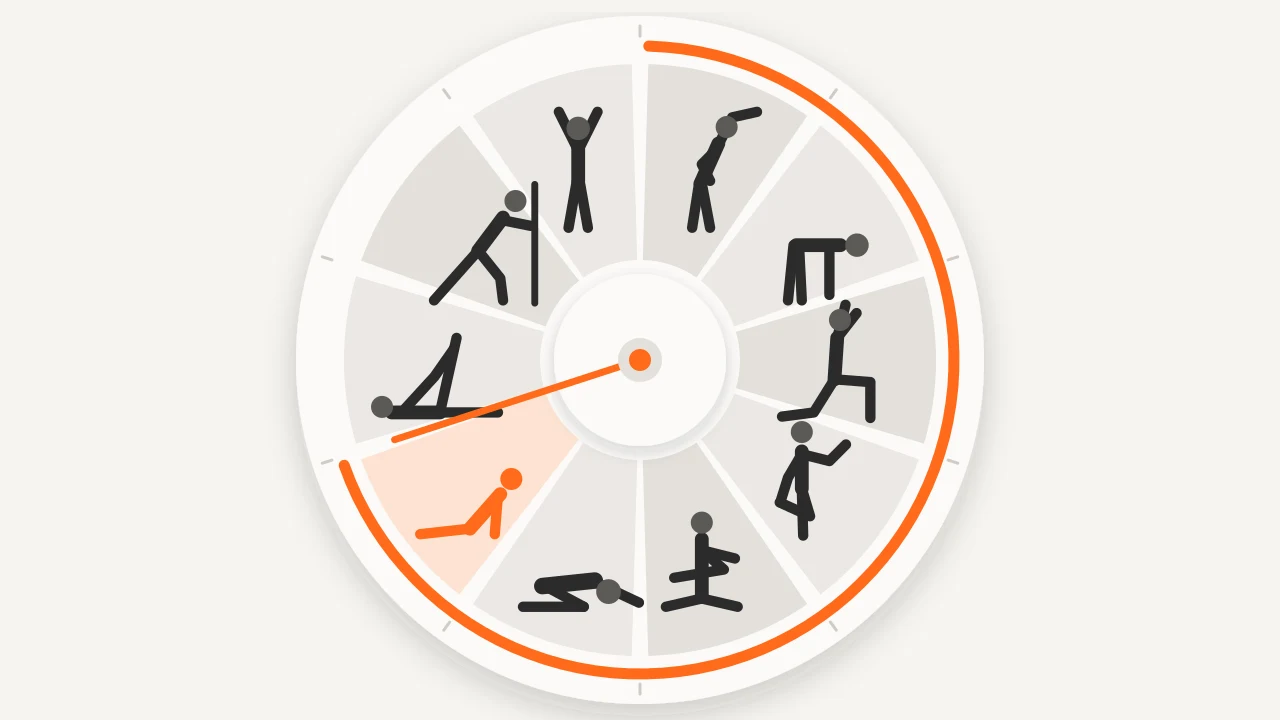
Key takeaways
- To build range of motion, hold each stretch for 15–30 seconds and repeat 2–4 times, reaching about 60 seconds per muscle group, daily or at least 2–3 days a week.
- Holds longer than about 60 seconds per muscle can reduce force and power for a short time, so use a dynamic warm-up before sprints, jumps or heavy lifts.
- A Cochrane review found that stretching before or after exercise has little to no effect on muscle soreness a day or two later, and strength training matters more for injury risk.
- Stretch to mild tension, roughly 3–4 out of 10 on a pain scale, and stop and get advice for sharp pain, persistent tingling or numbness.
This guide gives you the routine itself. For the theory, see mobility vs flexibility and static vs dynamic stretching; this page does not repeat them.
What stretching every day can and cannot do
- Range of motion. Regular static stretching reliably increases how far a joint moves. A review of the mechanism concludes that gains after one session and after programmes of a few weeks mostly reflect tolerating more stretch, not a longer muscle.
- Injuries. A meta-analysis of exercise programmes to prevent sports injuries found that strength training cut injuries to less than a third of the control rate in the pooled data, while stretching alone showed no significant effect.
- Soreness. A Cochrane review found that stretching before or after exercise has little to no effect on muscle soreness a day or two later.
- Performance. Holds longer than about 60 seconds per muscle can reduce force and power for a short time afterwards. Shorter holds have trivial effects.
- Sleep. Direct evidence that evening stretching improves sleep is limited. The case is practical: a short, quiet, predictable routine is a good way to wind down (sleep hygiene).
So stretch for the range, comfort and habit, not as an injury shield. Daily gentle stretching is safe for most healthy adults.
How long to hold a stretch
| Goal | Hold per stretch | Total per muscle group | How often |
|---|---|---|---|
| Build range of motion | 15–30 s, repeated 2–4 times | About 60 s | Daily, or at least 2–3 days a week |
| Older adults | 30–60 s | 60 s | Daily if comfortable |
| Evening wind-down | 20–30 s, slow breathing | 30–60 s | Any night |
| Before sprints, jumps or heavy lifts | Skip long holds; use a dynamic warm-up | n/a | Before training |
Stretch to mild tension, roughly 3–4 out of 10 on a pain scale. Stretching works a little better when muscles are warm, so after a walk, a workout or a warm shower is a good time (cool-down).
The 10-minute full-body sequence
Ten stretches of about one minute each. For one-sided stretches, hold 30 seconds per side. Breathe slowly and do not bounce.
| # | Stretch | How | Hold |
|---|---|---|---|
| 1 | Neck side tilt | Sit tall, ear toward shoulder, other shoulder down, no pulling | 30 s per side |
| 2 | Doorway chest stretch | Forearm on the frame, step through until the chest opens | 30 s per side |
| 3 | Thread the needle | From all fours, slide one arm under and rotate (thoracic mobility) | 30 s per side |
| 4 | Child's pose, arms forward | Hips back toward heels, reach long through the arms | 60 s |
| 5 | Half-kneeling hip flexor | Tuck the pelvis, squeeze the back glute (hip mobility) | 30 s per side |
| 6 | Figure-four on your back | Ankle over the opposite knee, pull both legs in | 30 s per side |
| 7 | Hamstring with a strap | On your back, strap on the foot, knee slightly bent | 30 s per side |
| 8 | Standing quad stretch | Hold a wall, heel toward the glute, knees together | 30 s per side |
| 9 | Calf stretch at a wall | Back heel down, back knee straight (ankle mobility) | 30 s per side |
| 10 | Lying spinal twist | Knees to one side, shoulders on the floor, slow breaths | 30 s per side |
Desk workers can swap number 4 for a wrist flexor stretch or a hip flexor stretch held longer (desk posture).
What to skip or change
- Bouncing into a stretch. Move in and hold.
- Long holds before power work. Before sprints, jumps or heavy lifts, use a dynamic warm-up instead (warm-up routine).
- Sharp pain, pins and needles or numbness. Back off at once. Nerve symptoms that persist need assessment.
- A freshly strained muscle. Let it settle and ask a clinician or physiotherapist before stretching it.
- Forced neck circles and hanging into end range. Keep the neck stretch gentle.
- More range if you are very flexible. Hypermobile people usually need strength and control, not longer holds.
What a watch can and cannot show
- Heart rate and energy. Stretching is light: the Compendium of Physical Activities lists mild stretching at about 2.3 METs. For 10 minutes at 70 kg that is only about 27 kcal (2.3 × 70 × 10/60), and heart rate sits close to resting. Wrist optical sensors read slow, low-motion activity fairly well, and calories are a rough estimate.
- Automatic detection. Watches rarely recognise stretching on their own. Start a Flexibility, Stretching or Mobility activity manually, or skip logging and note the day.
- Flexibility itself. No watch measures it. Pick a repeatable test and redo it every four weeks: seated toe touch (distance of fingertips from toes), the knee-to-wall test for ankles, or the hip flexor test in hip mobility.
- Recovery metrics. A short evening routine rarely moves HRV or resting heart rate in a way you can see. Compare weeks, not single nights (personal baseline).
In MoveVitals
Sessions your device logs as stretching, flexibility or mobility arrive as Stretching, with duration, heart rate and energy where the device recorded them, from Apple Health (Flexibility workouts), Garmin, WHOOP, Polar, COROS, Suunto and Strava; yoga and Pilates sessions are filed under Yoga. If a watch and another app record the same session, the duplicate is merged and fields are chosen by your priorities (how conflicts are resolved). Resting heart rate, HRV and sleep from your wearables sit alongside your stretching days, but they are not a flexibility measure. Your own test results, noted every four weeks, are.
Worked example
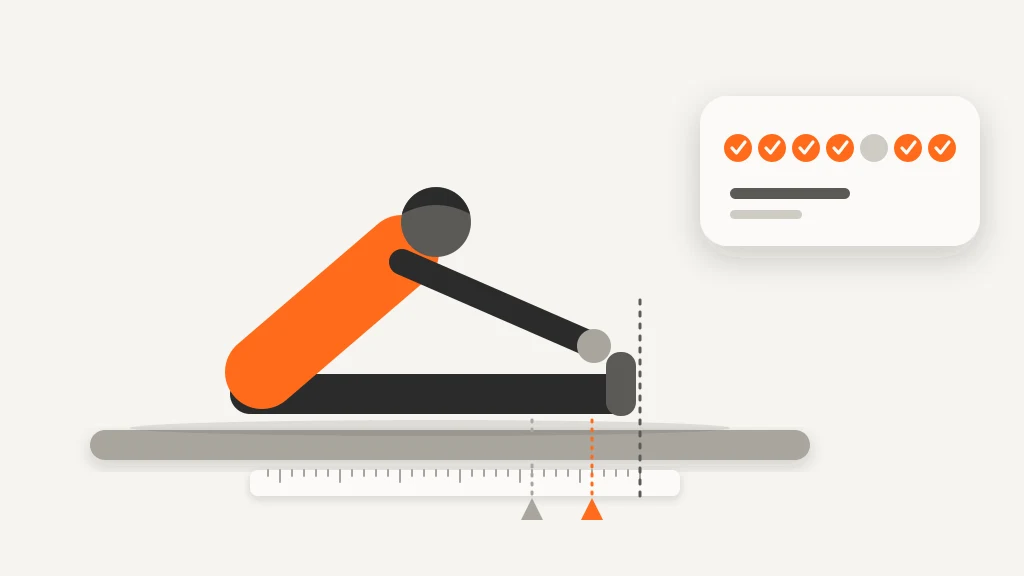
Illustrative scenario. Nora, 41, weighs 60 kg and works at a desk. She does the 10-minute sequence six evenings a week. Her watch, set to Stretching, logs 10 minutes with an average of 71 bpm, a peak of 84 and 26 kcal, close to 2.3 METs × 60 kg × 10/60 h ≈ 23 kcal. In week two she feels tingling behind the knee in the hamstring stretch, so she bends the knee slightly and eases off until it stops. Her baseline seated reach falls 9 cm short of her toes; six weeks later it is 4 cm short, a gain of 5 cm. She completes 36 of 42 days. Her overnight HRV and resting heart rate are unchanged (about 48 ms and 60 bpm), so she judges the routine by the reach test and by how her hips feel after a day at the desk. Figures are illustrative.
Action steps
- Pick a time you can repeat daily, such as after a walk, after training or before bed.
- Do the ten stretches above, roughly 30–60 seconds in total per area, at mild tension and with slow breathing.
- Skip long holds before sprints, jumps and heavy lifts; use a dynamic warm-up then.
- Retest one simple measure, such as seated reach, every four weeks.
- Add 2–3 strength sessions a week, since strength does more for injury risk than stretching.
- Stop and get advice if you have sharp pain, persistent tingling or numbness.
Related guides
- Static vs dynamic stretching: which, when and how long?
- Mobility vs flexibility: what's the difference and what do you need?
- Hip mobility for runners and cyclists: a 10-minute routine
- Thoracic spine mobility: for cyclists, rowers and desk workers
- Desk work and posture: moving more matters more than sitting perfectly
FAQ
How long should I hold a stretch? About 15–30 seconds per hold, repeated to reach roughly 30–60 seconds in total per muscle group, is enough for most adults. Older adults may benefit from holds of 30–60 seconds.
Is it OK to stretch every day? Yes, if it is gentle. Daily stretching is the most effective way to improve range, but stay at mild tension and skip the area if it is injured.
How long should a daily stretching routine take? Ten minutes is enough to cover the major areas. Longer sessions help only if you have time and feel good.
Does stretching before bed help sleep? Direct evidence is limited. A short, slow routine is a good wind-down habit, so keep it gentle and the lights low.
References
- Garber et al. (2011). Quantity and Quality of Exercise for Developing and Maintaining Cardiorespiratory, Musculoskeletal, and Neuromotor Fitness in Apparently Healthy Adults. Medicine & Science in Sports & Exercise. https://doi.org/10.1249/MSS.0b013e318213fefb
- Behm et al. (2016). Acute effects of muscle stretching on physical performance, range of motion, and injury incidence in healthy active individuals: a systematic review. Applied Physiology, Nutrition, and Metabolism. https://doi.org/10.1139/apnm-2015-0235
- Lauersen et al. (2014). The effectiveness of exercise interventions to prevent sports injuries: a systematic review and meta-analysis of randomised controlled trials. British Journal of Sports Medicine. https://doi.org/10.1136/bjsports-2013-092538
- Herbert et al. (2011). Stretching to prevent or reduce muscle soreness after exercise. Cochrane Database of Systematic Reviews. https://doi.org/10.1002/14651858.CD004577.pub3
- Weppler and Magnusson (2010). Increasing muscle extensibility: a matter of increasing length or modifying sensation? Physical Therapy. https://doi.org/10.2522/ptj.20090012
- Ainsworth et al. (2011). 2011 Compendium of Physical Activities: A Second Update of Codes and MET Values. Medicine & Science in Sports & Exercise. https://doi.org/10.1249/MSS.0b013e31821ece12
For general information only. This is not medical advice — talk to a qualified professional about your health.
Keep reading
Mobility & stretching
Mobility vs flexibility: what's the difference and what do you need?
3 min read
Mobility & stretching
The ideal warm-up: raise, activate, mobilise, potentiate
3 min read
Mobility & stretching
The cool-down: what it does (and doesn't do)
3 min read
Training science
Zone 2 training: the science and how to do it right
4 min read
Training science
Polarized training (80/20): easy most of the time, hard some of the time
4 min read
Sports
Japanese interval walking: the 3-minute fast / 3-minute slow method, step by step
8 min read