

Recovery & sleep
Overreaching and overtraining: warning signs and what to do
Short-term overreaching is a normal part of training. When fatigue keeps building without enough recovery, performance drops for weeks or months — that's overtraining.
Written by MoveVitals Editorial Collective
Community-authored educational content. Individual clinical review is identified only when a named review is actually recorded.
Editorial standards & corrections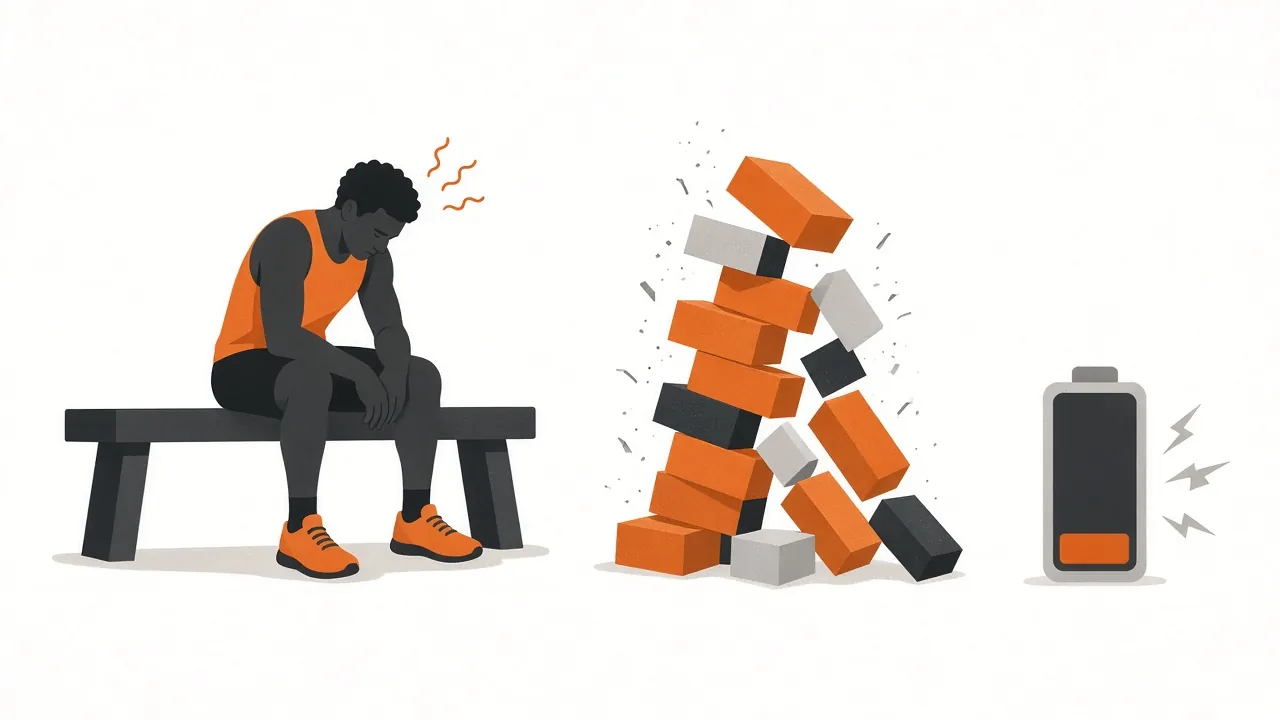
Key takeaways
- Functional overreaching drops performance for days and clears in days to 2 weeks, non-functional overreaching lasts weeks to months, and overtraining syndrome takes months or longer.
- Most "overtraining" in recreational athletes is non-functional overreaching, often combined with life stress, poor sleep and under-fuelling.
- Treat two or more markers worsening for over a week as a warning, cut volume by 30–50% and remove intensity for 1–2 weeks.
- No single marker is diagnostic, and very fatigued endurance athletes can occasionally show high HRV.
- See a doctor if performance and mood don't recover within 2–3 weeks, to rule out causes such as anaemia, thyroid problems or infection.
The continuum
| Stage | Duration of performance drop | Recovery time |
|---|---|---|
| Functional overreaching | Days | Days to 2 weeks — followed by improvement |
| Non-functional overreaching | Weeks | Weeks to months |
| Overtraining syndrome | Months | Months or longer |
Most "overtraining" in recreational athletes is actually non-functional overreaching, often combined with life stress, poor sleep and under-fuelling.
Warning signs
- Performance stalls or declines despite training
- Unusual fatigue, heavy legs, poor motivation
- Sleep problems, irritability, low mood
- Frequent colds or minor injuries
- Persistently lower HRV and higher resting heart rate — or, in some athletes, an unusually low heart rate response
- Reduced maximum heart rate during hard efforts
- Loss of appetite, weight loss
No single marker is diagnostic. A combination over 1–2 weeks matters.
Common causes
- Load rising too fast — see progressive overload
- Too much intensity, not enough easy volume — see polarized training
- Not enough sleep or calories (low energy availability, RED-S)
- Work, family or emotional stress
- Training through illness — see training when sick
What to do
- Reduce load immediately — a deload week or more.
- Prioritise sleep and adequate carbohydrates and protein.
- Keep only easy movement until HRV, resting heart rate and mood normalise.
- If symptoms persist beyond a few weeks, see a doctor to rule out other causes (anaemia, thyroid, infection).
Prevention with data
Watch fitness, fatigue and form, weekly load changes and your recovery markers together. MoveVitals combines these across devices.
Worked example

Illustrative scenario. Over six weeks Tom raises his running from 50 to 80 km a week while starting a new job. His 7-day average HRV falls from 62 to 48 ms, resting heart rate rises from 50 to 56 bpm, easy-run pace at the same heart rate slows by 15 s/km, and he sleeps poorly. These match the warning signs of non-functional overreaching in the Meeusen et al. (2013) consensus. He cuts volume by half for two weeks, removes intensity, and adds sleep. Metrics return near baseline in about 10 days; had they not, his next step would have been a medical check to rule out illness, anaemia or other causes.
Action steps
- Track 7-day trends in HRV, resting HR and performance at a fixed effort.
- Treat two or more worsening markers for over a week as a warning.
- Cut volume 30–50% and remove intensity for 1–2 weeks.
- Fix sleep and energy intake before adding training back.
- See a doctor if performance and mood don't recover within 2–3 weeks.
Related guides
- Normal heart rate variability (HRV) by age: RMSSD vs SDNN
- Training load explained: TRIMP, TSS, strain and relative effort
- Deload weeks: why planned easy weeks make you fitter
- WHOOP Recovery score: what drives it and how to act on it
- Recovery after strength training: rest days, DOMS and what HRV and resting heart rate show
FAQ
Can high HRV mean overtraining? Occasionally, in very fatigued endurance athletes. Context matters.
How long to recover? Overreaching: days to weeks. True overtraining syndrome: months.
How is overreaching different from overtraining? Functional overreaching resolves in days to weeks with rest; overtraining syndrome can take months and is a diagnosis of exclusion.
Can HRV alone diagnose overtraining? No. HRV is one signal; combine it with performance, mood, sleep and medical assessment.
Does life stress count? Yes, work and emotional stress add to the total load your body must recover from.
References
- Meeusen et al. (2013). Prevention, diagnosis and treatment of the overtraining syndrome: Joint consensus statement of the European College of Sport Science (ECSS) and the American College of Sports Medicine (ACSM). European Journal of Sport Science. https://doi.org/10.1080/17461391.2012.730061
- Halson (2014). Monitoring Training Load to Understand Fatigue in Athletes. Sports Medicine. https://doi.org/10.1007/s40279-014-0253-z
- Plews et al. (2013). Training Adaptation and Heart Rate Variability in Elite Endurance Athletes: Opening the Door to Effective Monitoring. Sports Medicine. https://doi.org/10.1007/s40279-013-0071-8
For general information only. This is not medical advice — talk to a qualified professional about your health.
Keep reading
Devices & setup
WHOOP and MoveVitals: what syncs and how to get the most from it
3 min read
Metrics explained
Normal heart rate variability (HRV) by age: RMSSD vs SDNN
6 min read
Recovery & sleep
Deload weeks: why planned easy weeks make you fitter
3 min read
Recovery & sleep
Alcohol, HRV and sleep: what your wearable shows the night after
3 min read
Devices & setup
How MoveVitals handles multiple devices: provenance, duplicates and conflicts
5 min read
Recovery & sleep
Your personal baseline: why "normal for you" beats population averages
4 min read