

Mobility & stretching
Ankle mobility: the knee-to-wall test and exercises that work
Limited ankle dorsiflexion changes how you squat, land and run. It's quick to test and responds well to a few minutes of daily work.
Written by MoveVitals Editorial Collective
Community-authored educational content. Individual clinical review is identified only when a named review is actually recorded.
Editorial standards & corrections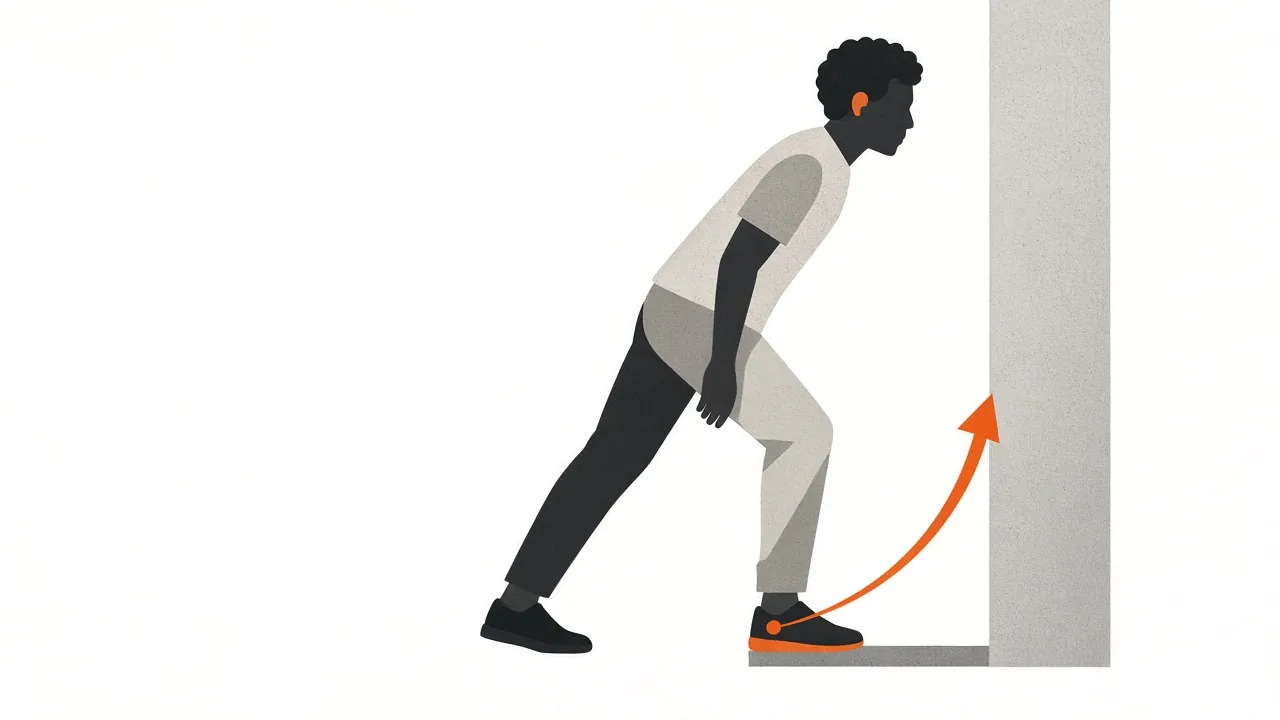
Key takeaways
- Dorsiflexion is bending the ankle so the knee moves forward over the toes, and runners need it on every stride.
- In the knee-to-wall test, a toe-to-wall distance of 10 cm or more is good, 6–9 cm is limited and under 6 cm is restricted.
- Five minutes of daily ankle work can combine knee-to-wall rocks (2 × 15 per side), straight-knee and bent-knee calf stretches (2 × 45 s) and eccentric calf raises (3 × 12).
- A block or pinch at the front of the ankle, rather than a stretch in the calf, points to a joint issue a physiotherapist can help with.
Dorsiflexion is bending the ankle so the knee moves forward over the toes. Runners need it for every stride; lifters need it for deep squats.
The knee-to-wall test
- Face a wall, one foot forward, toes a few centimetres from it.
- Keeping the heel down, push the knee to touch the wall.
- Move the foot back until you can just touch.
- Measure toe-to-wall distance.
| Distance | Interpretation |
|---|---|
| ≥ 10 cm | Good |
| 6–9 cm | Limited |
| < 6 cm | Restricted |
| > 2 cm difference left vs right | Worth addressing (common after ankle sprains) |
Exercises (daily, 5 minutes)
| Exercise | Dose |
|---|---|
| Knee-to-wall rocks | 2 × 15 per side |
| Weighted ankle rocks (kettlebell on knee) | 2 × 10 per side |
| Calf stretch, straight knee (gastrocnemius) | 2 × 45 s |
| Calf stretch, bent knee (soleus) | 2 × 45 s |
| Eccentric calf raises off a step | 3 × 12 |
| Deep squat hold, heels down | 3 × 30 s |
When it's a joint issue
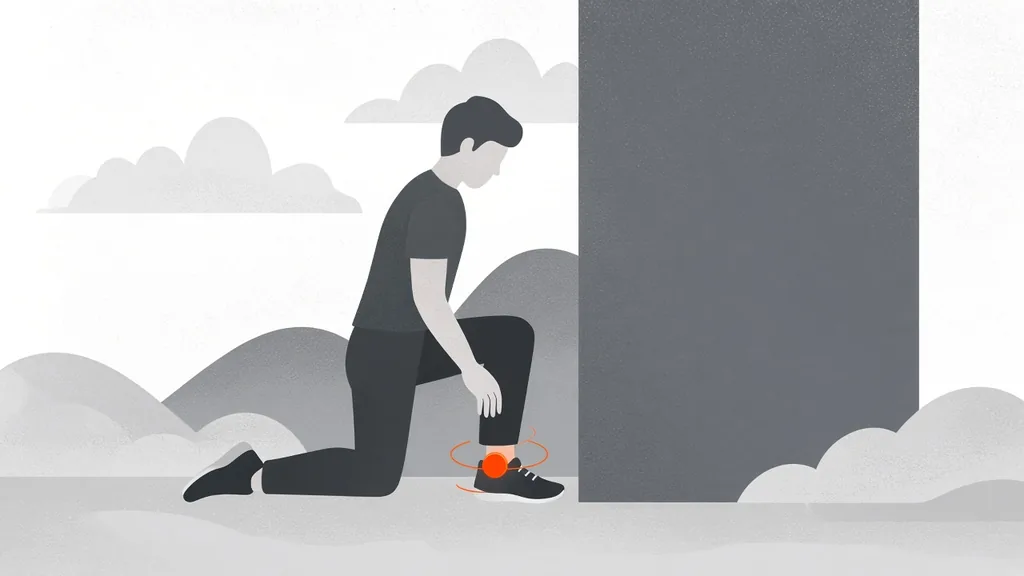
If you feel a block or pinch at the front of the ankle rather than a stretch in the calf, a physiotherapist can help with joint mobilisation.
Worked example
Illustrative scenario. Tom notices his heels lift during deep squats. He does the knee-to-wall test: right foot 11 cm from the wall, left only 7 cm. He adds 2 sets of 10 slow banded ankle mobilisations and 2×15 eccentric calf raises on the stiff side, 4 days a week. Four weeks later the gap is down to about 2 cm and his squat feels more balanced.
Action steps
- Test: knee-to-wall distance with heel down; record both sides.
- Mobilise: 2×10 slow knee-over-toe rocks, optionally with a band.
- Strengthen: 2–3×15 calf raises, slow lowering.
- Balance: 3×30 s single-leg stance, progressing to eyes closed.
- Retest every 2–4 weeks; a side-to-side gap over ~4 cm is worth addressing.
Related guides
- Hip mobility for runners and cyclists: a 10-minute routine
- Mobility vs flexibility: what's the difference and what do you need?
- Injury prevention for runners: load, strength and listening early
- The ideal warm-up: raise, activate, mobilise, potentiate
FAQ
Do heel-drop shoes matter? Changing drop shifts load between calves and knees; switch gradually.
Does stretching prevent Achilles problems? Strength (eccentric/heavy calf raises) matters more than stretching alone.
How do I test ankle mobility? The knee-to-wall test: with your foot about 10 cm from a wall, see whether your knee touches without the heel lifting.
How long until ankle mobility improves? Many people see changes within a few weeks of daily practice, though old injuries can limit progress.
References
- Doherty et al. (2014). The Incidence and Prevalence of Ankle Sprain Injury: A Systematic Review and Meta-Analysis of Prospective Epidemiological Studies. Sports Medicine. https://doi.org/10.1007/s40279-013-0102-5
- Behm et al. (2016). Acute effects of muscle stretching on physical performance, range of motion, and injury incidence in healthy active individuals: a systematic review. Applied Physiology, Nutrition, and Metabolism. https://doi.org/10.1139/apnm-2015-0235
For general information only. This is not medical advice — talk to a qualified professional about your health.
Keep reading
Mobility & stretching
Mobility vs flexibility: what's the difference and what do you need?
3 min read
Mobility & stretching
Hip mobility for runners and cyclists: a 10-minute routine
3 min read
Mobility & stretching
The ideal warm-up: raise, activate, mobilise, potentiate
3 min read
Training science
Zone 2 training: the science and how to do it right
4 min read
Training science
Polarized training (80/20): easy most of the time, hard some of the time
4 min read
Devices & setup
Strava and MoveVitals: workouts, streams and devices that arrive via Strava
3 min read