

Metrics explained
Normal heart rate variability (HRV) by age: RMSSD vs SDNN
Normal HRV depends on the metric, age and measurement protocol. Compare RMSSD and SDNN, understand age charts, and track your personal baseline.
Written by MoveVitals Editorial Collective
Community-authored educational content. Individual clinical review is identified only when a named review is actually recorded.
Editorial standards & corrections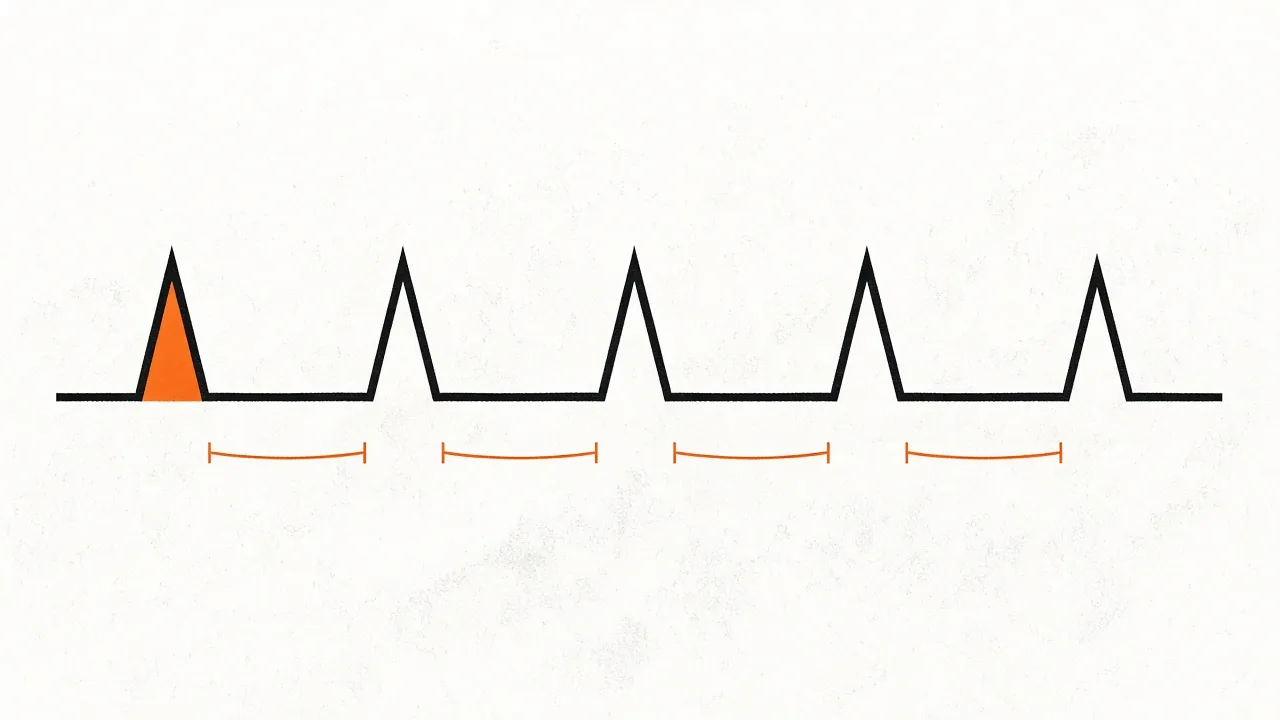
Key takeaways
- RMSSD summarizes differences between successive heartbeat intervals and SDNN their standard deviation over the recording; SDNN is not automatically higher, and there is no fixed conversion between them.
- Age charts need checking first: Voss et al. studied 1,906 healthy adults aged 25–74 using five-minute ECG recordings, which is not comparable to an overnight wearable reading.
- Collect at least 2–3 weeks of data for a baseline and watch the 7-day rolling average, because single nights mislead.
- Alcohol is often the largest single effect lowering HRV, and illness can lower it a day or two before symptoms.
- Review sustained changes alongside sleep, symptoms and training load, and seek clinical advice for persistent unexplained changes or symptoms.
Your heart does not beat like a metronome. Even at a steady 60 bpm, the gap between two beats might be 0.95 s, then 1.05 s, then 0.98 s. Heart rate variability (HRV) is the measure of that beat-to-beat variation. It is mostly governed by the autonomic nervous system: the parasympathetic ("rest and digest") branch increases variability, the sympathetic ("fight or flight") branch reduces it.
RMSSD vs SDNN: why HRV numbers differ
HRV summarizes variation in intervals between normal heartbeats. RMSSD and SDNN are both often reported in milliseconds, but they calculate different things.
| Metric | What it summarizes | How to interpret the value |
|---|---|---|
| RMSSD (ms) | Differences between successive normal heartbeat intervals | A common resting or overnight wearable metric |
| SDNN (ms) | Standard deviation of normal heartbeat intervals over the recording | Recording length matters; Apple HealthKit uses SDNN |
| ln RMSSD | Natural logarithm of RMSSD | A log scale, not the same value as raw milliseconds |
SDNN is not automatically higher than RMSSD, and there is no fixed conversion between them. Match the metric and recording conditions before comparing. Definitions in the primary study · Apple HealthKit documentation.
WHOOP describes RMSSD measured during sleep. Oura’s displayed nightly average combines five-minute samples taken during sleep. These summaries differ from a waking spot reading. Keep the source, timing and method consistent when tracking your baseline.
Normal HRV range by age: what research can tell you
There is no single normal HRV range that applies to every age, device and recording method. HRV often decreases across adult age groups, but a study’s reference values describe its own population and protocol.
For example, Voss et al. (2015) studied 1,906 healthy adults aged 25–74 using five-minute ECG recordings while lying down after rest. They found age- and sex-related differences. Those results are not universal normal limits for a whole-night wearable average or an Apple Watch SDNN sample.
| Before using an HRV-by-age chart, check | Why it matters |
|---|---|
| RMSSD, SDNN or ln RMSSD? | Different statistics and scales cannot be exchanged |
| Five minutes, a night or 24 hours? | Recording duration and state change the comparison |
| Which ages and study population? | A reference cohort is not a diagnosis or a personal target |
Compare yourself with your own baseline under consistent conditions. A wearable’s usual range is a tracking aid, not a medical normal range. An isolated value cannot diagnose a condition or measure your overall health.
What lowers and raises HRV
Things that typically lower HRV for one or more nights:
- Hard training, especially high-intensity or long sessions
- Alcohol — often the largest single effect
- Late, heavy meals, dehydration, heat
- Poor or short sleep, travel and jet lag
- Illness — HRV often drops a day or two before symptoms
- Psychological stress
Things that tend to raise it over weeks: consistent aerobic training, regular sleep timing, lower alcohol intake and good overall fitness.
How to use HRV in practice
- Build a baseline. Collect at least 2–3 weeks of data before drawing conclusions.
- Watch the 7-day rolling average, not single nights. One low night is noise; a week trending down is a signal.
- Use your usual range as context. A device’s baseline band is a tracking aid, not a diagnostic cutoff or an automatic training instruction. Consider sleep, symptoms and recent load together.
- Combine it with other signals. A low HRV with an elevated resting heart rate and poor sleep is far more meaningful than HRV alone.
- Keep conditions consistent. Compare night with night, or morning reading with morning reading — never mix them.
HRV in MoveVitals
MoveVitals stores HRV from every connected source with its origin, so a WHOOP RMSSD and an Apple SDNN are never silently mixed. When two devices report the same night, the conflict rules pick one according to your priorities, and you can see both values side by side.
Worked example
Worked example. Sam's 7-day rolling average HRV (RMSSD) is 58 ms and his normal range over 60 days is about 50–66 ms. After a late dinner with two glasses of wine, his morning HRV is 41 ms and resting heart rate is 6 bpm higher. A single low reading below his range is a cue, not a verdict: he swaps intervals for an easy 40-minute ride. Two days later HRV is back at 57 ms. Comparing against his own baseline — not someone else's number — is what makes HRV useful (Plews 2013).
Action steps
- Measure at the same time daily — overnight or right after waking.
- Wait 2–3 weeks to establish your baseline before acting on it.
- Watch the 7-day average rather than single readings.
- Note alcohol, illness, travel and late training alongside HRV.
- Review sustained changes alongside sleep, symptoms and training load; seek clinical advice for persistent unexplained changes or symptoms.
Related guides
- Your personal baseline: why "normal for you" beats population averages
- Resting heart rate: normal ranges and what changes it
- Alcohol, HRV and sleep: what your wearable shows the night after
- Slow breathing and HRV biofeedback: calming your nervous system
FAQ
Why is my HRV different on two devices? They measure at different times and may use different statistics (RMSSD vs SDNN). Pick one device as your HRV reference.
Is a higher HRV always better? Generally a higher personal trend reflects good recovery and fitness, but a sudden, unusual spike can also accompany illness or overreaching. Context matters.
Can I raise my HRV quickly? Not meaningfully. Sleep, alcohol and training load change it night to night; aerobic fitness changes it over months.
What is a normal HRV for my age? Age alone cannot classify your number. First identify RMSSD or SDNN, the recording duration and the device protocol; then compare compatible measurements and your own history.
Can breathing exercises raise HRV? Slow breathing at about 6 breaths per minute increases HRV during the practice, and some studies suggest modest longer-term benefits (Lehrer 2014).
References
- Task Force of the ESC and NASPE (1996). Heart Rate Variability. Circulation. https://doi.org/10.1161/01.CIR.93.5.1043
- Shaffer et al. (2017). An Overview of Heart Rate Variability Metrics and Norms. Frontiers in Public Health. https://doi.org/10.3389/fpubh.2017.00258
- Plews et al. (2013). Training Adaptation and Heart Rate Variability in Elite Endurance Athletes: Opening the Door to Effective Monitoring. Sports Medicine. https://doi.org/10.1007/s40279-013-0071-8
- Lehrer et al. (2014). Heart rate variability biofeedback: how and why does it work?. Frontiers in Psychology. https://doi.org/10.3389/fpsyg.2014.00756
- Voss et al. (2015). Short-Term Heart Rate Variability—Influence of Gender and Age in Healthy Subjects. PLOS ONE. https://doi.org/10.1371/journal.pone.0118308
- WHOOP (2026). Heart rate variability: how to read and improve your HRV. https://www.whoop.com/us/en/thelocker/heart-rate-variability-how-to-read-and-improve-your-hrv/
- Oura Member Care (updated October 2026). Heart Rate Variability. https://support.ouraring.com/hc/en-us/articles/360025441974-Heart-Rate-Variability
- Apple Developer Documentation. heartRateVariabilitySDNN. https://developer.apple.com/documentation/healthkit/hkquantitytypeidentifier/heartratevariabilitysdnn
For general information only. This is not medical advice — talk to a qualified professional about your health.
Keep reading
Metrics explained
Resting heart rate: normal ranges and what changes it
4 min read
Devices & setup
How MoveVitals handles multiple devices: provenance, duplicates and conflicts
5 min read
Recovery & sleep
Alcohol, HRV and sleep: what your wearable shows the night after
3 min read
Devices & setup
WHOOP and MoveVitals: what syncs and how to get the most from it
3 min read
Recovery & sleep
Overreaching and overtraining: warning signs and what to do
4 min read
Devices & setup
Oura Ring and MoveVitals: sleep, readiness and temperature in one place
3 min read