

Recovery & sleep
Slow breathing and HRV biofeedback: calming your nervous system
Breathing at around six breaths per minute creates large, rhythmic swings in heart rate. Practised regularly, it can reduce stress and support recovery.
Written by MoveVitals Editorial Collective
Community-authored educational content. Individual clinical review is identified only when a named review is actually recorded.
Editorial standards & corrections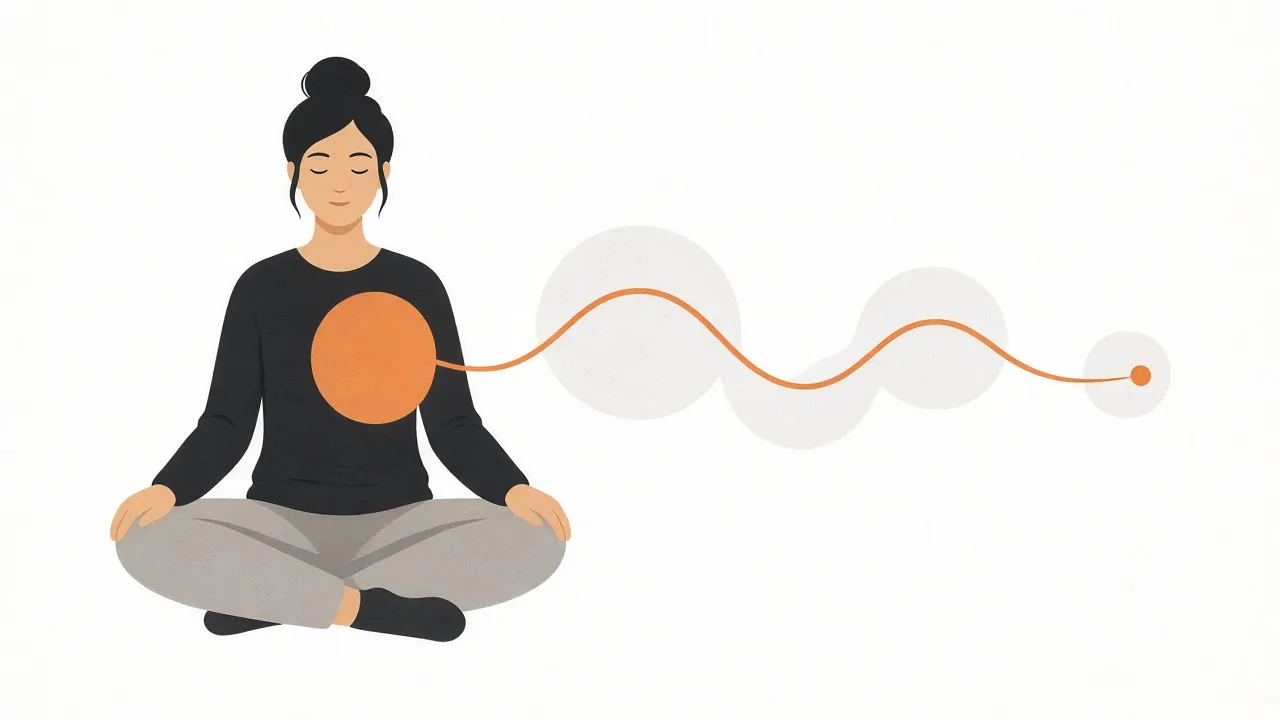
Key takeaways
- A simple HRV breathing protocol is to inhale through the nose for 4–5 seconds and exhale gently for 5–6 seconds, for 5–20 minutes once or twice a day.
- Resonance frequency breathing is the rate, usually around 5.5–6.5 breaths per minute, at which heart rate and blood pressure rhythms reinforce each other and HRV swings are largest.
- Box breathing is a different pattern, equal 4-4-4-4, that also slows breathing and can calm you.
- Stop if you feel light-headed, and breathe less deeply rather than faster.

How it works
When you inhale, heart rate rises slightly; when you exhale, it falls. This is respiratory sinus arrhythmia. At a slow rate — typically 5.5–6.5 breaths per minute for adults — breathing and blood-pressure reflexes resonate, producing the largest heart-rate oscillations. This is called resonance frequency breathing.
A simple protocol
- Sit comfortably, shoulders relaxed.
- Inhale through the nose for 4–5 seconds.
- Exhale gently for 5–6 seconds (slightly longer than the inhale).
- Continue for 5–20 minutes, once or twice a day.
- Keep it relaxed — don't over-breathe or force deep breaths.
What the research shows
- Short-term: lower arousal, reduced perceived stress, larger in-session HRV.
- Over weeks: improvements in anxiety, blood pressure and resting HRV in some studies.
- Before sleep: may help you fall asleep faster.
Using devices
A chest strap such as the Polar H10 captures beat-to-beat intervals precisely for biofeedback apps. Garmin, Oura and Apple Watch offer guided breathing sessions. You can watch your stress score drop during a session.
Worked example
Illustrative scenario. Jun's resting breathing rate is about 15 breaths per minute. He uses a chest strap and a breathing app to practise 10 minutes a day at 6 breaths per minute (4 s in, 6 s out). During the session his heart rate rises and falls with each breath by 15–20 bpm, far more than the 3–5 bpm swing he sees when breathing normally — the resonance effect described by Lehrer and colleagues. After four weeks his morning HRV average is only slightly higher, but he finds he can calm down faster before presentations, and his evening resting heart rate settles 3–4 bpm lower during practice. He treats the practice as stress management, not a fix for poor sleep or overtraining.
Action steps
- Sit upright and breathe through the nose at about 6 breaths per minute (for example 4 s in, 6 s out).
- Practise 10–20 minutes a day, ideally at the same time.
- Use a chest strap or app to see heart rate rise and fall with each breath.
- Try rates between 5.5 and 7 breaths per minute and keep the one with the largest swings.
- Stop if you feel light-headed; breathe less deeply rather than faster.
Related guides
- Normal heart rate variability (HRV) by age: RMSSD vs SDNN
- Stress scores on wearables: what they really measure
- Sleep hygiene: evidence-based habits for better sleep
- Respiratory rate during sleep: a quiet early-warning signal
- Tai chi and qigong (Baduanjin): heart rate, balance and who benefits
FAQ
Will this raise my morning HRV? Possibly over time, but the main benefit is how you feel and respond to stress.
Is box breathing the same? It's a different pattern (equal 4-4-4-4) but also slows breathing and can calm you.
What is resonance frequency breathing? It is the breathing rate, usually around 5.5–6.5 breaths per minute, at which heart rate and blood pressure rhythms reinforce each other and HRV swings are largest.
Can I do it before bed? Yes. Many people use 5–10 minutes of slow breathing as part of a wind-down routine.
References
- Lehrer et al. (2014). Heart rate variability biofeedback: how and why does it work?. Frontiers in Psychology. https://doi.org/10.3389/fpsyg.2014.00756
- Shaffer et al. (2017). An Overview of Heart Rate Variability Metrics and Norms. Frontiers in Public Health. https://doi.org/10.3389/fpubh.2017.00258
- Task Force of the ESC and NASPE (1996). Heart Rate Variability. Circulation. https://doi.org/10.1161/01.CIR.93.5.1043
For general information only. This is not medical advice — talk to a qualified professional about your health.
Keep reading
Devices & setup
How MoveVitals handles multiple devices: provenance, duplicates and conflicts
5 min read
Metrics explained
Normal heart rate variability (HRV) by age: RMSSD vs SDNN
6 min read
Metrics explained
Resting heart rate: normal ranges and what changes it
4 min read
Recovery & sleep
Your personal baseline: why "normal for you" beats population averages
4 min read
Devices & setup
WHOOP and MoveVitals: what syncs and how to get the most from it
3 min read
Recovery & sleep
Sleep hygiene: evidence-based habits for better sleep
4 min read