

Sports
Walking for fitness and weight loss: pace, heart rate zones and how much is enough
Walking for weight loss works best when you treat it as training, not just a step total: a brisk pace of about 100 steps a minute or more, around 150 minutes a week, and a heart rate that shows you are genuinely working.
Written by MoveVitals Editorial Collective
Community-authored educational content. Individual clinical review is identified only when a named review is actually recorded.
Editorial standards & corrections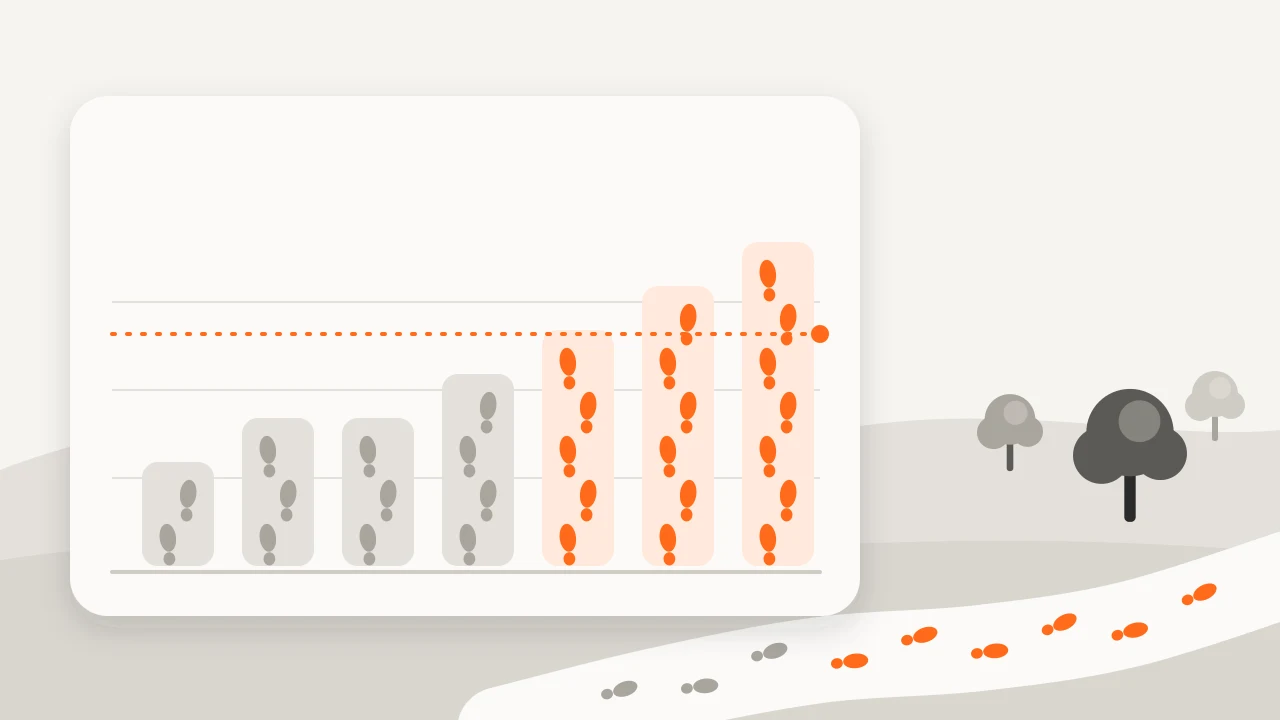
Key takeaways
- Brisk walking means 5–6.5 km/h, about 100–120 steps a minute, effort 5–6 out of 10 and 60–75 % of maximum heart rate, with enough breath to talk but not sing.
- The WHO recommends 150–300 minutes of moderate activity a week, and ACSM links more than about 250 minutes a week to clinically meaningful weight loss, mostly alongside diet.
- A 75 kg person walking 45 minutes briskly five times a week burns about 190 kcal above resting per walk, roughly 930 kcal a week.
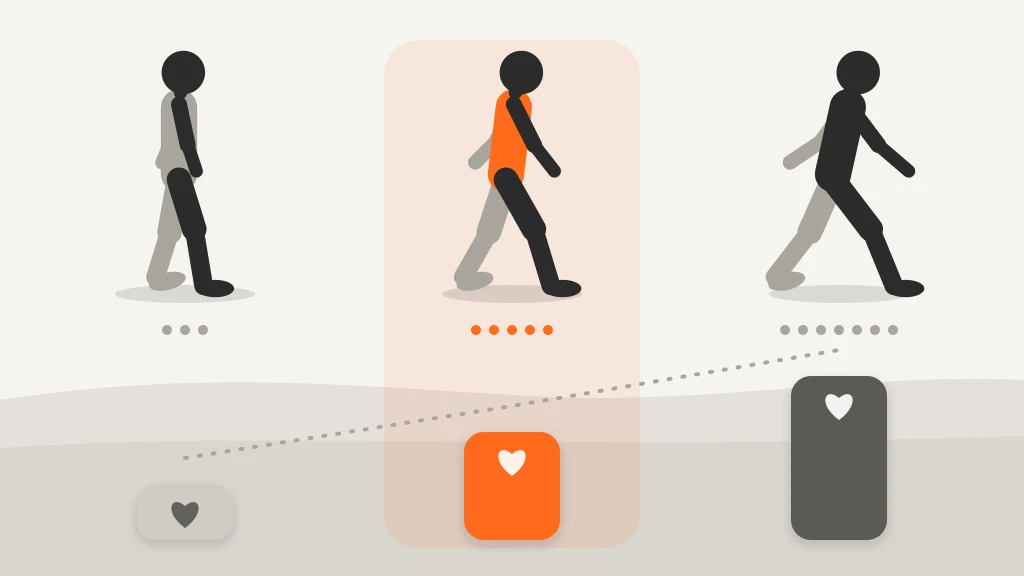
- Two people can walk at the same speed with heart rates 30 bpm apart and both be normal, and fitter people usually run lower at the same pace.
- Start with three brisk walks of 20–30 minutes a week, then change one thing at a time: minutes, then pace, then incline. This is the training side of walking; for the 10,000-step debate, see daily steps.
How fast is brisk walking?
Brisk walking is moderate-intensity exercise: you breathe harder, you can talk, but you could not sing. Four markers usually agree with each other:
| Pace | Speed | Steps per minute | Effort (0–10) | Heart rate (% of max) |
|---|---|---|---|---|
| Easy stroll | 3–4 km/h (2–2.5 mph) | under ~90 | 2–3 | 50–60% |
| Brisk walking | 5–6.5 km/h (3–4 mph, about 9–12 min/km or 15–20 min/mile) | ~100–120 | 5–6 | 60–75% |
| Power walking or steep hills | 6.5–8 km/h, or 8%+ incline | 120–130+ | 7 | 75–85% |
About 100 steps per minute is the most-cited cadence floor for moderate intensity in adults, and roughly 130 for vigorous effort (Tudor-Locke et al., 2018). Taller people take longer steps, so treat the number as a guide rather than a rule, and use the talk test as the cross-check (CDC). More on step rate in cadence.
Heart rate while walking: what is normal?
There is no single "normal" walking heart rate. It depends on pace, hills, age, fitness, heat, caffeine and sleep, so what matters is the percentage of your maximum. For someone with an estimated maximum of about 180 bpm (a typical 40-year-old):
| Effort | % of max | Example (bpm) |
|---|---|---|
| Easy stroll | 50–60% | 90–108 |
| Brisk walking | 60–75% | 108–135 |
| Power walk or hill | 75–85% | 135–153 |
Two people can walk at the same speed with heart rates 30 bpm apart and both be normal; fitter people usually run lower at the same pace. A beginner at 130–140 bpm on a brisk walk is not "doing it wrong" if they can still speak in short sentences. Avoid "220 − age" as gospel, since it can be off by 10–20 bpm (maximum heart rate). Brisk walking mostly sits in zone 2, and no zone burns fat "better": total energy use is what counts.
A watch can show a number but cannot tell you why it is high. Stop and seek medical advice if a walk brings on chest pain or pressure, faintness, palpitations with dizziness, or breathlessness out of proportion to the effort.
How many minutes per day is enough?
The WHO 2020 guidelines recommend 150–300 minutes of moderate activity per week for adults (or 75–150 minutes vigorous), plus muscle-strengthening on two or more days. They no longer require bouts of at least 10 minutes, so short walks count.
| Goal | Weekly brisk walking | Typical week |
|---|---|---|
| General health | about 150 min | 30 min × 5 days, or 3 × 10 min after meals |
| Weight loss (with food changes) | 200–300+ min | 40–60 min × 5 days |
| Just starting | 60–90 min | 3 walks of 15–25 min, then add a little each week |
ACSM's position stand links more than about 250 minutes a week to clinically meaningful weight loss, mostly alongside diet (Donnelly et al., 2009).
How many steps? There is no magic number for weight loss. Thirty brisk minutes at 100–120 steps a minute is about 3,000–3,600 steps; on top of a typical 4,000–5,000-step day that lands around 7,000–8,500, inside the range where large studies show most of the mortality benefit (Paluch et al., 2022). See daily steps.
Calories and weight loss
Energy cost is usually estimated in METs (multiples of resting energy use). In the Compendium of Physical Activities, walking at 4.8 km/h (3 mph) is about 3.5 METs, 5.6 km/h (3.5 mph) about 4.3, and 6.4 km/h (4 mph) about 5.0. Calories ≈ MET × body weight (kg) × hours; subtract 1 MET to get the extra above resting.
| Body weight | 1 hour at 5.6 km/h: total | Above resting |
|---|---|---|
| 60 kg (132 lb) | ~260 kcal | ~200 kcal |
| 75 kg (165 lb) | ~320 kcal | ~250 kcal |
| 90 kg (198 lb) | ~390 kcal | ~300 kcal |
A 75 kg person walking 45 minutes briskly five times a week burns about 190 kcal above resting per walk, roughly 930 kcal a week. That is useful but modest next to what changes in food can do, which is why walking works best as a sustainable habit alongside eating changes, and for the fitness and blood pressure benefits.
Wrist devices often disagree with tables like this. In validation studies, energy expenditure was the least accurate output of consumer wearables, with errors that can reach tens of percent (Shcherbina et al., 2017), and some devices show total rather than active calories. Use the figure to compare weeks, not to "earn" extra food, and judge results by the weight trend over several weeks (body weight). Background on the three energy figures: calories burned; MET values for other activities: calories burned by activity.
What your wearable measures on a walk
| Metric | How reliable | Tip |
|---|---|---|
| Steps | Good at brisk pace; can undercount very slow walking or pushing a stroller or trolley, and count arm movements as steps | Count 100 steps by hand once and compare |
| Heart rate (wrist) | Generally fine at a steady pace; slow to respond at the start, and affected by a loose strap or cold | Wear it snug; use a chest strap for hills and intervals |
| Pace and distance (GPS) | Good in open areas; less accurate between tall buildings or under dense trees | Judge pace by cadence and effort too |
| Calories | The least reliable output | Compare week to week only |
How to progress, and common mistakes
- Weeks 1–2: three brisk walks of 20–30 minutes, talk test only.
- Weeks 3–4: reach five days, or lengthen each walk by about 10 minutes.
- Weeks 5–6: make one walk hilly, or add 4–6 × 2 minutes faster (effort 7) with 2 minutes easy; see Japanese interval walking.
- Later: build toward 200–300 minutes a week and add two strength sessions.
Change one thing at a time (minutes, then pace, then incline). Common mistakes: relying on step count alone, strolling the whole way, believing the watch's calories, ramping up too fast (calf, shin and heel pain are the usual warning; persistent pain deserves a clinician) and ignoring food.
In MoveVitals
Walks recorded on Garmin, Polar, COROS or Suunto watches arrive as workouts with duration, distance and heart rate; Apple Watch walks reach MoveVitals once they are in Strava, since direct Apple Health sync is still planned. Daily steps come from sources such as Garmin, Polar, COROS and Oura. MoveVitals keeps steps per source and applies one priority for the daily total instead of adding sources together, merges duplicate copies of the same walk (for example Garmin plus Strava), and calculates time in zone from each workout's heart rate stream so you can see how many minutes were in zone 2 or above.
Worked example
Illustrative scenario. Maria, 45, weighs 78 kg, works at a desk and averages about 4,500 steps a day. Her estimated maximum heart rate is around 175 bpm, so brisk walking (60–75%) is roughly 105–131 bpm. She starts with three 25-minute walks at about 5.3 km/h (around 110 steps a minute, heart rate 110–125, effort 5 out of 10). By week six she walks 5 × 40 minutes, 200 minutes a week, and makes one of them hilly. At about 4.3 METs, 40 minutes burns roughly 170 kcal above resting, about 860 kcal a week; her watch says nearly 290 per walk, which she treats as a trend, not a budget. She trims evening snacks, follows her 7-day average weight instead of daily readings, and her daily steps settle around 7,500. Figures are illustrative.
Action steps
- Count your steps for one minute at a brisk pace: aim for about 100–120, and check that you can talk but not sing.
- Work out your zone (maximum heart rate × 0.60–0.75) and read your watch after the first five minutes, because heart rate lags.
- Build to 150 minutes a week in whatever chunks fit your day, and toward 200–300 minutes if weight loss is the goal.
- Change one thing at a time: more minutes first, then hills or faster intervals.
- Judge progress by your 7-day weight trend and by pace at the same heart rate, not by the watch's calorie number.
Related guides
- Daily steps: is 10,000 really the target?
- Heart rate zones explained: how to set and use them
- Zone 2 training: the science and how to do it right
- Calories burned: active, resting and total energy expenditure
- Japanese interval walking: the 3-minute fast / 3-minute slow method, step by step
- Nordic walking: technique, calories and heart rate with poles
- Rucking: weighted walking for fitness — load, pace, heart rate and injury risk
FAQ
How long should I walk each day to lose weight? Aim for at least 30 minutes of brisk walking on most days (150 minutes a week) and work toward 200–300 minutes if weight loss is the goal, ideally alongside changes in food. Short walks add up, and 10 minutes after a meal counts.
Which heart rate zone is best for walking? Mostly zone 2 (about 60–70% of maximum), moving into zone 3 on hills. No zone is magic for fat loss; total energy balance matters most (zone 2 training).
Why does my watch say I burned more calories than expected? Wrist estimates are rough, and the figure may include resting energy. Compare weeks with each other rather than trusting a single number.
References
- Bull et al. (2020). World Health Organization 2020 guidelines on physical activity and sedentary behaviour. British Journal of Sports Medicine. https://doi.org/10.1136/bjsports-2020-102955
- Tudor-Locke et al. (2018). How fast is fast enough? Walking cadence (steps/min) as a practical estimate of intensity in adults: a narrative review. British Journal of Sports Medicine. https://doi.org/10.1136/bjsports-2017-097628
- Ainsworth et al. (2011). 2011 Compendium of Physical Activities: a second update of codes and MET values. Medicine & Science in Sports & Exercise. https://doi.org/10.1249/MSS.0b013e31821ece12
- Shcherbina et al. (2017). Accuracy in wrist-worn, sensor-based measurements of heart rate and energy expenditure in a diverse cohort. Journal of Personalized Medicine. https://doi.org/10.3390/jpm7020003
- Paluch et al. (2022). Daily steps and all-cause mortality: a meta-analysis of 15 international cohorts. The Lancet Public Health. https://doi.org/10.1016/S2468-2667(21)00302-9
- Donnelly et al. (2009). Appropriate physical activity intervention strategies for weight loss and prevention of weight regain for adults. Medicine & Science in Sports & Exercise. https://doi.org/10.1249/MSS.0b013e3181949333
- CDC (2025). How to Measure Physical Activity Intensity: talk test. https://www.cdc.gov/physical-activity-basics/measuring/
For general information only. This is not medical advice — talk to a qualified professional about your health.
Keep reading
Devices & setup
How MoveVitals handles multiple devices: provenance, duplicates and conflicts
5 min read
Sports
Japanese interval walking: the 3-minute fast / 3-minute slow method, step by step
8 min read
Metrics explained
Resting heart rate: normal ranges and what changes it
4 min read
Sports
Hiking and trekking: heart rate on climbs, pacing and how to train for it
8 min read
Metrics explained
VO2 max: what it means and how to improve it
4 min read
Metrics explained
Heart rate zones explained: how to set and use them
4 min read