

Metrics explained
Blood pressure: categories, home measurement and what moves it
Blood pressure is the force of blood against artery walls. High blood pressure rarely causes symptoms, which is why measuring it regularly at home is so valuable.
Written by MoveVitals Editorial Collective
Community-authored educational content. Individual clinical review is identified only when a named review is actually recorded.
Editorial standards & corrections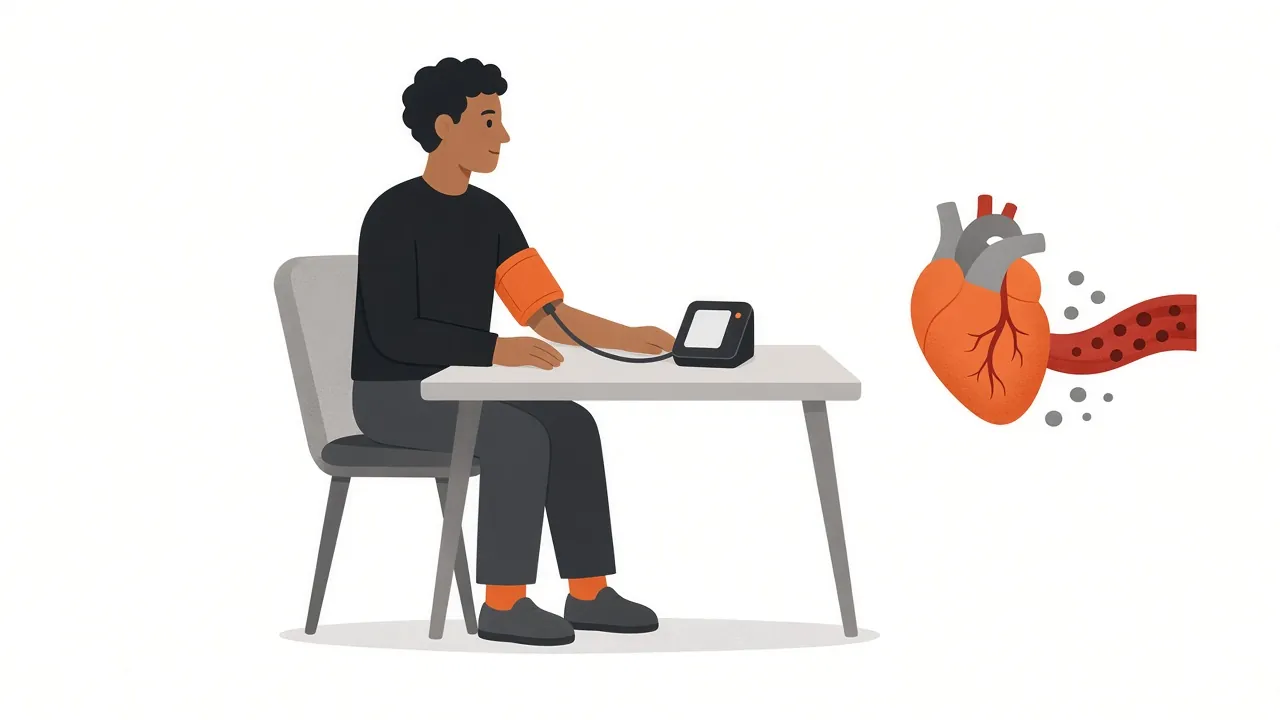
Key takeaways
- Under the 2025 US ACC/AHA office categories, normal is below 120/80 mmHg, stage 1 hypertension is 130–139 systolic or 80–89 diastolic, and stage 2 starts at 140 or 90.
- Systolic above 180 or diastolic above 120 mmHg with chest pain, breathlessness, new weakness or numbness, vision changes or difficulty speaking calls for emergency care right away.
- For home readings, sit quietly for 5 minutes, take 2–3 readings one minute apart morning and evening for 7 days, and average them, ignoring the first day.
- Regular aerobic exercise lowers blood pressure by about 5 to 8 mmHg, less salt by about 5 mmHg and weight loss by about 1 mmHg per kg.
- Share home averages with your doctor and do not change medication yourself.
Blood pressure is written as two numbers: systolic (pressure when the heart beats) over diastolic (pressure between beats), in mmHg — for example 118/76.
Categories (adults)
| Category | Systolic | Diastolic | |
|---|---|---|---|
| Normal | < 120 | and | < 80 |
| Elevated | 120–129 | and | < 80 |
| Stage 1 hypertension | 130–139 | or | 80–89 |
| Stage 2 hypertension | ≥ 140 | or | ≥ 90 |
| Very high — see the action guidance below | > 180 | and/or | > 120 |
These are the 2025 US ACC/AHA office blood pressure categories. The 2024 ESC and mainland Chinese guidelines use 140/90 mmHg in the clinic and 135/85 mmHg for the home average as hypertension thresholds. Either the systolic or diastolic threshold can qualify. Diagnosis uses repeated, properly measured readings and local criteria; diagnostic cutoffs are not the same as individual treatment targets.
Very high readings: symptoms change the next step
For nonpregnant adults, systolic > 180 or diastolic > 120 mmHg with chest pain, breathlessness, new weakness or numbness, vision changes, difficulty speaking, or another new concerning symptom needs emergency care: call the local emergency number immediately. Do not wait for it to fall. Without those symptoms, wait at least one minute and repeat the measurement; if it remains this high, contact a healthcare professional as soon as possible. Do not adjust medication yourself. Pregnancy requires separate clinical advice. AHA action guidance.
How to measure at home
- Use a validated upper-arm cuff (such as Withings BPM).
- Avoid caffeine, exercise and smoking for 30 minutes beforehand.
- Sit quietly for 5 minutes, back supported, feet flat, arm at heart level.
- Take 2–3 readings one minute apart, morning and evening.
- Measure for 7 days and average, ignoring the first day.
What raises and lowers it
| Raises | Lowers |
|---|---|
| High salt intake | Regular aerobic exercise (−5 to −8 mmHg) |
| Alcohol | Weight loss (about −1 mmHg per kg) |
| Excess weight | DASH-style diet rich in vegetables, fruit, potassium |
| Inactivity | Less salt (−5 mmHg) |
| Stress, poor sleep, sleep apnoea | Less alcohol, good sleep |
| Some medications (NSAIDs, decongestants) | Isometric exercise (e.g. wall sits, handgrip) |
Exercise and blood pressure
Blood pressure rises during exercise — that's normal. Regular endurance and strength training lower resting blood pressure over weeks. If your blood pressure is very high, talk to a doctor before starting intense training.
In MoveVitals
Readings from Withings BPM devices sync automatically with their timestamp. Systolic and diastolic are stored as separate metrics, and every reading keeps its source.
Worked example
Illustrative scenario. Alex's clinic readings were 138/86 but he suspected "white-coat" effect. He follows a home protocol: seated 5 minutes, arm at heart level, two readings 1 minute apart, morning and evening for 7 days. His home average is 131/83; his doctor interprets it using local home-monitoring criteria and his risk profile rather than diagnosing a white-coat effect from one clinic reading. With his doctor he starts 150 min/week of aerobic exercise plus less sodium and rechecks after 3 months.
Action steps
- Use a validated upper-arm cuff in the right size.
- Rest 5 minutes seated, back supported, feet flat, no talking.
- Take 2 readings 1 minute apart, morning and evening, for a week.
- Average the readings; ignore single outliers.
- Share averages with your doctor; do not change medication yourself.
Related guides
- Resting heart rate: normal ranges and what changes it
- Which blood tests are worth doing — a practical panel for active adults
- The lipid panel: LDL, HDL, triglycerides and total cholesterol explained
- Zone 2 training: the science and how to do it right
FAQ
Why is my reading higher at the doctor's? "White-coat" effect. Home readings are often more representative.
Can a smartwatch measure blood pressure? Some estimate it or flag trends, but a cuff remains the standard.
When is the best time to measure blood pressure at home? Morning before caffeine or medication and evening, seated and rested, averaged over several days.
Can exercise lower blood pressure? Regular aerobic and resistance exercise can lower blood pressure by several mmHg in many people.
References
- Jones et al. (2025). 2025 AHA/ACC multisociety guideline for the prevention, detection, evaluation, and management of high blood pressure in adults. Circulation. https://doi.org/10.1161/CIR.0000000000001356
- Garber et al. (2011). Quantity and Quality of Exercise for Developing and Maintaining Cardiorespiratory, Musculoskeletal, and Neuromotor Fitness in Apparently Healthy Adults. Medicine & Science in Sports & Exercise. https://doi.org/10.1249/MSS.0b013e318213fefb
- American Heart Association. When To Call 911 About High Blood Pressure. https://www.heart.org/en/health-topics/high-blood-pressure/understanding-blood-pressure-readings/when-to-call-911-for-high-blood-pressure
- McEvoy et al. (2024). 2024 ESC Guidelines for the management of elevated blood pressure and hypertension. European Heart Journal. https://doi.org/10.1093/eurheartj/ehae178
- Beijing Municipal Health Commission / Beijing Chao-Yang Hospital (2024). Report on the 2024 Chinese hypertension guideline revision and diagnostic thresholds. https://wjw.beijing.gov.cn/xwzx_20031/jcdt/202408/t20240821_3778401.html
For general information only. This is not medical advice — talk to a qualified professional about your health.
Keep reading
Metrics explained
Resting heart rate: normal ranges and what changes it
4 min read
Metrics explained
Heart rate zones explained: how to set and use them
4 min read
Recovery & sleep
Your personal baseline: why "normal for you" beats population averages
4 min read
Devices & setup
How MoveVitals handles multiple devices: provenance, duplicates and conflicts
5 min read
Metrics explained
Normal heart rate variability (HRV) by age: RMSSD vs SDNN
6 min read
Training science
Zone 2 training: the science and how to do it right
4 min read