

Metrics explained
The lipid panel: LDL, HDL, triglycerides and total cholesterol explained
The standard lipid panel is the most common blood test in any check-up. Here is what each number means, the usual ranges, and how training and diet change them.
Written by MoveVitals Editorial Collective
Community-authored educational content. Individual clinical review is identified only when a named review is actually recorded.
Editorial standards & corrections
Key takeaways
- Usual adult targets are LDL below 100 mg/dL (2.6 mmol/L), HDL of at least 40 mg/dL for men and 50 for women, fasting triglycerides below 150 mg/dL and total cholesterol below 200 mg/dL.
- A triglyceride-to-HDL ratio above about 3.5 (mg/dL) hints at insulin resistance, and very high HDL above 100 mg/dL doesn't add protection.
- For a clean result, fast 9–12 hours, skip hard training for 48 hours and alcohol for 24 hours.
- Your doctor may set a lower LDL target if you have other risk factors, and a retest 6–12 weeks after changing diet or starting medication shows the effect.
The four numbers
| Marker | Usual target (adults) | What it says |
|---|---|---|
| LDL cholesterol | < 100 mg/dL (< 2.6 mmol/L) | Cholesterol in plaque-forming particles; the main treatment target |
| HDL cholesterol | ≥ 40 mg/dL men, ≥ 50 mg/dL women | Cholesterol returning to the liver; low values travel with insulin resistance |
| Triglycerides | < 150 mg/dL (< 1.7 mmol/L), fasting | Circulating fat; very sensitive to sugar, alcohol and refined carbs |
| Total cholesterol | < 200 mg/dL (< 5.2 mmol/L) | Sum of all; little meaning on its own |
Your doctor may set a lower LDL target if you have other risk factors. Non-HDL cholesterol (total minus HDL) and ApoB capture all atherogenic particles and are often better guides — see ApoB and Lp(a).
Ratios worth a glance
- Triglyceride / HDL above about 3.5 (mg/dL) hints at insulin resistance.
- Total / HDL below 4 is generally favourable.
How exercise and diet move them
- Endurance training: raises HDL modestly and lowers triglycerides within weeks.
- Weight loss: lowers triglycerides and LDL.
- Saturated fat: the biggest dietary driver of LDL; replacing it with unsaturated fat lowers LDL.
- Alcohol and sugar: raise triglycerides quickly.
- A very hard session or a large meal the day before can raise triglycerides temporarily — test fasted and rested.
Getting a clean result
Fast 9–12 hours (water allowed), skip hard training for 48 hours and alcohol for 24 hours. Many labs now accept non-fasting samples; if triglycerides come back high, repeat fasted.
In MoveVitals
In Body Lab each marker is stored in mg/dL — enter mmol/L and it's converted — and compared with the range printed on your report when you add it. All four sit in the Blood lipids domain alongside ApoB and Lp(a). Overview: which blood tests are worth doing.
Worked example
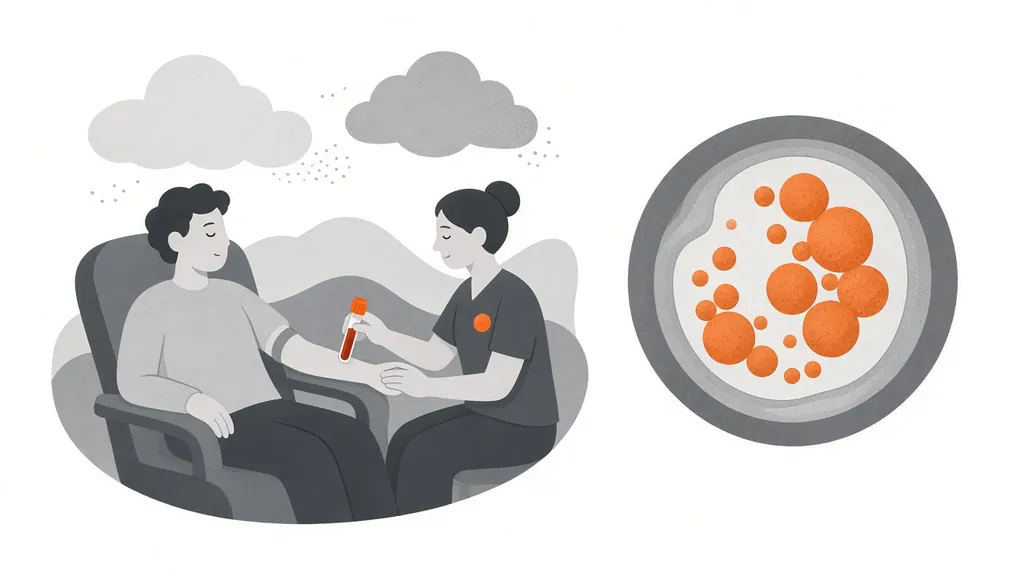
Illustrative scenario. Tom, 50, gets a lipid panel: total cholesterol 5.6 mmol/L, HDL 1.2, triglycerides 1.5 and LDL 3.6 mmol/L (about 139 mg/dL). Non-HDL cholesterol = 5.6 − 1.2 = 4.4 mmol/L. Guidelines set LDL targets according to overall cardiovascular risk rather than a single cut-off (Mach 2020). His doctor estimates his 10-year risk, and they agree on 3 months of diet changes and more aerobic exercise before deciding whether medication is needed.
Action steps
- Calculate non-HDL cholesterol: total minus HDL.
- Ask your doctor to estimate your overall cardiovascular risk.
- Increase fibre and replace saturated fats with unsaturated ones.
- Exercise regularly — aerobic work can raise HDL and lower triglycerides.
- Retest 6–12 weeks after changes to see the effect.
Related guides
- ApoB and Lp(a): the two lipid tests that matter most
- hs-CRP: measuring low-grade inflammation
- Blood pressure: categories, home measurement and what moves it
- Visceral fat: the fat you can't see and why it matters most
FAQ
Is high HDL always good? Very high HDL (> 100 mg/dL) doesn't add protection; focus on LDL/ApoB.
How often should I test? Yearly if normal; 6–12 weeks after changing diet or starting medication.
Is high HDL always protective? Not necessarily; very high HDL has not consistently shown extra benefit, so doctors look at the overall profile.
Does a big workout the day before change lipid results? Triglycerides can drop after a long session, so test after usual activity for consistent results.
References
- Mach et al. (2020). 2019 ESC/EAS Guidelines for the management of dyslipidaemias: lipid modification to reduce cardiovascular risk. European Heart Journal. https://doi.org/10.1093/eurheartj/ehz455
- Grundy et al. (2019). 2018 AHA/ACC/AACVPR/AAPA/ABC/ACPM/ADA/AGS/APhA/ASPC/NLA/PCNA Guideline on the Management of Blood Cholesterol: A Report of the American College of Cardiology/American Heart Association Task Force on Clinical Practice Guidelines. Circulation. https://doi.org/10.1161/CIR.0000000000000625
- Sniderman et al. (2019). Apolipoprotein B Particles and Cardiovascular Disease. JAMA Cardiology. https://doi.org/10.1001/jamacardio.2019.3780
For general information only. This is not medical advice — talk to a qualified professional about your health.
Keep reading
Metrics explained
ApoB and Lp(a): the two lipid tests that matter most
3 min read
Metrics explained
Which blood tests are worth doing — a practical panel for active adults
4 min read
Recovery & sleep
Your personal baseline: why "normal for you" beats population averages
4 min read
Metrics explained
HbA1c, fasting glucose and fasting insulin: reading your metabolic health
3 min read
Metrics explained
hs-CRP: measuring low-grade inflammation
3 min read
Metrics explained
Ferritin, iron and haemoglobin: the endurance athlete's blind spot
3 min read