

Metrics explained
Ferritin, iron and haemoglobin: the endurance athlete's blind spot
Low iron stores sap energy and endurance long before a blood count shows anaemia. Runners, women and plant-based eaters are most at risk — and a single ferritin test tells you where you stand.
Written by MoveVitals Editorial Collective
Community-authored educational content. Individual clinical review is identified only when a named review is actually recorded.
Editorial standards & corrections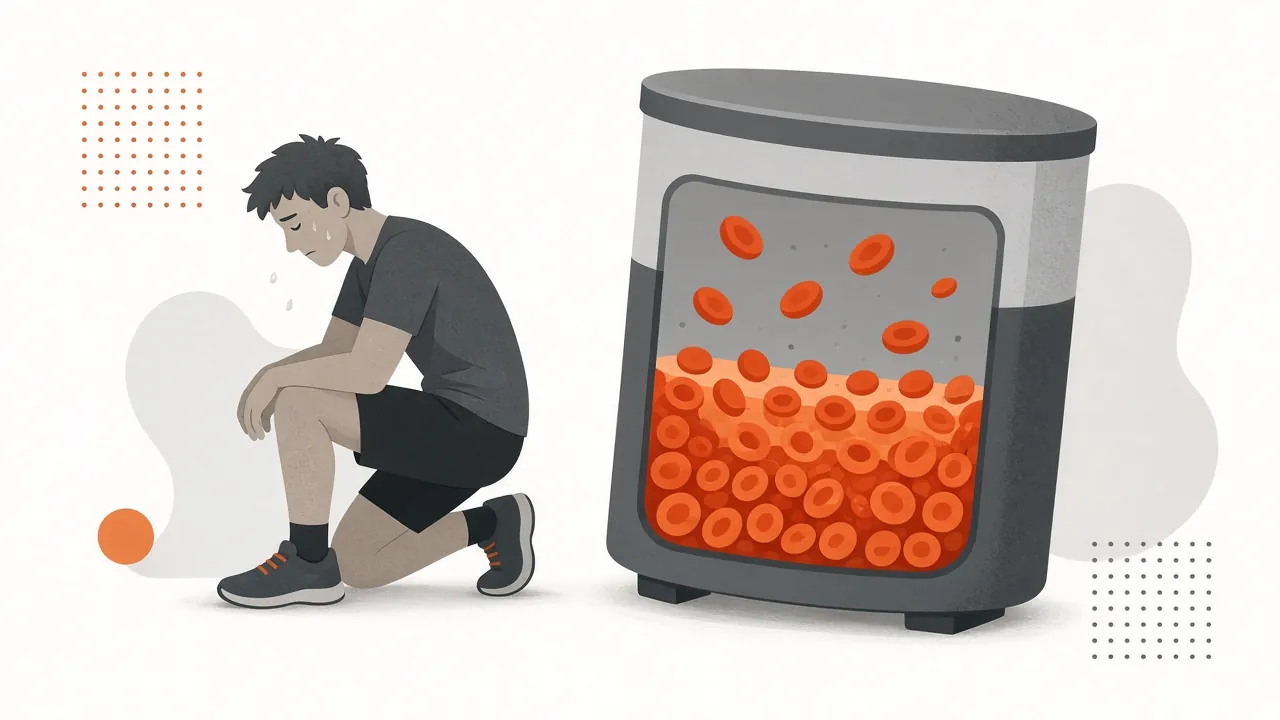
Key takeaways
- The typical adult ferritin range is 30–400 ng/mL for men and 15–150 ng/mL for women, but many sports physicians consider below 30–35 ng/mL low for endurance athletes even with normal haemoglobin.
- Ferritin is an acute-phase protein, so illness or a hard race raises it and can hide deficiency; avoid hard training for 24 hours before the test.
- Hepcidin rises for a few hours after hard sessions and blocks iron absorption, and non-haem iron from plant-based diets is absorbed less well.
- Take iron supplements only after testing and on medical advice, retest after 8–12 weeks, and have persistently high ferritin assessed by a doctor.
The markers
| Marker | Typical adult range | What it tells you |
|---|---|---|
| Ferritin | Men 30–400 ng/mL, women 15–150 ng/mL | Iron stores |
| Haemoglobin | Men 13.2–16.6 g/dL, women 11.6–15.0 g/dL | Oxygen-carrying capacity |
| Transferrin saturation | 20–50 % | Iron available for use right now |
Many sports physicians consider ferritin below 30–35 ng/mL low for endurance athletes even when haemoglobin is normal (iron deficiency without anaemia), because it is linked to fatigue and reduced training response.
Why athletes run low
- Foot-strike haemolysis and sweat losses.
- Hepcidin rises for a few hours after hard sessions and blocks iron absorption.
- Menstrual losses; low energy availability; plant-based diets (non-haem iron is absorbed less well).
Testing tips
Ferritin is an acute-phase protein: illness or a hard race raises it and can hide deficiency. Test rested and healthy, ideally with hs-CRP alongside. Retest 8–12 weeks after any change.
Improving iron status
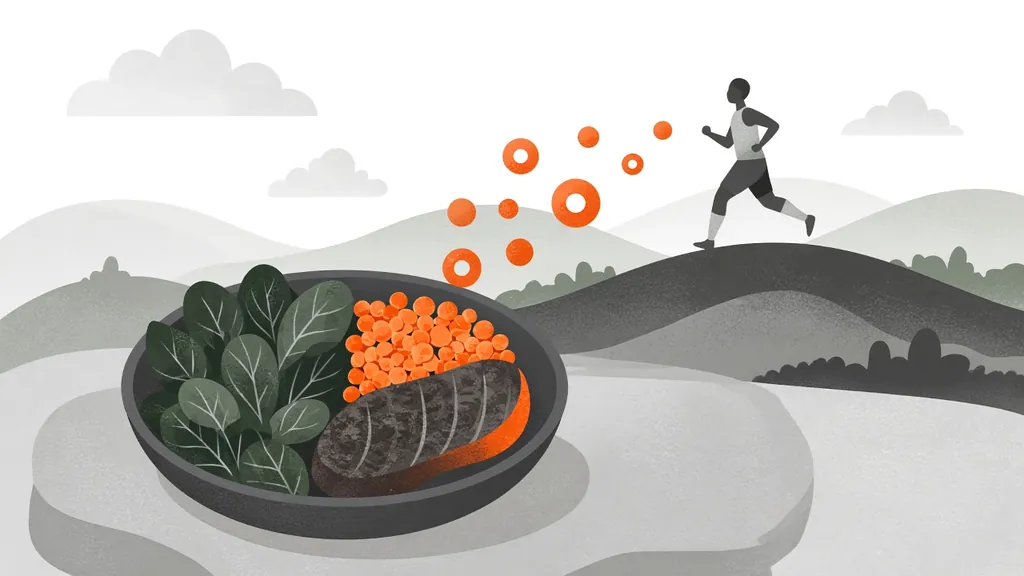
Iron-rich foods (red meat, legumes, dark greens) with vitamin C; avoid tea and coffee with iron-rich meals; take supplements only after testing and with medical advice — too much iron is harmful. Take supplements in the morning or on rest days, when hepcidin is lower.
In MoveVitals
Ferritin and haemoglobin live under Micronutrients and Inflammation and blood in Body Lab. Low ferritin often shows up in your data as a stalled VO₂ max or rising heart rate at the same pace.
Worked example
Illustrative scenario. Hana, a 29-year-old runner, has felt flat for weeks. Her haemoglobin is normal, but ferritin is 22 µg/L. Many sports medicine reviews consider values below about 35 µg/L as suboptimal iron stores in athletes, even without anaemia (Sim 2019). With her doctor she chooses an iron supplement taken in the morning on alternate days, away from coffee, and retests after 8–12 weeks: ferritin 48 µg/L. Iron should not be supplemented without testing, as excess can be harmful.
Action steps
- Test ferritin, haemoglobin and ideally transferrin saturation together.
- Avoid hard training for 24 hours before the test.
- Eat iron-rich foods with vitamin C sources.
- Keep tea and coffee away from iron-rich meals or supplements.
- Supplement only on medical advice and retest after 8–12 weeks.
Related guides
- Which blood tests are worth doing — a practical panel for active adults
- hs-CRP: measuring low-grade inflammation
- Overreaching and overtraining: warning signs and what to do
- VO2 max: what it means and how to improve it
FAQ
Ferritin 25, haemoglobin normal — is that a problem? For an endurance athlete it is often worth discussing with a doctor.
Can ferritin be too high? Yes; persistently high values need medical assessment (inflammation, liver disease, haemochromatosis).
Why is ferritin sometimes high after illness? Ferritin rises with inflammation, so a recent infection or very hard training can mask low iron stores.
Who is most at risk of low iron? Menstruating athletes, vegetarians, endurance runners and people who donate blood often.
References
- Sim et al. (2019). Iron considerations for the athlete: a narrative review. European Journal of Applied Physiology. https://doi.org/10.1007/s00421-019-04157-y
- McNulty et al. (2020). The Effects of Menstrual Cycle Phase on Exercise Performance in Eumenorrheic Women: A Systematic Review and Meta-Analysis. Sports Medicine. https://doi.org/10.1007/s40279-020-01319-3
For general information only. This is not medical advice — talk to a qualified professional about your health.
Keep reading
Metrics explained
VO2 max: what it means and how to improve it
4 min read
Training science
Interval training and HIIT: designing sessions that work
4 min read
Recovery & sleep
Your personal baseline: why "normal for you" beats population averages
4 min read
Training science
Zone 2 training: the science and how to do it right
4 min read
Mobility & stretching
Mobility vs flexibility: what's the difference and what do you need?
3 min read
Devices & setup
Strava and MoveVitals: workouts, streams and devices that arrive via Strava
3 min read