

Sports
Hiking and trekking: heart rate on climbs, pacing and how to train for it
Hiking heart rate jumps on climbs because you are lifting your body and pack against gravity, and altitude and heat push it higher still. Pace by effort with a heart rate cap and the talk test, and train with strength work and loaded walks rather than only more flat miles.
Written by MoveVitals Editorial Collective
Community-authored educational content. Individual clinical review is identified only when a named review is actually recorded.
Editorial standards & corrections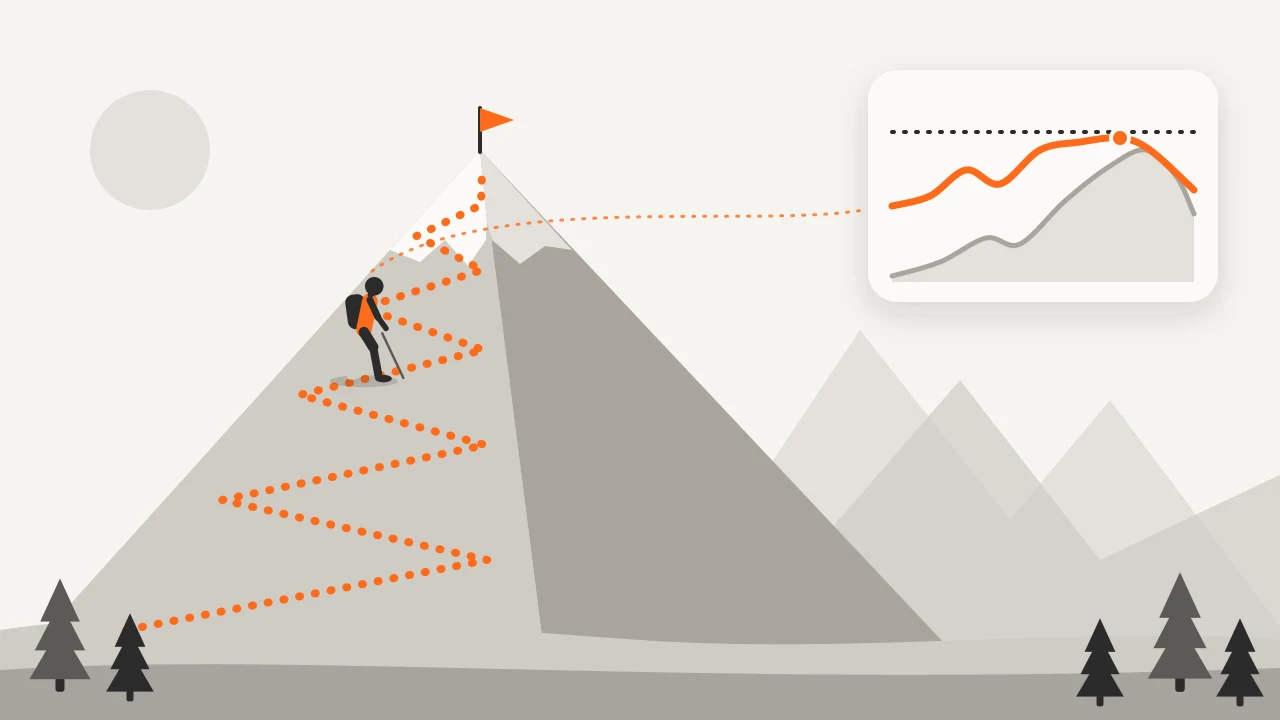
Key takeaways
- For climbs on a long hiking day, a cap of about 75–80% of max heart rate is a sensible start, lower at altitude or in heat, and short sentences on the talk test match that effort.
- Heart rate lags effort by a minute or two, so slow down before you reach the cap.
- Naismith's rule estimates hiking time as 1 hour per 5 km on the flat plus 1 hour per 600 m of ascent, for fit walkers without heavy loads.
- Train for a big trip for 8–12 weeks with one loaded long walk building toward 60–80% of the target day, one hill or stair session and two strength sessions a week.
- Chest pain, fainting, palpitations with dizziness or worsening altitude symptoms mean stop, rest and get help, or descend.
Hiking is mostly walking, but a climb can push your heart rate into the range you would normally reach only when running. For flat walking, see walking for fitness.
Why is my hiking heart rate so high on climbs?
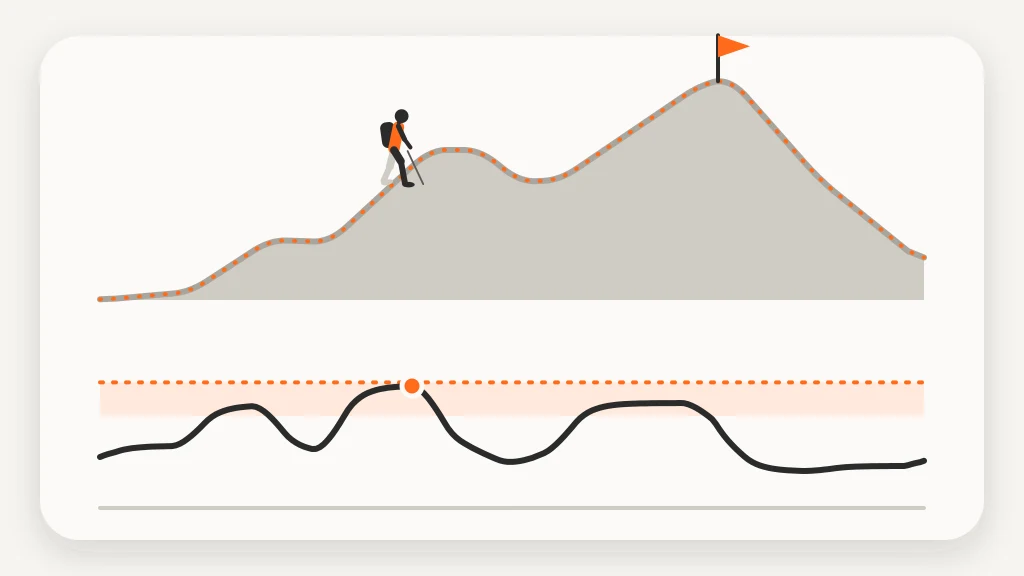
The energy cost of walking rises steeply with gradient (Minetti et al., 2002), because every step lifts your body weight and pack against gravity. Breathing and heart rate follow. Add a pack, altitude, heat, poor sleep or a skipped meal, and the same pace costs more.
| Factor | Effect on heart rate | What to do |
|---|---|---|
| Steeper gradient | Large rise, the biggest single factor | Shorten steps, slow down, use poles, go by effort |
| Pack weight | Raises the cost of every step | Train with the pack; carry only what you need |
| Altitude | Higher heart rate at the same effort, lower SpO2; maximum heart rate may also be lower | Slow down, climb by effort, acclimatise (altitude) |
| Heat and dehydration | Heart rate drifts up over hours (cardiac drift) | Drink and eat regularly; start early (hydration) |
| Fatigue, poor sleep, illness, caffeine | Higher than usual | Check your resting heart rate trend; skip hard days when unwell |
Is a high heart rate when hiking uphill dangerous? A number that looks alarming in absolute terms may be a moderate effort for you. Maximum heart rate varies with age and the individual, and "220 − age" can be off by 10–20 bpm (maximum heart rate), so look at the percentage of your own maximum and at how you feel. But stop, rest and seek medical help for chest pain or pressure, fainting or near-fainting, palpitations with dizziness, or breathlessness that does not settle with rest. A watch shows a number; it cannot tell you why.
Pacing by effort: heart rate cap, talk test and RPE
| Effort | % of max HR | Talk test | RPE (0–10) | Use it for |
|---|---|---|---|---|
| Easy | 55–70% (zones 1–2) | Full sentences | 3–4 | Flats, descents, all-day base |
| Steady climb | 70–80% (zone 3) | Short sentences | 5–6 | Most climbing on a long day |
| Hard push | 80–90% (zone 4) | A few words | 7–8 | Short steep pitches only, a few minutes |
- Set a cap. For climbs on a long day, something like 75–80% of max HR is a sensible starting point, lower at altitude or in heat. Many sports watches can alert you when you exceed a heart rate.
- Slow down before you reach it. Heart rate lags effort by a minute or two (heart rate zones), so react to breathing and the talk test as well as the number (RPE).
- Keep a steady rhythm. Short steps, poles, brief rests in the shade instead of long stops.
- Eat and drink on a schedule, roughly every 30–60 minutes.
To plan the day, Naismith's rule is a classic estimate for fit walkers without heavy loads: 1 hour per 5 km on the flat, plus 1 hour per 600 m of ascent. Add time for stops, a heavy pack and steep or rough descents.
How to train for hiking
| Element | Example | How often |
|---|---|---|
| Aerobic base | Easy walking or cycling, 45–90 min (zone 2) | 2–3 times a week |
| Hills and stairs | Incline treadmill at 8–12%, stair climbs or step-ups with a light pack, 20–40 min | Once a week |
| Strength | Squats, step-ups, lunges, calf raises, single-leg work, core (strength training) | Twice a week |
| Loaded long walk | The pack you will carry, building toward 60–80% of the target day's duration | Once a week |
| Back-to-back days | Two long days in a row for multi-day treks | Once or twice before the trip |
| Downhill control | Slow step-downs (3–4 seconds each), walking down stairs | Within strength sessions |
Start 8–12 weeks before a big trip and add load and duration gradually. Common mistakes: starting the first climb too fast, training only on the flat, ignoring descents (knees and quadriceps), never practising with the pack, wearing new boots on the trip, and under-eating and under-drinking.
Altitude, heat and safety
- Altitude. Above roughly 2,500 m, heart rate runs higher at the same effort and SpO2 falls; acclimatise and avoid climbing too quickly. Headache, nausea and dizziness mean do not go higher, and descend if they worsen; severe headache, confusion or breathlessness at rest call for descent and medical help (Luks et al., 2019). A wrist SpO2 reading is a rough indicator, not a diagnosis (SpO2).
- Heat. Heart rate drifts up over hours; drink regularly and replace salt on long hot days (hydration).
What to look for in a hiking watch
If you are searching for hiking watch recommendations, start with features rather than brand:
| Feature | Why it matters |
|---|---|
| Barometric altimeter | Steadier ascent and descent than GPS-only elevation; calibrate at a known height |
| Ascent, descent and grade | Lets you pace climbs and compare days |
| Battery life in GPS mode | Must outlast your longest day with margin; multi-band GPS and bright screens use more |
| Navigation (breadcrumb, route import, track back) | A safety feature, not just a statistic |
| Heart rate alerts and chest strap support | Hold your cap; steadier readings on steep ground |
| Garmin, COROS, Suunto and Polar all make watches with these features, so compare by features and battery instead of brand. On data quality: wrist optical sensors are generally less accurate during vigorous, rhythmic movement (Bent et al., 2020) and can lock onto step cadence on steep climbs, so a chest strap is worth considering. GPS distance can read slightly short on tight switchbacks, and calorie estimates often ignore pack weight and terrain. |
In MoveVitals
Hikes recorded on Garmin, COROS, Suunto and Polar watches arrive as workouts with duration, distance and heart rate. Suunto adds ascent and altitude data, and Strava brings elevation and altitude streams, GPS and laps; for COROS, second-by-second streams arrive through Strava if you connect it too. Apple Watch hikes reach MoveVitals through Strava. Duplicates, such as a Suunto hike also uploaded to Strava, are merged, and time in zone is calculated from the heart rate stream, so you can see how long a climb spent above your cap.
Worked example
Illustrative scenario. Mia, 38, plans a 14 km day hike with 900 m of ascent. Naismith's rule gives 14 ÷ 5 = 2.8 h plus 900 ÷ 600 = 1.5 h, about 4.3 hours of moving time, and with stops and a slow descent she plans for around 5.5 hours. Her maximum heart rate is about 185 bpm from a field test, so her easy range is 111–130 bpm (60–70%) and she sets a climbing cap of 148 bpm (80%) with a watch alert. On last year's hike she hit 165 bpm within ten minutes of the first climb and had to stop; this time she starts slower with shorter steps and poles, and keeps the first climb at 135–148 bpm, speaking in short sentences. Over ten weeks she did an incline treadmill session with an 8 kg pack each week, two strength sessions and a long walk growing from 90 minutes to 4 hours; by the trip the same climb costs about 8–10 bpm less. Figures are illustrative.
Action steps
- Find your maximum heart rate (a field test if you can) and set an easy range and a climbing cap, for example about 80% on climbs of a long day, lower at altitude or in heat.
- Pace by effort: slow down before the cap, keep to short sentences on climbs and set a watch alert if it has one.
- Train weekly: one loaded long walk, one hill or stair session and two strength sessions, starting 8–12 weeks before a big trip.
- Practise with the pack, boots and poles you will use, plus slow downhill steps.
- Choose a watch by altimeter, battery life in GPS mode and navigation, and carry a map and a spare battery pack.
- Know the warning signs: chest pain, fainting, palpitations with dizziness or worsening altitude symptoms mean stop, rest and get help, or descend.
Related guides
- Heart rate zones explained: how to set and use them
- Altitude: acclimatisation, training camps and your wearable data
- Strength training for endurance athletes
- Hydration and electrolytes: drinking smart for training and racing
- Blood oxygen (SpO2): what wearables measure and when to worry
- Rucking: weighted walking for fitness — load, pace, heart rate and injury risk
FAQ
What heart rate is normal when hiking uphill? It depends on your age, fitness, pack, altitude and heat. Judge it by the percentage of your own maximum (roughly 70–80% on steady climbs of an all-day hike) and by the talk test, not by anyone else's number.
Why is my heart rate too high on climbs, and when should I worry? Climbing, a pack, altitude and heat all raise it, and starting too fast is the usual culprit; slow down until you can speak in short sentences. Stop and seek medical help for chest pain, fainting, palpitations with dizziness or breathlessness that does not settle.
My watch shows low SpO2 at altitude. Should I worry? SpO2 normally falls at altitude, and wrist readings are noisy in cold or when moving. Symptoms matter more than the number: headache, nausea, dizziness or breathlessness at rest mean stop climbing and descend if they worsen (SpO2).
References
- Minetti et al. (2002). Energy cost of walking and running at extreme uphill and downhill slopes. Journal of Applied Physiology. https://doi.org/10.1152/japplphysiol.01177.2001
- Luks et al. (2019). Wilderness Medical Society clinical practice guidelines for the prevention and treatment of acute altitude illness: 2019 update. Wilderness & Environmental Medicine. https://doi.org/10.1016/j.wem.2019.04.006
- Bent et al. (2020). Investigating sources of inaccuracy in wearable optical heart rate sensors. npj Digital Medicine. https://doi.org/10.1038/s41746-020-0226-6
For general information only. This is not medical advice — talk to a qualified professional about your health.
Keep reading
Sports
Trail running with a watch: heart rate, climbs and pacing by effort
7 min read
Metrics explained
VO2 max: what it means and how to improve it
4 min read
Metrics explained
Heart rate zones explained: how to set and use them
4 min read
Metrics explained
Maximum heart rate: formulas, field tests and why age-based estimates fail
4 min read
Training science
Tempo runs: how fast, how long and why they work
3 min read
Sports
Walking for fitness and weight loss: pace, heart rate zones and how much is enough
9 min read