

Metrics explained
Blood oxygen (SpO2): what wearables measure and when to worry
SpO2 is the percentage of haemoglobin in your blood that carries oxygen. Wearables estimate it with light through the skin; it is useful as a night-time trend, not as a diagnosis.
Written by MoveVitals Editorial Collective
Community-authored educational content. Individual clinical review is identified only when a named review is actually recorded.
Editorial standards & corrections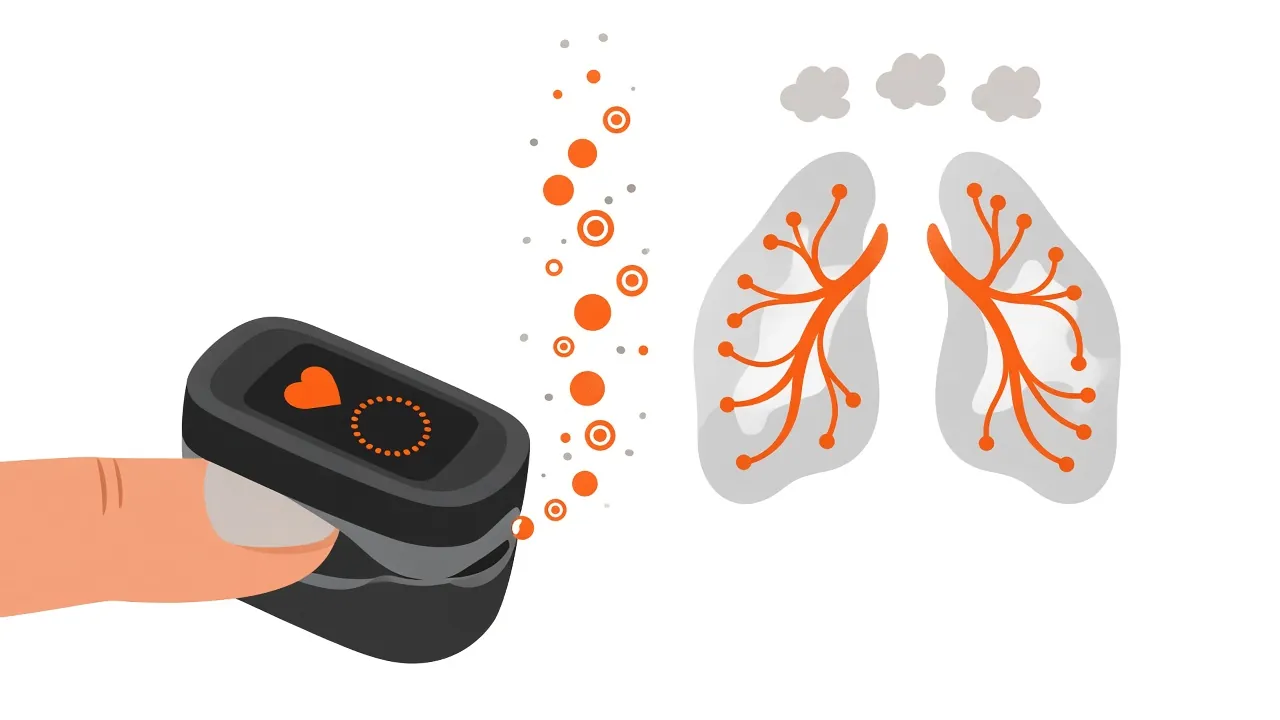
Key takeaways
- An SpO2 of 95–100 % is normal at sea level for a healthy adult, 92–94 % is slightly low and common during sleep or at altitude, and repeated readings below 92 % are worth discussing with a doctor.
- Night-time values naturally dip by 1–3 points, so read SpO2 as a trend over nights and ignore isolated low readings.
- Most wrist and ring sensors are not medical devices for SpO2, and pulse oximeters can overestimate saturation in people with darker skin.
- Discuss repeated night-time dips below about 90%, snoring or daytime sleepiness with a doctor, and seek urgent care for shortness of breath, chest pain, confusion or bluish lips, whatever the device says.
Peripheral oxygen saturation (SpO2) is the share of haemoglobin in arterial blood that is loaded with oxygen. Medical pulse oximeters clip onto a finger; WHOOP, Oura, Withings and Apple Watch estimate it from red and infrared light reflected from the wrist or finger, mostly while you sleep.
Normal values
| SpO2 | Meaning (at sea level, healthy adult) |
|---|---|
| 95–100 % | Normal |
| 92–94 % | Slightly low — common during sleep, at altitude or with poor sensor contact |
| < 92 % repeatedly | Worth discussing with a doctor, especially with symptoms |
Night-time values naturally dip by 1–3 points. At altitude, values of 88–94 % can be normal for the first days.
Accuracy and limits
Wrist and ring sensors are not medical devices for SpO2 (unless explicitly cleared, such as some Withings devices). Movement, cold hands, tattoos, a loose fit and darker skin tones can reduce accuracy. Treat a single low reading with caution and look for repeated patterns.
Why track it
- Breathing during sleep: frequent dips together with loud snoring can be a sign of sleep apnoea, which needs a proper sleep study.
- Illness: respiratory infections can lower SpO2 and raise respiratory rate.
- Altitude acclimatisation: SpO2 rises again over several days as you adapt.
When to seek help
Seek urgent medical care if you have shortness of breath, chest pain, confusion or bluish lips — regardless of what a wearable says. Do not rely on a consumer wearable to rule anything out.
In MoveVitals
Night-time SpO2 from WHOOP, Oura, Withings and Apple Health is stored per source with the measurement window, so averages from different devices are never blended silently.
Worked example
Illustrative scenario. Raj's ring reports a nightly average SpO2 of 96% with brief dips to 92% on most nights. On a trip to 2,500 m, his average falls to about 92% with dips to 87% for the first few nights, then slowly improves — an expected response to altitude. Back home, he notices frequent dips below 90% on nights after alcohol, with loud snoring reported by his partner. Rather than self-diagnosing, he brings the trend to his doctor, who arranges a proper sleep study. The numbers are illustrative; a wearable trend can prompt a conversation but cannot diagnose sleep apnoea.
Action steps
- Read SpO2 as a trend over nights; ignore isolated single low readings.
- Wear the sensor snugly and keep still for spot checks.
- Expect lower values at altitude and track how they recover over days.
- Discuss repeated night-time dips below ~90%, snoring or daytime sleepiness with a doctor.
- Seek urgent care for shortness of breath or chest pain, whatever the device says.
Related guides
- Altitude: acclimatisation, training camps and your wearable data
- Respiratory rate during sleep: a quiet early-warning signal
- Sleep stages: light, deep and REM sleep explained
- Resting heart rate: normal ranges and what changes it
- Sleep apnea detection on watches and rings: how breathing-disturbance alerts work
FAQ
Why does my ring show 93 % while I feel fine? Night dips and sensor fit are common causes. Look at the multi-week trend.
Can I use SpO2 to detect COVID or apnoea? No. It can prompt a conversation with a doctor, but diagnosis needs proper testing.
Is SpO2 accuracy affected by skin tone? Studies of pulse oximeters have found they can overestimate oxygen saturation in people with darker skin, which is one reason to treat readings with caution.
Why does my SpO2 drop at altitude? Air pressure is lower, so less oxygen reaches the blood; values usually rise again as you acclimatise.
References
- Sjoding et al. (2020). Racial Bias in Pulse Oximetry Measurement. New England Journal of Medicine. https://doi.org/10.1056/nejmc2029240
- Bergeron et al. (2012). International Olympic Committee consensus statement on thermoregulatory and altitude challenges for high-level athletes. British Journal of Sports Medicine. https://doi.org/10.1136/bjsports-2012-091296
- Bent et al. (2020). Investigating sources of inaccuracy in wearable optical heart rate sensors. npj Digital Medicine. https://doi.org/10.1038/s41746-020-0226-6
For general information only. This is not medical advice — talk to a qualified professional about your health.
Keep reading
Metrics explained
Respiratory rate during sleep: a quiet early-warning signal
3 min read
Devices & setup
How MoveVitals handles multiple devices: provenance, duplicates and conflicts
5 min read
Devices & setup
WHOOP and MoveVitals: what syncs and how to get the most from it
3 min read
Metrics explained
Resting heart rate: normal ranges and what changes it
4 min read
Metrics explained
Normal heart rate variability (HRV) by age: RMSSD vs SDNN
6 min read
Recovery & sleep
Sleep hygiene: evidence-based habits for better sleep
4 min read