

Metrics explained
Sleep apnea detection on watches and rings: how breathing-disturbance alerts work
Some watches now notify you when your sleep shows breathing-disturbance patterns that may point to sleep apnea. These alerts can prompt a conversation with a doctor, but they cannot diagnose it, and a quiet watch does not rule it out.
Written by MoveVitals Editorial Collective
Community-authored educational content. Individual clinical review is identified only when a named review is actually recorded.
Editorial standards & corrections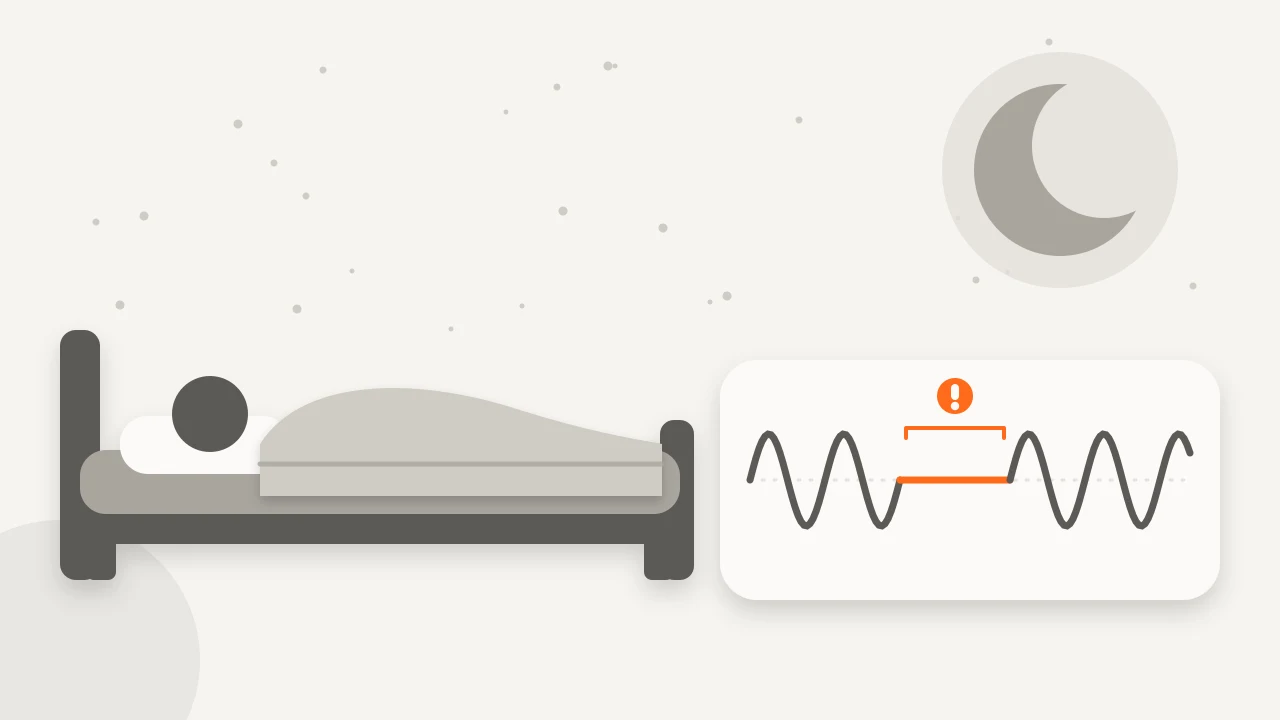
Key takeaways
- Apple's sleep apnea notification uses the accelerometer over a 30-day period and was cleared by the US FDA in September 2024 for adults 18 and over without a diagnosis.
- For Apple's feature, the FDA summary reports 66.3 % sensitivity and 98.5 % specificity for moderate-to-severe apnea in 1,499 people, so a notification deserves attention and a silent watch tells you little.
- See a doctor for loud snoring with pauses or gasping, waking unrefreshed, daytime sleepiness or morning headaches, even if the watch stays quiet.
- If your watch gives a notification, do not self-diagnose: export the report and book an appointment.
- Do not drive when drowsy, and seek urgent care for severe breathlessness.
What sleep apnea is, and why it hides
In obstructive sleep apnea the airway repeatedly narrows or closes during sleep, so breathing pauses or becomes shallow. Severity is graded by the apnea-hypopnea index (AHI), the number of events per hour of sleep: 5–14 is mild, 15–29 moderate and 30 or more severe. One literature-based estimate puts about 936 million adults aged 30–69 worldwide at mild-to-severe sleep apnea and 425 million at moderate-to-severe, though the data are patchy and the analysis was funded by a maker of sleep-apnea devices.
Because the main events happen while you sleep, many people do not notice them. The US National Heart, Lung, and Blood Institute lists breathing that starts and stops, frequent loud snoring and gasping at night, plus daytime sleepiness, fatigue, headaches and waking often to urinate, and notes you may not notice the night-time signs until someone points them out. A bed partner's observations matter as much as any device.
How wearables try to spot sleep apnea
| Signal | How it is used | Example | Main limit |
|---|---|---|---|
| Wrist motion (accelerometer) | Tiny repeated movements tied to breathing effort are classed each night as elevated or not | Apple Watch sleep apnea notifications | Indirect; one signal; tuned for moderate-to-severe apnea |
| Blood oxygen (optical SpO2) | Oxygen dips that go with breathing events over a couple of nights | Samsung Galaxy Watch sleep apnea feature | Misses events without an oxygen drop; movement and fit add noise |
| Breathing rate, SpO2 and HRV trends | Wellness context that can flag unusual nights | Oura, WHOOP, Withings, Polar and others | Not standardised; no AHI; not a diagnosis |
Apple Watch. The sleep apnea notification was cleared by the US FDA in September 2024 for adults 18 and over without a sleep apnea diagnosis. Apple lists Apple Watch Series 9 or later, Ultra 2 or later and SE 3. When you wear the watch to bed, its accelerometer detects breathing disturbances, each night classed "Elevated" or "Not Elevated". If Elevated nights are consistent across a 30-day period you get a notification. Sleep tracking must be on and you need at least 10 nights of wear in each 30-day period. Apple publishes a country list, and not every country is on it.
Samsung Galaxy Watch. Samsung received FDA De Novo authorization in February 2024 and later added CE marking for Europe (2025) and Health Canada approval. Its feature uses the blood-oxygen sensor over two nights of at least four hours within ten days, for adults 22 and over, and looks for signs of moderate-to-severe obstructive sleep apnea. It is available only in selected markets, on supported watch and phone combinations.
Oura and other rings. Oura tracks overnight breathing and SpO2, and in the US an Oura and ResMed programme notifies some members with a Gen3 or Ring 4 and an active membership when it detects more breathing disturbances, suggesting they consider speaking to a healthcare provider. Oura frames its data as wellness insights, so check its current regulatory statement before treating any ring output as a medical result.
Sleep apnea notification accuracy: what the numbers say
The clearest public numbers come from the FDA summary for Apple's feature. In a prospective study of 1,499 people compared with a home sleep test, sensitivity for moderate-to-severe apnea (AHI of 15 or more) was 66.3 % (95 % CI 62.2–70.3) and specificity for normal-to-mild (AHI under 15) was 98.5 % (98.0–99.0). The summary describes the feature as tuned for high specificity because it is opportunistic, and states that no notification does not mean no sleep apnea.
In practice that means a notification is worth taking seriously, a silent watch tells you little, and mild apnea is not the target. A 2023 expert review in the Journal of Sleep Research noted concerns about the validation and accuracy of consumer sleep technology for sleep-disordered breathing, and set out a systematic review comparing devices with polysomnography. Claims therefore differ widely by device: a regulated feature has been tested against a reference, while an unregulated breathing score may not have been.
Getting a proper test
A doctor decides how to test. In-lab polysomnography records breathing, oxygen, heart rhythm, brain activity and movement overnight. A home sleep apnea test is a simpler device worn at home. The American Academy of Sleep Medicine's 2017 guideline supports home testing for uncomplicated adults at increased risk of moderate-to-severe obstructive sleep apnea, and generally follows a negative or inconclusive home test with an in-lab study. Treatments exist and a clinician can explain them. Do not self-treat, and do not buy supplements or devices on the strength of a watch result.
See a doctor if you have loud snoring with pauses or gasping, waking unrefreshed, daytime sleepiness, morning headaches, frequent night-time urination or high blood pressure that is hard to control, with or without a notification. If you feel drowsy while driving, do not drive; stop somewhere safe and seek advice. Severe breathlessness, chest pain or confusion at night needs emergency care.
Reading the rest of your wearable data
Dips in blood oxygen and a raised respiratory rate add context but have many other causes, including altitude, illness and a loose sensor, and estimates such as sleep efficiency and sleep stages are rough (see how accurate is sleep tracking). Evening alcohol can worsen snoring and breathing events for some people (alcohol, HRV and sleep). Bring symptoms and a multi-week trend to your clinician, and avoid chasing a nightly number (using health data without obsession).
In MoveVitals
MoveVitals does not import Apple's sleep apnea notifications, Samsung's apnea results or Oura's breathing-disturbance scores, and it does not calculate an AHI or screen for sleep apnea. Those stay in the maker's app, where you can export a report for your clinician. From its direct connections MoveVitals can show surrounding context: overnight respiratory rate, SpO2 from sources such as WHOOP, Oura and Withings, and sleep duration, stages and efficiency. Each value is stored per source with its time window, and devices that compute the same metric differently are not blended silently. Direct Apple Health sync is planned, so Apple Watch sleep data does not arrive through it today. See how MoveVitals resolves conflicts.
Worked example
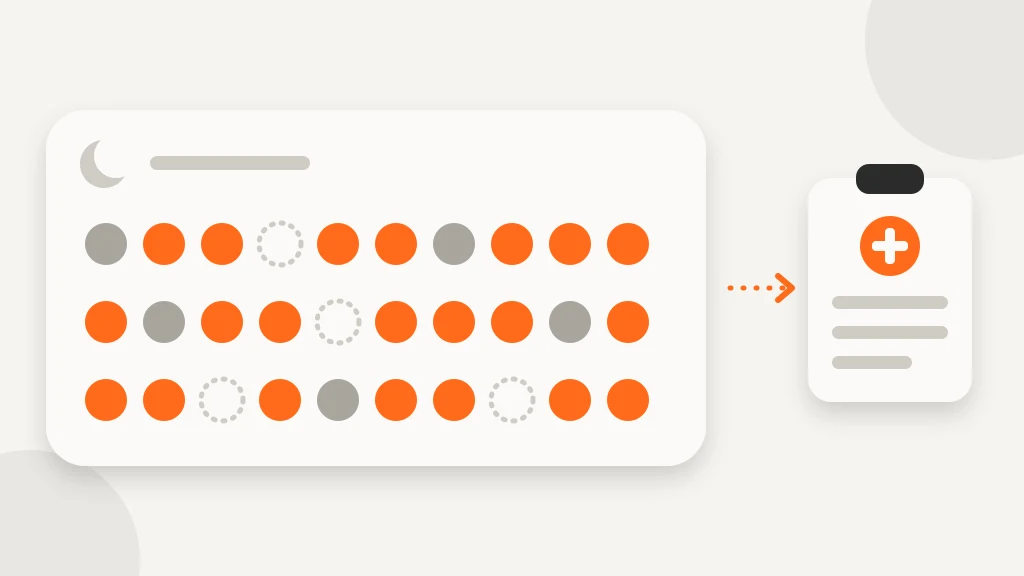
Illustrative scenario. Sam, 52, wears a smartwatch with sleep tracking on 24 of 30 nights, comfortably above the 10 the maker requires. At the end of the period he gets a notification that his sleep showed signs consistent with moderate-to-severe sleep apnea. His partner has mentioned loud snoring and pauses, and he is sleepy by mid-afternoon. He exports the report, books a visit with his doctor and is referred for a sleep test, where a clinician will interpret the results and discuss options. Ana, 47, has worn a similar watch for months with no notification, yet she snores loudly, wakes with headaches and feels drowsy on long drives. The quiet watch does not stop her asking her doctor, because no notification is needed to seek a test. Both cases are illustrative.
Action steps
- Learn the signs (loud snoring with pauses or gasping, unrefreshing sleep, daytime sleepiness, morning headaches) and ask a bed partner what they notice.
- If your watch gives a notification, do not self-diagnose: export the report and book an appointment.
- If you have the signs but no notification, see a doctor anyway, because a quiet watch is not clearance.
- If you use a device feature, wear it for at least the nights the maker requires, keep the software updated and check availability for your country and model.
- Do not drive when drowsy, and seek urgent care for severe breathlessness or chest pain at night.
Related guides
- Respiratory rate during sleep: a quiet early-warning signal
- Blood oxygen (SpO2): what wearables measure and when to worry
- Sleep stages: light, deep and REM sleep explained
- Sleep efficiency: what percentage of time in bed you actually sleep
- Alcohol, HRV and sleep: what your wearable shows the night after
FAQ
Can Apple Watch detect sleep apnea? It can notify you of signs consistent with moderate-to-severe sleep apnea, using its accelerometer over a 30-day period, on supported models and in listed countries. It does not diagnose, and not everyone with sleep apnea will receive a notification.
How accurate are sleep apnea notifications? For Apple's feature the FDA summary reports 66.3 % sensitivity and 98.5 % specificity for moderate-to-severe apnea in 1,499 people. That is few false alarms but many missed cases. Other devices differ, and unregulated breathing scores have no published accuracy at all.
Can Oura detect sleep apnea? Oura tracks overnight breathing and SpO2, and in the US a ResMed programme can nudge some members to talk to a healthcare provider. It presents these as wellness insights rather than a diagnosis, so use them as a prompt, not a result.
If my watch is quiet, can I rule out sleep apnea? No. Apple states that not all people with sleep apnea will receive a notification. If you have symptoms, ask a doctor about testing whatever your watch says.
References
- U.S. FDA (2024). 510(k) K240929: Sleep Apnea Notification Feature (Apple). https://www.accessdata.fda.gov/cdrh_docs/pdf24/K240929.pdf
- Apple. Sleep apnea notifications on your Apple Watch. https://support.apple.com/en-gb/120031
- Samsung (2024). Samsung's sleep apnea feature on Galaxy Watch authorized by US FDA. https://news.samsung.com/us/samsung-sleep-apnea-feature-galaxy-watch-first-its-kind-authorized-us-fda
- Kapur et al. (2017). Clinical Practice Guideline for Diagnostic Testing for Adult Obstructive Sleep Apnea. Journal of Clinical Sleep Medicine. https://doi.org/10.5664/jcsm.6506
- Benjafield et al. (2019). Estimation of the global prevalence and burden of obstructive sleep apnoea: a literature-based analysis. The Lancet Respiratory Medicine. https://doi.org/10.1016/S2213-2600(19)30198-5
- Pires et al. (2023). Consumer sleep technology for the screening of obstructive sleep apnea and snoring: current status and a protocol for a systematic review and meta-analysis of diagnostic test accuracy. Journal of Sleep Research. https://doi.org/10.1111/jsr.13819
- National Heart, Lung, and Blood Institute. Sleep apnea: symptoms. https://www.nhlbi.nih.gov/health/sleep-apnea/symptoms
For general information only. This is not medical advice — talk to a qualified professional about your health.
Keep reading
Metrics explained
Blood oxygen (SpO2): what wearables measure and when to worry
4 min read
Metrics explained
Respiratory rate during sleep: a quiet early-warning signal
3 min read
Devices & setup
How MoveVitals handles multiple devices: provenance, duplicates and conflicts
5 min read
Devices & setup
WHOOP and MoveVitals: what syncs and how to get the most from it
3 min read
Recovery & sleep
Your personal baseline: why "normal for you" beats population averages
4 min read
Recovery & sleep
Sleep hygiene: evidence-based habits for better sleep
4 min read