

Metrics explained
How accurate is sleep tracking? What wearables get right and wrong
Sleep tracker accuracy depends on what you ask: wearables are good at telling sleep from wake and reasonable at total sleep time, but only moderate at sleep stages. Here is how to read the numbers without over-trusting them.
Written by MoveVitals Editorial Collective
Community-authored educational content. Individual clinical review is identified only when a named review is actually recorded.
Editorial standards & corrections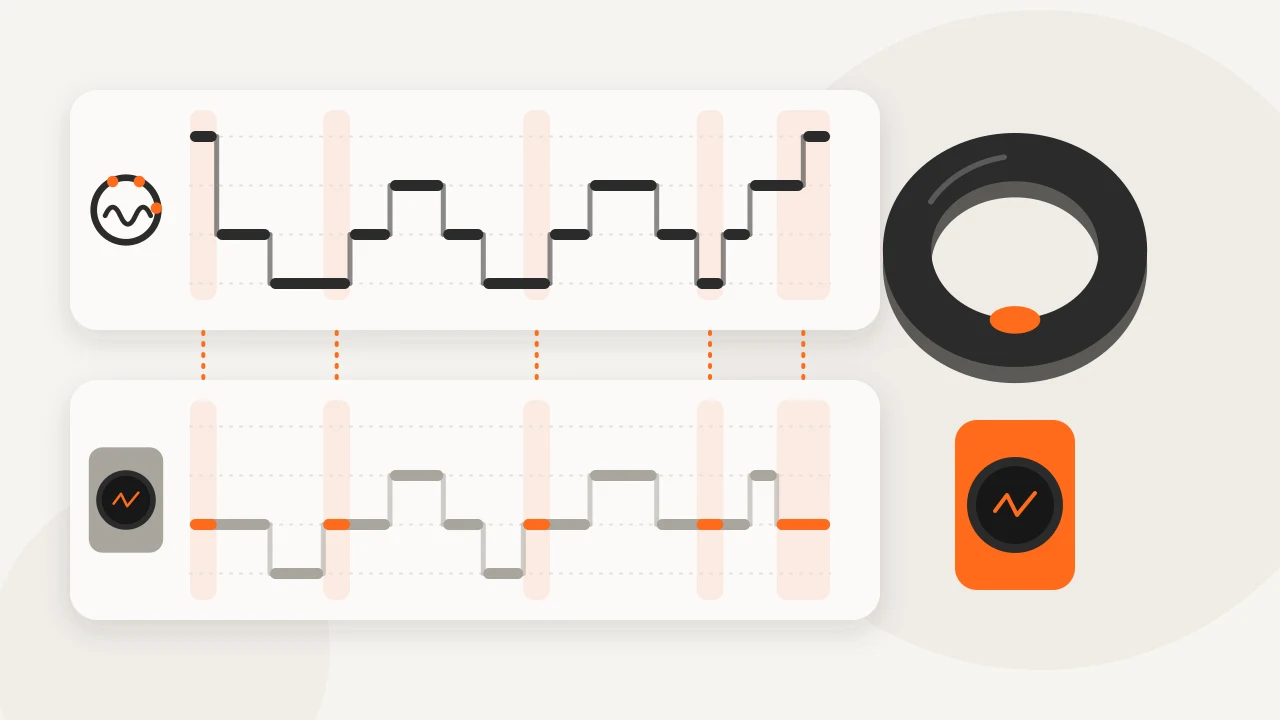
Key takeaways
- Researchers compare a tracker with polysomnography one 30-second epoch at a time, and no consumer wearable reads brain waves.
- Asleep versus awake is the strongest measure, with sensitivity usually above 90 %, while four-stage agreement is often about 50–80 % and awake time is weak.
- In one lab comparison of seven devices in 34 healthy young adults, every device had sensitivity of 0.93 or higher, but specificity ranged from 0.18 to 0.54.
- Use 7–14 day averages from one primary device, and see a doctor if you snore loudly, stop breathing in your sleep or are sleepy by day, whatever the tracker says.
Sleep trackers do not measure sleep directly. A sleep lab records brain waves, eye movements and muscle tone; a ring, watch or band senses movement and pulse (sometimes temperature) and infers sleep from them. “Accuracy” is about how good that inference is, and it is better for some questions than others.
How accuracy is measured
Researchers compare a device with polysomnography (PSG), the lab recording, one 30-second epoch at a time. Four terms come up again and again:
- Sensitivity: the share of true sleep epochs the device calls sleep.
- Specificity: the share of true wake epochs the device calls wake.
- Agreement and kappa: how often the device and the lab give the same stage, and the same figure corrected for chance.
- Bias in total sleep time: minutes over or under the lab value, usually the number people care about most.
Even PSG is not perfect, because trained scorers do not agree on every epoch, but it is the reference.
What wearables actually measure
No consumer wearable reads brain waves. Rings, watches and bands combine movement (accelerometer), a pulse signal from an optical sensor (heart rate, HRV, breathing rate) and sometimes skin temperature or blood oxygen. Algorithms trained on lab recordings turn those signals into wake, light, deep and REM. Deep sleep tends to come with a low, steady heart rate, high HRV and little movement; REM with an irregular heart rate and stillness. These are correlations, which is why lying still and awake can look like sleep.
What wearables get right and wrong
| What you see | Typical performance against a lab | How to treat it |
|---|---|---|
| Asleep vs awake | Strong: sensitivity usually above 90 % | Trust the broad picture of when you slept |
| Total sleep time | Good on average, often within tens of minutes; larger errors on poor nights | Use as a trend |
| Awake time, sleep latency, efficiency | Weak: specificity in one lab study ranged from 0.18 to 0.54 | Do not trust the exact minutes |
| Sleep stages (light, deep, REM) | Moderate: four-stage agreement often about 50–80 %, with bias that differs by device | Weekly averages, not nightly numbers |
| Overnight heart rate, HRV, breathing rate | Usually better than stages because you are still | Good for trends; see resting heart rate |
| Blood oxygen and breathing disturbances | Screening at best | Not a diagnosis |
| Sleep score | A proprietary summary | Compare a device only with itself |
In one lab comparison of seven consumer devices in 34 healthy young adults over three nights (Chinoy 2021), every device had high sensitivity (all at or above 0.93) but low-to-medium specificity (0.18–0.54), stage results were mixed, and devices did worse on nights of poor or disrupted sleep. In another one-night study of six popular wearables (Miller 2022), sleep/wake agreement with PSG was 86–89 % and multi-stage agreement 50–65 %, with kappa between about 0.2 and 0.5 for stages. A third study (Kainec 2024) found that all five devices tested overestimated wake time on nights with little waking and underestimated it on nights with a lot, so estimates squeeze toward the middle. Young, healthy lab sleepers are not everyone, and firmware changes: treat these as patterns, not guarantees.
Ring, wrist, band or mat: do device types differ?
| Type | Examples | Strengths | Weak spots |
|---|---|---|---|
| Ring | Oura | The finger gives a good pulse signal at rest; comfortable in bed; built around sleep, HRV and temperature | Needs a good fit; part of the published validation involves the maker (Altini 2021) |
| Wrist watch | Apple Watch, Garmin, Polar, COROS, Withings watches | Already on your wrist; good sleep/wake from movement; also tracks workouts | Optical signal gets noisier with a loose fit and wrist movement; the battery must last the night |
| Strap or band | WHOOP | Worn day and night; designed around recovery, HRV and resting heart rate; can be worn on the wrist or upper arm | Same optical limits as watches; scores are vendor-specific |
| Mat or bedside sensor | Withings Sleep Analyzer | Nothing to wear; senses movement and breathing | Depends on placement and may be affected by a partner in the same bed |
No class is a clear winner in independent comparisons: differences between individual models and software versions are often bigger than differences between categories. A ring study found that adding pulse- and temperature-based signals and time-of-night features lifted four-stage accuracy from 57 % (movement only) to 79 % (Altini 2021) — a useful reminder of what the extra sensors add, but a figure from the maker, so read it as a best case.
Why devices and scores disagree
Different sensors, different algorithms, different rules for when sleep starts and a wake counts, different score formulas, and updates that re-score history. The same night can read 7 h 05 min on a ring and 7 h 20 min on a watch, with deep sleep of 1 h 22 min against 0 h 48 min. See sleep scores compared for how each brand builds its number and sleep stages for what the stages mean.
How to use sleep data well
- Look at total sleep and regularity first (sleep duration, sleep efficiency); stages come second.
- Use 7–14-day averages and compare them with your personal baseline.
- Pick one primary device and wear it the same way every night.
- Rate how rested you feel before opening the app, and let a persistent mismatch with the numbers prompt a closer look.
- Treat shifts in resting heart rate, HRV or breathing rate as prompts, not as findings.
If the numbers start to cause worry, see using health data without obsession. And see a doctor about loud snoring, pauses in breathing or gasping at night, strong daytime sleepiness or lasting insomnia, however good your tracker says your sleep is. A wearable cannot diagnose sleep apnoea or insomnia, and a high score does not rule them out.
Common mistakes
- Chasing deep-sleep minutes. You cannot control them directly, and they are the least reliable stage.
- Comparing scores across brands.
- Judging one night.
- Switching devices often, which resets your baseline.
- Trusting awake minutes to the minute.
In MoveVitals
Sleep reaches MoveVitals from Oura, WHOOP, Garmin, Polar, COROS and Withings (watches and the Sleep Analyzer), with stages stored per source as minutes of light, deep, REM and awake. When two devices cover the same night, MoveVitals keeps both and shows the one you rank first in your source priorities; a conflict flag appears only when the gap exceeds that metric’s tolerance, and scores are never averaged across brands. Sleep recorded in Apple Health, for example by an Apple Watch, does not arrive through the current Strava-based route: direct Apple Health sync is planned. Strava and Suunto do not supply sleep. Each record keeps its local time zone, so nights after travel land on the right day. See the Oura guide for a ring example.
Worked example
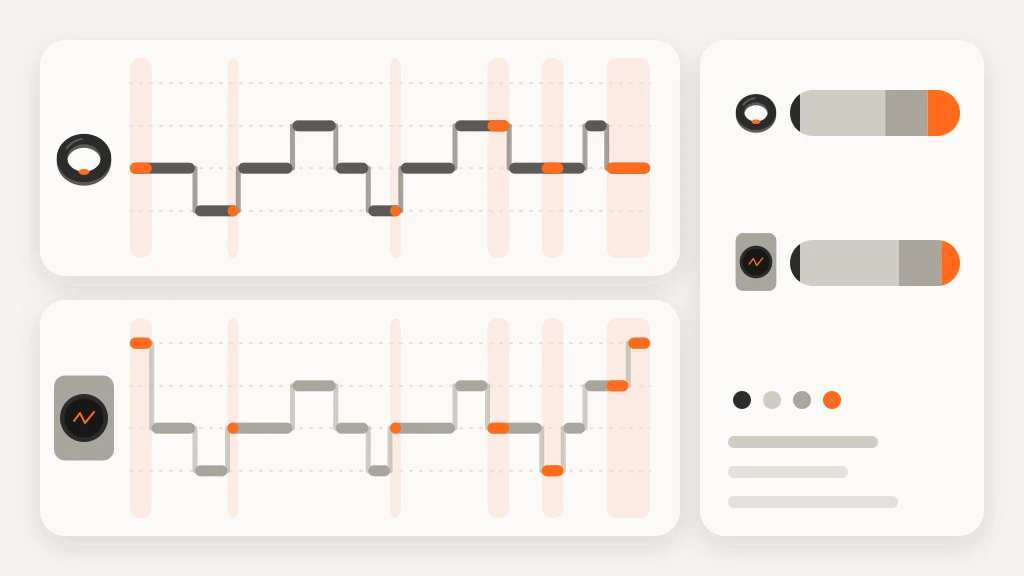
Illustrative scenario. Tomás wears a smart ring and a smartwatch. Over 14 nights the ring averages 7 h 02 min asleep and the watch 7 h 18 min, a 16-minute gap: close enough to trust the overall picture. On stages they disagree: the ring averages 1 h 22 min of deep sleep, the watch 0 h 48 min, and the ring’s nightly deep sleep ranges from 55 to 105 minutes. On Tuesday the ring says 6 h 50 min and a score of 78; the watch says 7 h 25 min and 71. Instead of picking the “right” one, he ranks the ring first for sleep and tracks the 7-day average of total sleep and bedtime. His average of 6 h 48 min, with bedtimes varying by over an hour, rises to 7 h 12 min after three weeks of going to bed at 23:00 ± 30 minutes, and both devices show the same trend even though their absolute numbers differ. He ignores nightly deep-sleep minutes and checks how rested he feels each morning. Figures are illustrative.
Action steps
- Pick one device as your main sleep source and keep wearing it the same way (fit, wrist or finger, charging routine).
- Read total sleep and bedtime regularity first; treat stage minutes and awake time as rough estimates.
- Compare 7–14-day averages with your personal baseline, not one night with another night or another brand.
- Rate how rested you feel before opening the app, and notice when feeling and data disagree.
- If you snore loudly, stop breathing in your sleep, are sleepy by day or have lasting insomnia, see a doctor whatever the tracker says.
Related guides
- Sleep stages: light, deep and REM sleep explained
- Sleep scores compared: Oura, Garmin, Polar, Withings and WHOOP
- Using health data without obsession (orthosomnia and data anxiety)
- Sleep efficiency: what percentage of time in bed you actually sleep
- Your personal baseline: why "normal for you" beats population averages
FAQ
Are sleep trackers accurate? For whether you were asleep and roughly for how long, usually yes. For awake time and for light, deep and REM stages they are only moderately accurate, so use weekly trends rather than single nights.
How accurate is Apple Watch sleep tracking? Like other wrist devices, it estimates sleep from movement and heart rate, so the general pattern applies: sleep/wake and total time are the strongest, stages moderate. Validation studies of specific models go out of date quickly with software updates, so look at your own trend. Apple Health sleep does not reach MoveVitals yet through the website.
Is deep sleep tracking accurate? Not reliably night by night. Devices can differ by tens of minutes on the same night, and the direction of the error differs by brand. Do not set a deep-sleep target; watch the trend and how you feel.
How does Oura compare with polysomnography? A study involving the ring’s maker reported about 96 % sleep/wake accuracy and 79 % across four stages against PSG in 106 people (Altini 2021). That is promising, but it comes from the maker, and independent lab tests of consumer devices find stage agreement is moderate. Treat any single figure as a best case for your own nights.
Can a tracker diagnose sleep apnoea or insomnia? No. Wearables can flag patterns, but diagnosis needs a clinician and often a sleep study. Seek medical advice for loud snoring, witnessed pauses in breathing or lasting sleepiness.
References
- Chinoy et al. (2021). Performance of seven consumer sleep-tracking devices compared with polysomnography. Sleep. https://doi.org/10.1093/sleep/zsaa291
- Miller et al. (2022). A Validation of Six Wearable Devices for Estimating Sleep, Heart Rate and Heart Rate Variability in Healthy Adults. Sensors. https://doi.org/10.3390/s22166317
- Kainec et al. (2024). Evaluating Accuracy in Five Commercial Sleep-Tracking Devices Compared to Research-Grade Actigraphy and Polysomnography. Sensors. https://doi.org/10.3390/s24020635
- Altini et al. (2021). The Promise of Sleep: A Multi-Sensor Approach for Accurate Sleep Stage Detection Using the Oura Ring. Sensors. https://doi.org/10.3390/s21134302
- de Zambotti et al. (2019). Wearable Sleep Technology in Clinical and Research Settings. Medicine & Science in Sports & Exercise. https://doi.org/10.1249/mss.0000000000001947
For general information only. This is not medical advice — talk to a qualified professional about your health.
Keep reading
Devices & setup
How MoveVitals handles multiple devices: provenance, duplicates and conflicts
5 min read
Metrics explained
Blood oxygen (SpO2): what wearables measure and when to worry
4 min read
Recovery & sleep
Sleep hygiene: evidence-based habits for better sleep
4 min read
Metrics explained
Normal heart rate variability (HRV) by age: RMSSD vs SDNN
6 min read
Metrics explained
Resting heart rate: normal ranges and what changes it
4 min read
Recovery & sleep
Alcohol, HRV and sleep: what your wearable shows the night after
3 min read