

Metrics explained
How much sleep do you need? Sleep duration and sleep debt
Total sleep time is the single most important sleep metric. Most adults need 7–9 hours; athletes in heavy training often need more.
Written by MoveVitals Editorial Collective
Community-authored educational content. Individual clinical review is identified only when a named review is actually recorded.
Editorial standards & corrections
Key takeaways
- Recommended sleep is 8–10 hours for teenagers aged 14–17, 7–8 hours for adults over 65 and 8–10 hours for athletes in hard training.
- Getting at least 7 hours of actual sleep usually means 7.5–8 hours in bed, because only time asleep counts.
- Wearables typically measure total sleep within 20–40 minutes of a lab, but they may count quiet wakefulness as sleep.
- Move bedtime earlier in 15-minute steps with a fixed wake time, and judge by a 2-week average; if you sleep enough but still feel exhausted, talk to a doctor about possible sleep disorders.
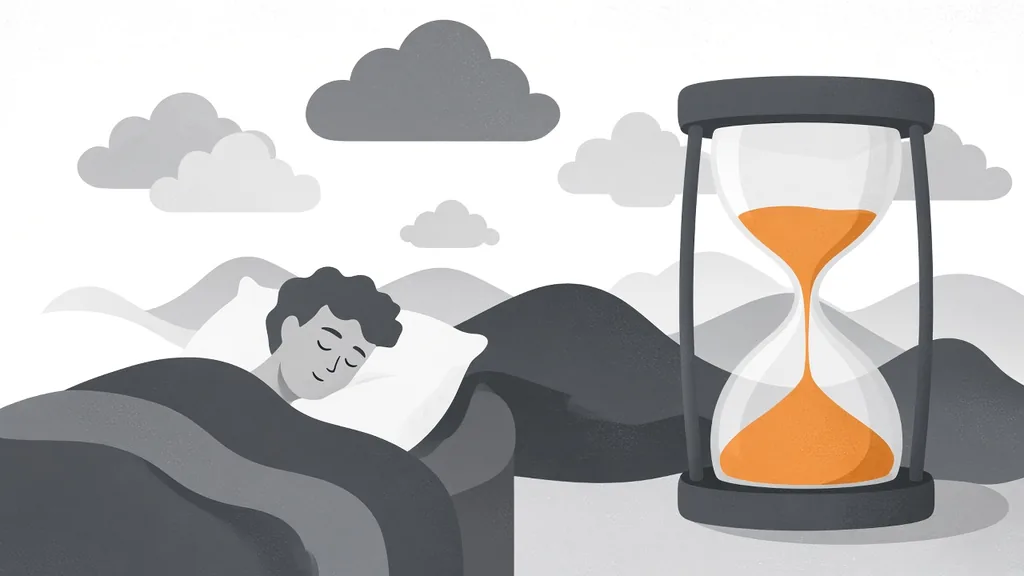
Sleep duration is the time you actually spend asleep — not time in bed. Wearables subtract periods awake, so "8 hours in bed" often becomes 7 h 10 min of sleep.
Recommended amounts
| Age | Recommended sleep per night |
|---|---|
| Teenagers (14–17) | 8–10 h |
| Adults (18–64) | 7–9 h |
| Older adults (65+) | 7–8 h |
| Athletes in hard training | 8–10 h |
Regularly sleeping under 7 hours is linked to poorer recovery, reduced performance, higher injury risk, worse mood and long-term health risks.
Sleep debt
When you sleep less than you need, the shortfall accumulates as sleep debt. Some platforms (such as WHOOP's sleep need) estimate it. A single long lie-in only partly repays debt; consistent, adequate sleep repays it best. Naps of 20–30 minutes can help — see napping.
How to get more sleep
- Fix your wake time first, then move bedtime earlier.
- Keep the bedroom dark, quiet and cool (around 16–19 °C).
- Avoid caffeine in the 8 hours before bed — see caffeine timing.
- Limit alcohol; it shortens and fragments sleep.
- Wind down for 30–60 minutes without bright screens.
- Get daylight in the morning to anchor your body clock.
More in sleep hygiene.
Reading the data
Wearables are good at measuring total sleep time (typically within 20–40 minutes of a lab), but they may count quiet wakefulness as sleep. Look at weekly averages and your sleep consistency rather than a single night.
In MoveVitals
Sleep duration from every device is stored per night and source; your priority settings decide which value appears on the dashboard when devices disagree.
Worked example
Illustrative scenario. Ana is in bed from 23:15 to 06:30 (7 h 15 min), but her tracker shows about 6 h 35 min asleep. Over a 5-day work week that is roughly 2 hours below the 7-hour minimum recommended for adults. She moves her bedtime 15 minutes earlier every three days until lights-out is 22:30, keeping the same wake time. After three weeks her average sleep is about 7 h 20 min, and her afternoon slump eases. She doesn't try to repay the deficit with a 10-hour weekend sleep, which would disrupt her rhythm. The numbers are illustrative.
Action steps
- Aim for at least 7 hours of actual sleep, which usually means 7.5–8 hours in bed.
- Use your 2-week average, not one night, to judge whether you're short.
- Move bedtime earlier in 15-minute steps while keeping wake time fixed.
- Protect sleep during heavy training blocks and travel — needs often rise.
- If you sleep enough but still feel exhausted, talk to a doctor about possible sleep disorders.
Related guides
- Sleep consistency: why a regular schedule beats a long lie-in
- Sleep efficiency: what percentage of time in bed you actually sleep
- Napping for athletes: how long, when and does it count?
- Sleep scores compared: Oura, Garmin, Polar, Withings and WHOOP
FAQ
Is 6 hours enough if I feel fine? A small number of people need less, but many underestimate how impaired they are. Try a week at 7.5–8 hours and compare.
Does time in bed count? No — only time asleep.
Can I catch up on sleep at the weekend? Partly, for short-term deficits, but large lie-ins shift your body clock. Regular sufficient sleep is better.
Do athletes need more sleep? Many athletes benefit from 8+ hours, especially in heavy training; sleep loss has been linked with higher injury risk in young athletes.
Does a nap count toward my total? Most devices add naps to daily sleep; it helps total sleep but doesn't fully replace night-time sleep.
References
- Hirshkowitz et al. (2015). National Sleep Foundation’s updated sleep duration recommendations: final report. Sleep Health. https://doi.org/10.1016/j.sleh.2015.10.004
- Watson et al. (2015). Recommended Amount of Sleep for a Healthy Adult: A Joint Consensus Statement of the American Academy of Sleep Medicine and Sleep Research Society. Journal of Clinical Sleep Medicine. https://doi.org/10.5664/jcsm.4758
- Milewski et al. (2014). Chronic Lack of Sleep is Associated With Increased Sports Injuries in Adolescent Athletes. Journal of Pediatric Orthopaedics. https://doi.org/10.1097/bpo.0000000000000151
For general information only. This is not medical advice — talk to a qualified professional about your health.
Keep reading
Metrics explained
Resting heart rate: normal ranges and what changes it
4 min read
Devices & setup
How MoveVitals handles multiple devices: provenance, duplicates and conflicts
5 min read
Metrics explained
Normal heart rate variability (HRV) by age: RMSSD vs SDNN
6 min read
Recovery & sleep
Sleep hygiene: evidence-based habits for better sleep
4 min read
Metrics explained
Blood oxygen (SpO2): what wearables measure and when to worry
4 min read
Metrics explained
VO2 max: what it means and how to improve it
4 min read