

Key takeaway
Among 60,977 UK Biobank adults who wore a wrist accelerometer for a week, the most regular fifth of sleepers had a fully adjusted all-cause mortality HR of 0.70 (95% CI 0.59–0.83) against the least regular fifth, over about 6.3 years and 1859 deaths. Regularity fitted the data better than sleep duration, but the study is observational and rests on one week of sleep data.
Study design
Cohort study
Reading basis
Full text
Reading focus
Association & confounding
The research question
Short and long sleep have been tied to earlier death, and sleep health guidelines concentrate on getting the right number of hours. Newer work suggests that sleep regularity, the day-to-day consistency of sleep and wake times, can predict some health outcomes better than duration, and irregular sleepers are exposed to irregular light, activity and meals, which is thought to disrupt circadian rhythms. Self-reported irregularity had been linked to mortality, but it had not been tested prospectively in a large cohort with objective sleep data, and nobody knew which mattered more. The authors set out to test whether the Sleep Regularity Index (SRI), scored 100 for perfectly regular sleep–wake patterns and zero for random ones, predicts death from any cause, from cardiometabolic disease and from cancer, and whether it predicts better than sleep duration.
Who and how
This was a prospective cohort study in the UK Biobank, which recruited about 502,000 people aged 40 to 69 in 2006–2010. Of these, 103,669 wore a tri-axial Axivity AX3 accelerometer on the dominant wrist for 7 days of free-living life in 2013–2016. Sleep and wake were estimated for each epoch with the open-source GGIR package, and the SRI was the average agreement in sleep–wake state between all pairs of time points 24 hours apart, calculated with the authors’ sleepreg package so that naps, fragmented sleep and non-wear were handled. A valid score needed at least 120 hours (5 days) of such pairs. The analysis covered 60,977 people with valid scores (62.8 ± 7.8 years, 55.0% female, 97.2% white; median SRI 81.0, IQR 73.8–86.3). Sleep duration came from sustained inactivity between estimated sleep onset and offset, averaged over the same days (mean 6.77 ± 1.00 hours).
Deaths came from NHS Digital (England) and the NHS Central Register (Scotland), including primary cause of death coded in ICD-10, from June 2013 to March 2021: 1859 deaths from any cause (4.84 per 1000 person-years), 377 cardiometabolic and 1092 from cancer, over a mean follow-up of 6.30 ± 0.83 years. SRI and sleep duration were each split into quintiles (fifths), and the top four were compared with the lowest, which allows non-linear patterns. Cox proportional hazards models used time since recording as the timescale, with competing-risks models for cause-specific deaths. Three models were run: SRI alone, duration alone, and both. Each was minimally adjusted (age, sex, ethnicity; 60,780 people) or fully adjusted (adding physical activity, employment, income, deprivation, social activity, smoking, urban residence, shift work and cholesterol or blood pressure medication; 46,721 people). Akaike Information Criterion compared the SRI-only and duration-only models, a likelihood ratio test compared models with and without duration, and further adjustments for mid-sleep timing, existing disease, BMI, cholesterol ratio and mood were added one at a time.
What it found
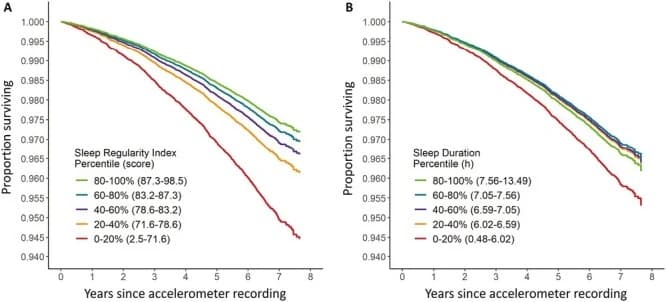
- 1Higher sleep regularity went with lower all-cause mortality in a stepwise way. The most regular fifth had an HR of 0.70 (95% CI 0.59–0.83, P < 0.001) versus the least regular fifth in the fully adjusted model, and 0.52 (0.45–0.60, P < 0.001) in the minimally adjusted one, with deaths of 288 (0.47%) against 565 (0.93%) in the minimal model. Fully adjusted HRs fell with each fifth: 0.80 (0.69–0.93), 0.75 (0.64–0.88), 0.72 (0.61–0.84) and 0.70.
- 2Sleep duration showed a weaker pattern. In the minimally adjusted model it was U-shaped, with the lowest risk in the 60th to 80th percentile (HR 0.69, 95% CI 0.60–0.80) and a higher HR of 0.78 (0.68–0.89) in the longest fifth; fully adjusted, the trend was roughly linear, reaching 0.76 (0.65–0.89) in the longest fifth. The longest fifth slept more than 7.56 hours, not an extreme length, so the study could not test very long sleep.
- 3Head to head, regularity was the better predictor, but the margin depends on the test. SRI models fitted all-cause mortality better than equivalent duration models (Akaike comparison P < 0.001 minimal, P = 0.005 fully adjusted), and adding duration to SRI models did not improve fit (minimal χ²(4) = 6.88, P = 0.14; fully adjusted 5.94, P = 0.20). Fully adjusted, the best HRs (0.70 versus 0.76) have overlapping confidence intervals. With both in the model, the top SRI fifth was still 0.54 (0.47–0.63) minimal and 0.74 (0.62–0.89) fully adjusted, and duration kept a smaller role (0.84, 0.71–0.99 for the 80th to 100th percentile).
- 4Regularity predicted cancer deaths while duration did not. For cancer, the best SRI HRs were 0.61 (0.50–0.73) minimal and 0.76 (0.61–0.94) fully adjusted; duration was not a significant predictor. The relationship held in people without a prior cancer diagnosis, according to the authors.
- 5For cardiometabolic death, both mattered, and the two overlapped. The best HRs were 0.43 (0.31–0.60) minimal and 0.62 (0.42–0.91) fully adjusted for SRI, and 0.49 (0.35–0.67) and 0.56 (0.39–0.80) for duration. In fully adjusted models containing both, SRI was no longer a significant predictor of cardiometabolic mortality, though it stayed significant for cancer and other-cause deaths. For deaths from other causes, SRI alone gave a best HR of 0.39 (0.29–0.55) minimal and 0.60 (0.41–0.88) fully adjusted.
- 6The result held after extra adjustment for mid-sleep timing, pre-existing cancer, diabetes, vascular conditions, BMI, cholesterol ratio and mood symptoms, with and without duration. Regularity and duration were only weakly related (adjusted R² 0.125 for the best, cubic, fit): longer sleep went with higher SRI up to 7.83 hours (SRI 81.76) and lower SRI beyond. The authors describe the top fifth of SRI as going to sleep and waking within about 1-hour windows on most days, against about 3-hour windows in the bottom fifth.
Limits & uncertainty
- 1The authors note that a single week of accelerometer data is only a snapshot of anyone’s sleep and does not capture multiple weekend–weekday transitions, and that covariates were collected in 2006–2010, years before the 2013–2016 recording, so some may have changed.
- 2The authors note that their fully adjusted models include variables, such as smoking, that may be both confounders and mediators, so the true strength of the link likely lies between the minimally and fully adjusted results. They also stress that the findings are correlational and that sleep regularity may be both a cause and a marker of premature mortality risk.
- 3The authors note that the participants are older and mostly of homogeneous ethnicity (97.2% white), so the findings need replicating in other cohorts and across cultures.
- 4Our observation: only 60,977 of the 103,669 people who wore a device had valid scores, and the fully adjusted models used 46,721, so the results come from a selected subset of a volunteer cohort. Follow-up was about 6 years, so early illness could already be making sleep irregular for some people.
- 5Our observation: ‘stronger predictor’ rests on model fit and quintile hazard ratios whose confidence intervals overlap once fully adjusted, not on a direct test that the two effects differ. Duration was also inferred from wrist inactivity, which cannot by itself separate lying awake from sleeping, so duration may be measured less well than regularity.
What to take from it
Seeing sleep as more than hours is reasonable: in this cohort, people whose sleep and wake times stayed within about an hour of each other did better on mortality than those whose times drifted across about three hours. That is easier to act on than adding sleep, and worth trying for its own sake. It does not mean short sleep is harmless when it is regular, since duration still predicted cardiometabolic deaths, and the model with both showed duration retained some independent signal.
The study cannot show that making your sleep more regular will lengthen your life. People with undiagnosed illness may have irregular sleep because of it, which is why the authors call regularity possibly both a cause and a marker, and hazard ratios from a single week of recording describe groups, not you. Certainty is moderate that the association is real and low that changing regularity would change survival.
Reading your own data
Use at least a week of bedtime and wake times from your wearable, and look at how widely they spread rather than the average; the study needed at least 5 valid days. A consumer ‘consistency’ or ‘regularity’ score may not be the SRI, which compares your asleep or awake state at every moment with the same moment 24 hours earlier and so counts naps and night-time awakenings; stick to one device and follow your own trend. A travel week, night shifts or a late weekend will pull the score down, so judge several weeks together, and do not read it as a prediction of how long you will live.
How to read this evidence
Exposure precedes follow-up outcomes, but confounding and reverse causation can remain. A hazard ratio is not an individual absolute risk or a demonstrated intervention effect.
Sources & attribution
Sleep regularity is a stronger predictor of mortality risk than sleep duration: A prospective cohort study
Sleep · 2024-01-11
DOI: 10.1093/sleep/zsad253 ↗PubMed · 37738616 ↗MoveVitals editorial interpretation · educational content · no individual clinical review recorded
Sources checked 2026-11-01
Practical guides
Read in context
Exercise improved sleep-quality scores in adults 45 and older with sleep disorders
Pooling 23 randomized trials with 1,478 adults aged 45 to 77 who had sleep disorders, exercise improved Pittsburgh Sleep Quality Index scores (SMD 0.62, 95% CI 0.40–0.83), and aerobic exercise showed the largest effect in the network analysis (SMD 1.34, 95% CrI 0.86–1.82). Certainty was low to moderate, the outcomes were questionnaires, and the best weekly dose of about 539 MET-min/week is a model estimate, not a prescription.
Journal of Exercise Science & Fitness
Sleep extension cut daily energy intake by about 270 kcal in adults with overweight
In 80 adults with overweight who usually slept under 6.5 hours, two weeks of sleep-extension counselling added about 1.2 hours of sleep and lowered measured energy intake by 270.4 kcal/d versus control (95% CI −393.4 to −147.4). The trial was short, single-centre and in a narrow group, so it does not show lasting weight loss or any benefit for people who already sleep enough.
JAMA Internal Medicine
Six hours or less of sleep at 50 and 60 linked to higher dementia risk
In 7959 British civil servants followed for about 25 years, sleeping six hours or less at age 50 (HR 1.22, 95% CI 1.01–1.48) or age 60 (HR 1.37, 1.10–1.72) was linked to a higher dementia rate than sleeping seven hours, and persistent short sleep gave an HR of 1.30 (1.00–1.69). Sleep was mostly self-reported and the study is observational, so early brain disease or other factors may explain part of the link.
Nature Communications
Students with irregular sleep had later melatonin timing and lower grades
Among 61 Harvard undergraduates tracked for about 30 days, the most irregular sleepers had melatonin onset at 00:08 versus 21:32 in the most regular sleepers (p < 0.003), and sleep regularity correlated with grade point average (r = 0.37, p < 0.004). The sample was small and the design observational, so the data cannot show that irregular sleep lowers grades or shifts the body clock.
Scientific Reports