

Metrics explained
Sleep consistency: why a regular schedule beats a long lie-in
Sleep consistency measures how similar your bed and wake times are from day to day. Research increasingly shows regularity matters almost as much as duration.
Written by MoveVitals Editorial Collective
Community-authored educational content. Individual clinical review is identified only when a named review is actually recorded.
Editorial standards & corrections
Key takeaways
- Good sleep consistency targets are wake time within ±30 minutes every day, bedtime within ±45 minutes and a weekend shift under 1 hour.
- Social jet lag is the difference between your sleep timing on work days and free days, and an extra 30–60 minutes at the weekend is fine.
- Large studies link irregular sleep with poorer metabolic health, mood and cardiovascular risk, independent of total sleep time.
- Anchor your wake time 7 days a week, get outdoor light within an hour of waking, and change your schedule gradually, by 15–30 minutes every few days.
Sleep consistency (WHOOP calls it sleep consistency, others use "sleep regularity") compares when you fall asleep and wake up across days. Going to bed at 23:00 on weekdays and 02:00 on Saturday creates "social jet lag" — your body clock is pulled back and forth like a weekly trip across time zones.
Why regularity matters
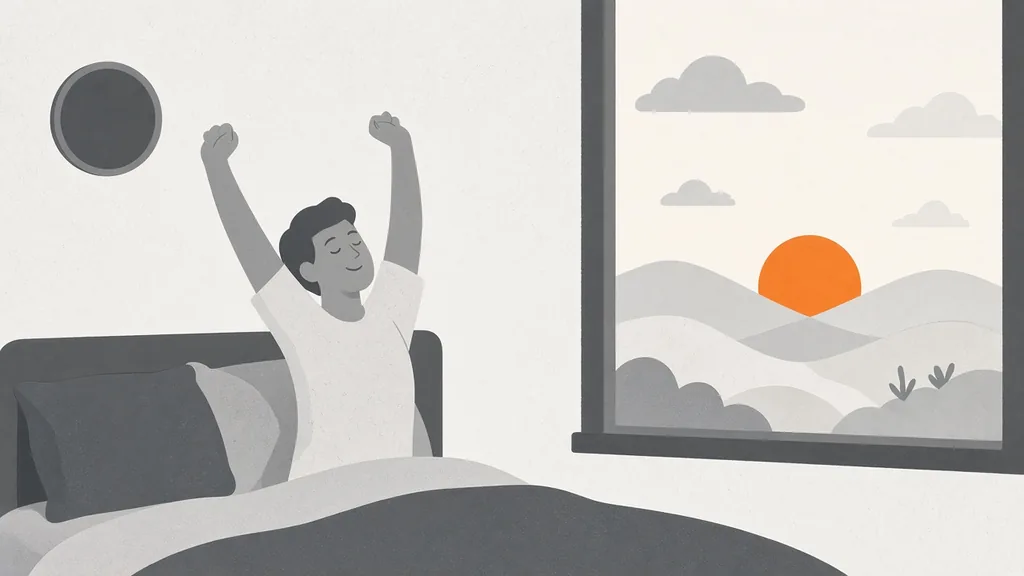
- Your circadian rhythm controls hormone release, body temperature and alertness. A stable schedule keeps these signals aligned with your sleep.
- Large studies link irregular sleep with poorer metabolic health, mood and cardiovascular risk, independent of total sleep time.
- Consistent timing tends to improve sleep efficiency and makes falling asleep easier.
Targets
| Measure | Good target |
|---|---|
| Variation in wake time | within ±30 minutes every day |
| Variation in bedtime | within ±45 minutes |
| Weekend shift (social jet lag) | under 1 hour |
How to improve it
- Anchor your wake time — set it 7 days a week. Bedtime follows naturally.
- Get morning daylight within an hour of waking.
- Keep meals and exercise at roughly regular times.
- If you need to recover sleep, prefer an early night or a short nap over sleeping in for hours.
- For shift work or travel, see jet lag and travel.
In MoveVitals
MoveVitals keeps the bedtime and wake time from each night's sleep record, so you can see your regularity across devices — including nights when you switched from ring to watch.
Worked example
Illustrative scenario. Sam sleeps about 7.5 hours on average, but on weekdays he sleeps 23:30–06:45 and on weekends 01:30–10:00. That is a ~2.5-hour shift in sleep midpoint — similar to flying across two time zones every weekend. His Monday HRV tends to be the lowest of the week. He sets a rule: bedtime within 45 minutes of 23:30 every night, and wake-up no later than 08:00 on weekends, with a 20-minute nap if needed. After four weeks his midpoint shift is under an hour, his device's consistency score rises, and Mondays feel less groggy. These figures are illustrative.
Action steps
- Pick a fixed wake-up time and keep it within about 30–60 minutes every day, including weekends.
- Get outdoor light within an hour of waking to anchor your body clock.
- If you're short on sleep, use a short early-afternoon nap rather than a long lie-in.
- Track your sleep midpoint, not just total hours.
- Change your schedule gradually, by 15–30 minutes every few days.
Related guides
- How much sleep do you need? Sleep duration and sleep debt
- Sleep hygiene: evidence-based habits for better sleep
- Jet lag and travel: protecting sleep and performance
- Napping for athletes: how long, when and does it count?
FAQ
Is a lie-in at the weekend bad? An extra 30–60 minutes is fine. Several hours shifts your clock and makes Monday harder.
Does consistency matter if I sleep 8 hours anyway? Yes — regularity has effects of its own.
What is social jet lag? The difference between your sleep timing on work days and free days. Large differences are linked with poorer sleep and daytime functioning.
Does shift work make consistency impossible? It makes it harder. Keeping the same schedule across consecutive shifts and using dark, quiet sleep conditions still helps.
References
- Windred et al. (2024). Sleep regularity is a stronger predictor of mortality risk than sleep duration: A prospective cohort study. SLEEP. https://doi.org/10.1093/sleep/zsad253
- Irish et al. (2015). The role of sleep hygiene in promoting public health: A review of empirical evidence. Sleep Medicine Reviews. https://doi.org/10.1016/j.smrv.2014.10.001
- Watson et al. (2015). Recommended Amount of Sleep for a Healthy Adult: A Joint Consensus Statement of the American Academy of Sleep Medicine and Sleep Research Society. Journal of Clinical Sleep Medicine. https://doi.org/10.5664/jcsm.4758
For general information only. This is not medical advice — talk to a qualified professional about your health.
Keep reading
Devices & setup
How MoveVitals handles multiple devices: provenance, duplicates and conflicts
5 min read
Recovery & sleep
Sleep hygiene: evidence-based habits for better sleep
4 min read
Metrics explained
Normal heart rate variability (HRV) by age: RMSSD vs SDNN
6 min read
Metrics explained
Resting heart rate: normal ranges and what changes it
4 min read
Recovery & sleep
Alcohol, HRV and sleep: what your wearable shows the night after
3 min read
Metrics explained
Blood oxygen (SpO2): what wearables measure and when to worry
4 min read