

Recovery & sleep
Jet lag and travel: protecting sleep and performance
Crossing time zones misaligns your body clock with local time. Light timing, sleep strategy and sensible training help you adapt faster.
Written by MoveVitals Editorial Collective
Community-authored educational content. Individual clinical review is identified only when a named review is actually recorded.
Editorial standards & corrections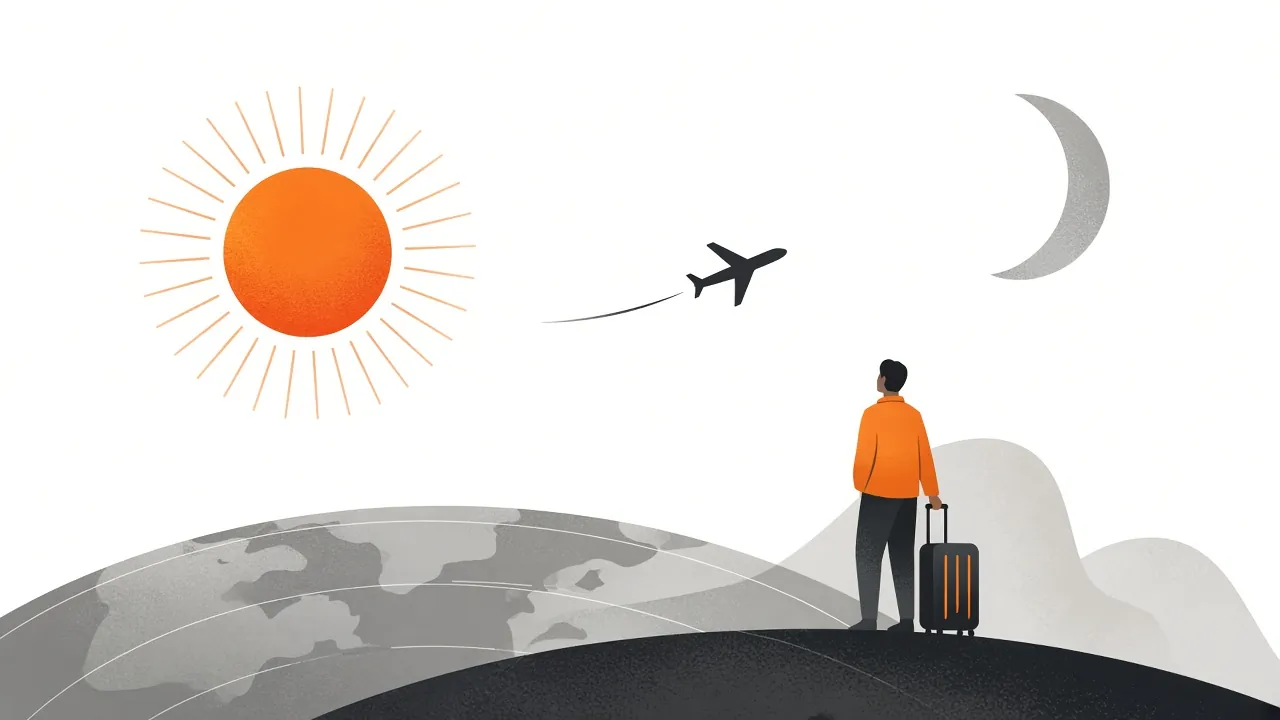
Key takeaways
- Adapting to a new time zone takes roughly one day per time zone crossed, and low recovery or readiness scores can last 1–4 days.
- Flying east, seek morning light and avoid evening light; flying west, seek evening light and avoid early morning light.
- Before an important trip, shift sleep gradually by 30–60 minutes a day for 2–3 days, and for trips of 1–2 days consider staying on home time.
- Avoid very hard sessions for the first 1–2 days after a long-haul flight; for races, arrive about one day early per time zone.
- Melatonin at 0.5–3 mg at local bedtime can help eastward travel, but check with a doctor first.
How long does adaptation take?
Roughly one day per time zone crossed. Flying east (shortening the day) is usually harder than flying west.
What you'll see in your data
- Shorter, fragmented sleep and lower sleep scores
- Lower HRV, higher resting heart rate
- Low recovery or readiness for 1–4 days
- Note: wearables may assign sleep to the wrong day around time-zone changes; MoveVitals stores each record in its local time zone to keep days correct
Light is the main lever
| Direction | Seek light | Avoid light |
|---|---|---|
| Flying east | Morning (local) | Evening |
| Flying west | Evening (local) | Early morning |
For trips of 1–2 days, consider staying on home time instead.
Other strategies
- Shift gradually before travel: 30–60 minutes per day for 2–3 days.
- On the plane: set your watch to destination time; sleep or stay awake accordingly; hydrate and limit alcohol.
- Melatonin: 0.5–3 mg at local bedtime can help eastward travel (check with a doctor).
- Caffeine in the local morning, not the afternoon — see caffeine timing.
- Short naps (≤ 30 min) before mid-afternoon — see napping.
Training while travelling
- Easy outdoor sessions in daylight help reset your clock.
- Avoid very hard sessions for the first 1–2 days after long-haul flights.
- For races, arrive early: about one day per time zone for important events.
Worked example
Illustrative scenario. Ryo flies from Tokyo to London, 8 hours west (time zones vary seasonally). A common rule of thumb is that the body clock adjusts by about 1 hour per day, faster westward than eastward (Waterhouse 2007). On arrival he gets outdoor light in the late afternoon, stays awake until 22:00 local time and keeps his first two runs easy. His HRV is 15% below baseline for 3 days and resting heart rate is 5 bpm higher, so he moves his key session to day 4.
Action steps
- Shift sleep 1 hour toward the destination for a few days before an important trip.
- Seek daylight at the right local time after arrival.
- Keep caffeine to the local morning.
- Train easy for the first 1–3 days and judge by HRV and how you feel.
- Schedule key sessions or races after a few days of adjustment if possible.
Related guides
- Sleep consistency: why a regular schedule beats a long lie-in
- Caffeine: performance benefits and how timing affects sleep
- Normal heart rate variability (HRV) by age: RMSSD vs SDNN
- Sleep hygiene: evidence-based habits for better sleep
FAQ
Is jet lag worse with age? Many people find adaptation slows with age.
Does fasting help? Some evidence suggests adjusting meal timing to the new zone helps; it's a minor factor compared with light.
Does melatonin help jet lag? Low-dose melatonin taken at local bedtime may help some travellers, especially eastward; check with a doctor or pharmacist first, as rules and suitability vary.
Should I nap on arrival? A short nap under 30 minutes early in the afternoon is usually fine; long naps can delay adjustment.
References
- Waterhouse et al. (2007). Jet lag: trends and coping strategies. The Lancet. https://doi.org/10.1016/s0140-6736%2807%2960529-7
- Chinoy et al. (2021). Performance of seven consumer sleep-tracking devices compared with polysomnography. Sleep. https://doi.org/10.1093/sleep/zsaa291
- Windred et al. (2024). Sleep regularity is a stronger predictor of mortality risk than sleep duration: A prospective cohort study. SLEEP. https://doi.org/10.1093/sleep/zsad253
For general information only. This is not medical advice — talk to a qualified professional about your health.
Keep reading
Recovery & sleep
Overreaching and overtraining: warning signs and what to do
4 min read
Devices & setup
WHOOP and MoveVitals: what syncs and how to get the most from it
3 min read
Metrics explained
Normal heart rate variability (HRV) by age: RMSSD vs SDNN
6 min read
Recovery & sleep
Alcohol, HRV and sleep: what your wearable shows the night after
3 min read
Devices & setup
How MoveVitals handles multiple devices: provenance, duplicates and conflicts
5 min read
Recovery & sleep
Your personal baseline: why "normal for you" beats population averages
4 min read