

Sports
Japanese interval walking: the 3-minute fast / 3-minute slow method, step by step
Japanese interval walking alternates 3 minutes of fast walking with 3 minutes of easy walking, for about 30 minutes, on at least four days a week. This guide explains the method as it was tested at Shinshu University, how to run it with a watch, and what the evidence does not show.
Written by MoveVitals Editorial Collective
Community-authored educational content. Individual clinical review is identified only when a named review is actually recorded.
Editorial standards & corrections
Key takeaways
- Fast blocks target about 70% of heart rate reserve, roughly 80% of max heart rate and effort 6–7 out of 10, and slow blocks about 40% of reserve; five fast blocks add up to 15 minutes a day.
- In the 2007 trial of 246 adults with a mean age of 63, fewer than half of the interval group met the targets, so the results describe people who managed them.
- Evidence comes mostly from middle-aged and older adults in Japan, the 2019 study had no control group, and fat-loss claims on social media go beyond the data.
- Build over six weeks from 3 rounds on 3 days a week to 5 rounds on 4 or more days, and check with a doctor first if you have heart or lung disease or uncontrolled high blood pressure.
The method behind the "Japanese walking" trend, interval walking training (IWT), was developed by Hiroshi Nose and colleagues at Shinshu University in Matsumoto, Japan.
The method in one minute
- Optionally warm up with 3–5 minutes of easy walking.
- Walk fast for 3 minutes: a pace at which you can say only a few words at a time.
- Walk slowly for 3 minutes: relaxed, in full sentences.
- Repeat for 5 or more rounds (30 minutes or more).
- Do it on 4 or more days a week.
| Segment | Original target | Practical stand-in (heart rate reserve) | Effort (0–10) | Talk test |
|---|---|---|---|---|
| Slow | about 40% of peak aerobic capacity | about 40% of reserve (roughly 60–65% of max HR) | 2–3 | Full sentences |
| Fast | 70% or more | 70% of reserve or more (roughly 80% of max HR) | 6–7 | A few words at a time |
Five fast blocks add up to 15 minutes of fast walking a day, which on four days is about 60 minutes a week.
Japanese walking benefits: what the research shows
| Study | Who | What was tested | Main finding |
|---|---|---|---|
| Nemoto et al., 2007 | 246 adults, mean age 63, randomised | 5 months: interval walking vs moderate continuous walking vs no training | Interval group: knee extension strength +13%, flexion +17%, peak aerobic capacity +8–9%, and a larger fall in resting systolic blood pressure; all greater than with continuous walking |
| Masuki et al., 2019 | 679 adults, mean age 65, one group, no control | 5 months of interval walking | Estimated peak aerobic capacity +14%, lifestyle-disease score −17%; gains rose with fast-walking time up to about 50 min/week, then levelled off; gains were not positively linked to slow or total walking time |
| Karstoft et al., 2013 | 32 adults with type 2 diabetes (Denmark) | 4 months: interval vs energy-matched continuous walking, 5 × 60 min a week | Interval group improved fitness, body composition and glucose control; continuous walking did not |
The thread running through the data is that the fast minutes carry the benefit, which fits what interval training research shows more broadly.
What the evidence does not show
- It is mostly middle-aged and older adults in Japan, plus one small trial in Denmark; results may not transfer to young or already fit people.
- Adherence was uneven: in the 2007 trial, fewer than half of the interval group met the targets (11 of 19 men and 31 of 68 women), so the results describe people who managed it.
- The 2019 study had no control group. It shows that more fast walking went with bigger gains, not that fast walking caused them.
- No trial compared it head to head with other equally hard exercise such as hill walking, cycling or HIIT. The benefit probably comes from the intensity, not from anything specific to Japan.
- Fat-loss claims on social media go beyond the data. The main trials measured fitness, strength and blood pressure; a body-composition effect appeared only in the small diabetes trial.
It suits older adults and people returning to exercise, because it needs no equipment and is low-impact. Ask a doctor first if you have heart or lung disease, uncontrolled high blood pressure or symptoms on exertion, and stop and seek care for chest pain or pressure, fainting, or palpitations with dizziness.
Japanese interval walking heart rate: how to run it with a watch
- Set targets. The original trials set intensity from each person's measured peak aerobic capacity and tracked it with an accelerometer; heart rate and effort are practical stand-ins, not the same thing. Heart rate reserve target = resting HR + fraction × (max HR − resting HR), with a fraction of 0.40 for slow and 0.70 for fast. Estimated maximums are rough (maximum heart rate).
- Build the workout. Most modern sports watches can run a repeating timed workout with alerts (3:00 fast, 3:00 easy, repeat 5 times); otherwise use a phone interval timer.
- Lead with effort, check with heart rate. Heart rate takes a minute or two to respond (heart rate zones), so in a 3-minute fast block it may only reach the target near the end. Read it in the last 30 seconds and steer by RPE.
- Consider a chest strap for the first sessions if wrist readings seem laggy.
- Hills work too. Fast uphill and slow on the flat gives the same alternation on a treadmill incline or a rolling route.
A gentle 6-week build-up, and common mistakes
| Weeks | Days per week | Rounds (3 + 3 min) | Session |
|---|---|---|---|
| 1–2 | 3 | 3 | 18 min |
| 3–4 | 4 | 4 | 24 min |
| 5–6 | 4–5 | 5 | 30 min |
This ramp is a practical suggestion, not taken from the studies. Keep at least one day a week free of fast blocks.
Common mistakes: letting the fast blocks drift into a medium stroll (the fast minutes drive the gains), going so fast you break into a jog, skipping the slow blocks, judging heart rate at the start of a block, and ignoring knee or hip pain.
In MoveVitals
Walks recorded by Garmin, Polar, COROS or Suunto watches arrive as workouts with duration, distance and heart rate, and Apple Watch walks arrive through Strava. If your watch records each block as a lap, Strava and Suunto workouts bring lap splits into MoveVitals, so you can compare fast and slow segments. Time in zone is calculated from the heart rate stream, so you can check that slow blocks sit in zone 1–2 and fast blocks reach zone 3–4. If you track blood pressure at home, compare the trend over 4–8 weeks, not single readings.
Worked example
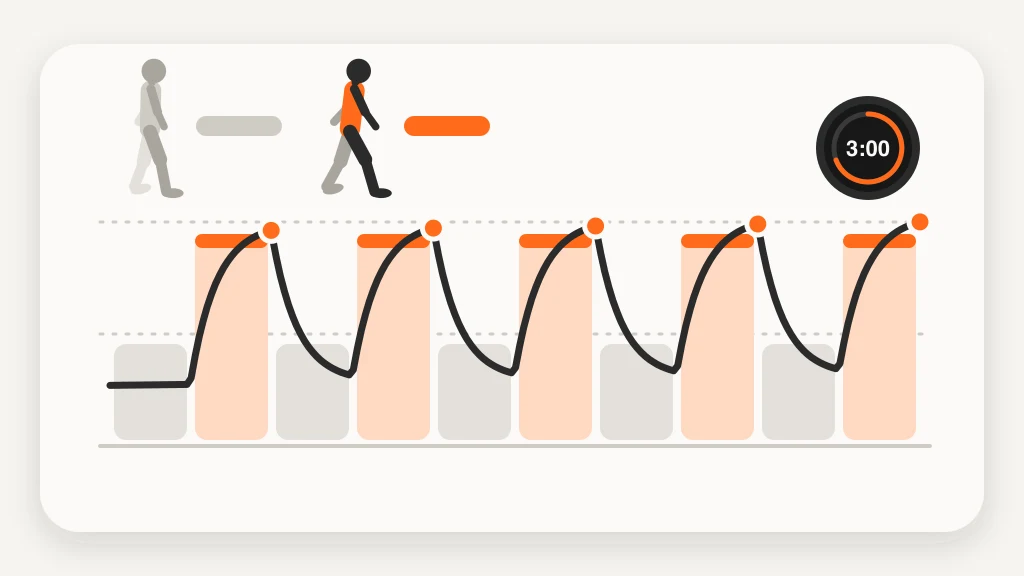
Illustrative scenario. Tom, 62, has an estimated maximum heart rate of about 158 bpm (220 − age, a rough guess) and a resting heart rate of 66, a reserve of 92. His fast target is 66 + 0.70 × 92 ≈ 130 bpm and his slow target 66 + 0.40 × 92 ≈ 103 bpm. After the six-week build-up, his watch workout is 5 minutes easy, 5 × (3 minutes slow + 3 minutes fast), then 3 minutes easy, four days a week, at roughly 4 km/h and 6 km/h. His heart rate reaches about 125–135 by the end of each fast block (effort 6–7) and settles to 100–108 in the slow blocks. That is 15 minutes of fast walking a day, 60 a week, close to the roughly 50 minutes a week beyond which gains levelled off in the large cohort. After eight weeks he holds the fast pace at a heart rate about 5 bpm lower and keeps an eye on his home blood pressure trend. Figures are illustrative.
Action steps
- Check with a doctor first if you have heart or lung disease, uncontrolled high blood pressure or symptoms when you exert yourself.
- Set your targets: slow at about 40% and fast at about 70% of heart rate reserve, or effort 3 and effort 6–7 out of 10.
- Program the watch or phone timer for 3 minutes slow and 3 minutes fast, starting with 3 rounds.
- Build over six weeks to 5 rounds on 4 or more days a week.
- Re-check every 4–6 weeks: pace at the same heart rate, resting heart rate and, if you measure it, blood pressure trend.
Related guides
- Walking for fitness and weight loss: pace, heart rate zones and how much is enough
- Heart rate zones explained: how to set and use them
- RPE (rate of perceived exertion): the sensor you always carry
- Interval training and HIIT: designing sessions that work
- VO2 max: what it means and how to improve it
- Incline walking and the 12-3-30 workout: benefits, heart rate and calories
FAQ
Does Japanese walking help you lose weight? It is mainly a fitness protocol. The main trials found gains in aerobic fitness, leg strength and blood pressure, and one small trial in type 2 diabetes saw body-composition changes. Energy use is similar to steady walking at the same average effort, and weight depends on overall energy balance (walking for fitness).
Do I need 30 minutes and four days a week? That is what the studies prescribed, and a shorter session is a fine place to start. In the large cohort, gains rose with fast-walking time up to about 50 minutes a week and added little beyond that.
Is it safe for beginners and older adults? It was designed for middle-aged and older people, but fast blocks are demanding if you are deconditioned. Start with shorter sessions, build gradually, and talk to a doctor first if you have a heart, lung or blood pressure condition.
References
- Nemoto et al. (2007). Effects of high-intensity interval walking training on physical fitness and blood pressure in middle-aged and older people. Mayo Clinic Proceedings. https://doi.org/10.4065/82.7.803
- Masuki et al. (2019). High-intensity walking time is a key determinant to increase physical fitness and improve health outcomes after interval walking training in middle-aged and older people. Mayo Clinic Proceedings. https://doi.org/10.1016/j.mayocp.2019.04.039
- Karstoft et al. (2013). The effects of free-living interval-walking training on glycemic control, body composition, and physical fitness in type 2 diabetic patients: a randomized, controlled trial. Diabetes Care. https://doi.org/10.2337/dc12-0658
For general information only. This is not medical advice — talk to a qualified professional about your health.
Keep reading
Sports
Walking for fitness and weight loss: pace, heart rate zones and how much is enough
9 min read
Training science
Zone 2 training: the science and how to do it right
4 min read
Training science
Polarized training (80/20): easy most of the time, hard some of the time
4 min read
Sports
Hiking and trekking: heart rate on climbs, pacing and how to train for it
8 min read
Training science
Interval training and HIIT: designing sessions that work
4 min read
Sports
Trail running with a watch: heart rate, climbs and pacing by effort
7 min read