

Sports
Incline walking and the 12-3-30 workout: benefits, heart rate and calories
The 12-3-30 treadmill workout is 30 minutes of walking at 3 mph (4.8 km/h) on a 12% incline. It costs about as much energy as jogging at 8 km/h on the flat with far less impact, which makes incline walking a strong low-impact way to raise your heart rate, as long as you build up gradually.
Written by MoveVitals Editorial Collective
Community-authored educational content. Individual clinical review is identified only when a named review is actually recorded.
Editorial standards & corrections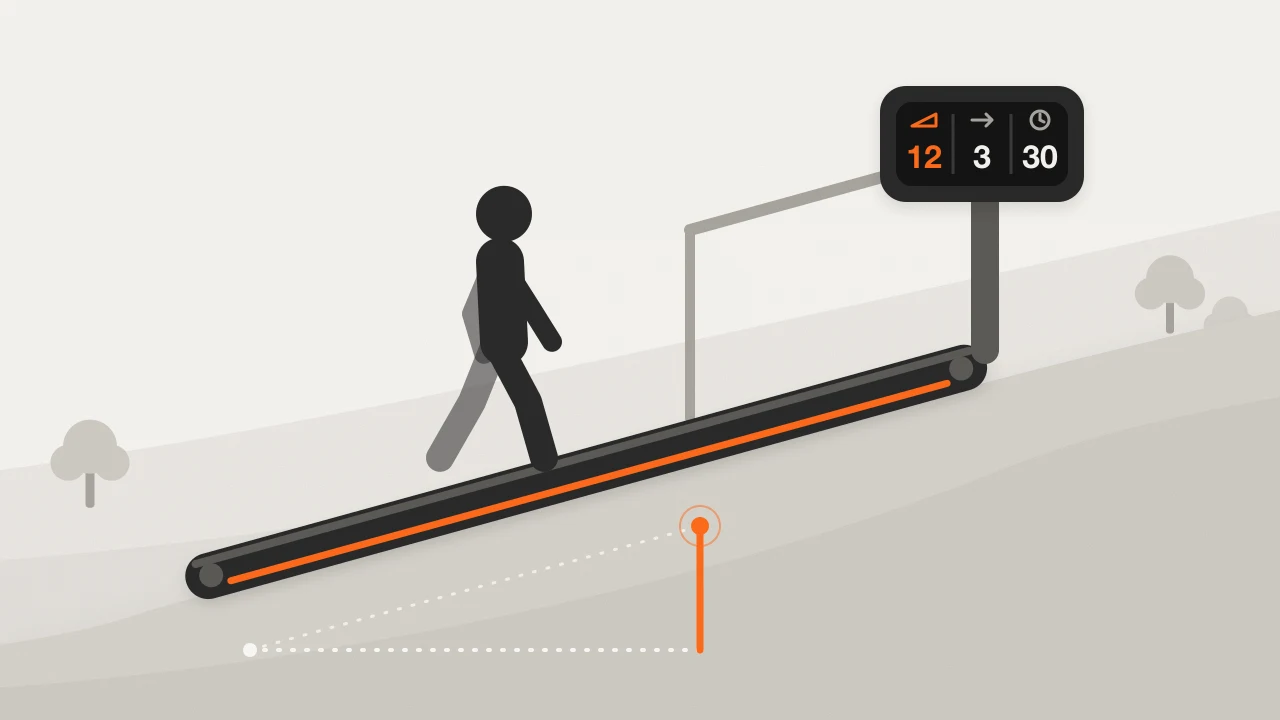
Key takeaways
- 12-3-30 costs about 8 METs at about 70–85% of max heart rate, against 3.5 METs for walking 4.8 km/h on the flat, and burns roughly 250–375 kcal per session depending on body weight.
- In 30 minutes, 12-3-30 covers 2.4 km while running at 8 km/h covers 4 km, so it does not train running speed.
- Build up over about seven weeks, from 4–6% for 20 minutes to 12% for 30 minutes, because steep grades load the calves and Achilles tendons more than flat walking.
- No controlled trial has tested this exact protocol, and a watch usually misses belt incline, so judge progress by heart rate at the same incline and speed.
- Stop and seek medical advice for chest pain or pressure, faintness, palpitations with dizziness, or breathlessness out of proportion to the effort.
The 12-3-30 workout means 12% incline, 3 mph, 30 minutes. This guide explains what those numbers do to your heart rate and calories, how incline walking compares with flat walking and running, how to start without sore calves, and what your watch shows on a treadmill. For walking in general, see walking for fitness.
What 12-3-30 is, and what the evidence covers
The 12 is the incline in percent (12 m of rise for every 100 m of belt travel), the 3 is the speed in mph (4.8 km/h) and the 30 is the minutes. The routine spread on social media around 2019–2020 and is normally done without holding the rails. In 30 minutes you cover about 2.4 km (1.5 miles) and climb roughly 290 m (about 950 ft).
No controlled trial has tested this exact protocol. What can be said rests on two bodies of research: the energy cost of walking uphill, which is well characterised (Minetti et al., 2002), and the broad evidence for regular moderate-to-vigorous activity (Bull et al., 2020). Claims that 12-3-30 works "better than running" or "melts fat" go beyond that evidence.
How hard is it? Energy, heart rate and effort
| Activity | Approx. METs | Effort (0–10) | Typical heart rate (% of max) |
|---|---|---|---|
| Walking 4.8 km/h (3 mph), flat | 3.5 | 3 | about 50–65% |
| Brisk walking 6.4 km/h (4 mph), flat | 5.0 | 5 | about 60–75% |
| 12-3-30: 12% at 4.8 km/h (3 mph) | about 8 | 6–7 | about 70–85% |
| Running 8 km/h (5 mph), flat | 8.3 | 6–7 | about 70–85% |
The ACSM walking equation (oxygen cost = 0.1 × speed + 1.8 × speed × grade + 3.5, with speed in m/min and grade as a fraction) puts 12% at 4.8 km/h at about 29 ml/kg/min, or 8.3 METs. It is an estimate; real cost varies with fitness, stride and handrail use. A 40-year-old with an estimated maximum of 180 bpm would see roughly 126–153 bpm at 70–85%, but heart rate also depends on heat, sleep, caffeine and fitness, so trust the talk test as well: you should manage short sentences but not sing (heart rate zones).
Stop and seek medical advice if a session brings on chest pain or pressure, faintness, palpitations with dizziness, or breathlessness out of proportion to the effort.
Calories: what 30 minutes of 12-3-30 burns
Calories ≈ MET × body weight (kg) × hours; subtract 1 MET for the energy above what you would use at rest.
| Body weight | Total in 30 min | Above resting |
|---|---|---|
| 60 kg (132 lb) | ~250 kcal | ~220 kcal |
| 70 kg (154 lb) | ~290 kcal | ~255 kcal |
| 80 kg (176 lb) | ~330 kcal | ~290 kcal |
| 90 kg (198 lb) | ~375 kcal | ~330 kcal |
Three or four sessions a week at 70 kg add roughly 765–1,020 kcal above resting: useful, but modest next to what changes in food can do. Body weight depends on overall energy balance, and no single workout is a fat-loss method (see the fat-burning heart rate zone). Holding the rails can cut the real cost noticeably, so these figures assume you do not lean on them. For other activities, see calories burned by activity.
Incline walking vs running
| Incline walking (12-3-30) | Running at 8 km/h (5 mph) | |
|---|---|---|
| Energy per minute | about 8 METs | about 8.3 METs |
| Distance in 30 min | 2.4 km (1.5 mi) | 4 km (2.5 mi) |
| Impact | Lower: one foot is always on the belt, and ground forces are typically around 1–1.5 × body weight, against roughly 2–3 × when running | Higher |
| Muscles working hardest | Calves, glutes, hamstrings | Quads and calves, with more tendon and bone impact |
| Common trouble spots | Calf, Achilles, plantar fascia, lower back if you lean | Shins, knees, feet |
| Best for | Low-impact cardio and a base while managing joints | Speed, race-specific fitness |
On steep slopes the energy cost of walking approaches that of running over the same distance (Minetti et al., 2002), which is why steep walking feels so hard. At 12% it is a low-impact way to train at jogging-like intensity, but it does not replace running if you are preparing for a race; it makes good cross-training.
Start gently: calves, Achilles and joint load
A steep incline pushes the ankle further forward and makes the calf and Achilles tendon work harder; glutes and hamstrings also do more. Joint impact is low, but tendons take weeks to adapt. Mild calf tightness in the first days is common. Sharp or persistent pain at the heel, Achilles, shin or knee is a reason to stop, and to see a clinician if it lingers. If you have a heart, lung or joint condition, check with a clinician first.
| Weeks | Incline | Speed | Time | Sessions per week |
|---|---|---|---|---|
| 1–2 | 4–6% | 4.8 km/h (3 mph) | 20 min | 2–3 |
| 3–4 | 8% | 4.8 km/h | 25 min | 3 |
| 5–6 | 10% | 4.8 km/h | 30 min | 3 |
| 7 onward | 12% | 4.8 km/h | 30 min | 3–4 |
Add five minutes of flat walking before and after, and change one thing at a time. If your treadmill stops at 10%, 10% at about 5 km/h is a similar but slightly easier effort (about 7.7 METs). Walk tall with short strides and let your arms swing; use the rails only for balance. Five minutes of calf and ankle work afterwards helps (ankle mobility).
Common mistakes: starting at 12% on day one, leaning back on the rails, adding speed and incline together, doing it every day with no easy days, and treating the watch's calorie number as exact.
What your watch shows on a treadmill
| Metric | What to expect | Tip |
|---|---|---|
| Heart rate | Wrist optical is generally fine at a steady walk, but it lags at the start and gripping the rails can disturb it; a chest strap is more accurate | Read it after the first five minutes and expect a slow upward drift |
| Distance and pace | No GPS indoors: the watch estimates from motion and can differ from the treadmill display | Calibrate to the treadmill's distance, or note the treadmill's own numbers |
| Elevation gain | Usually zero or missing, since a watch cannot sense the belt incline unless the treadmill sends it or you enter it | Do not expect the roughly 290 m climb to appear |
| Calories | Heart-rate-based estimates partly reflect the extra effort; those based on speed and distance may ignore incline and undercount | Use them as a trend and compare with the table above |
Energy expenditure is the least accurate output of wrist wearables, with errors that can reach tens of percent (Shcherbina et al., 2017), and some devices show total rather than active calories.
In MoveVitals
Treadmill walks from Garmin, Polar, COROS or Suunto watches arrive as workouts with duration, distance, heart rate and the calories your device reports; Apple Watch walks arrive through Strava. Depending on how your device labels the activity (walk, treadmill or indoor run), MoveVitals may file it as a walk or an indoor run, so check the sport on the workout. Time in zone is calculated from the heart rate stream, so you can see how many of the 30 minutes were in zones 3–4, and because the belt incline is rarely sent to the watch, expect little or no elevation gain on these sessions. Comparing heart rate at the same incline and speed over several weeks shows your fitness trend.
Worked example
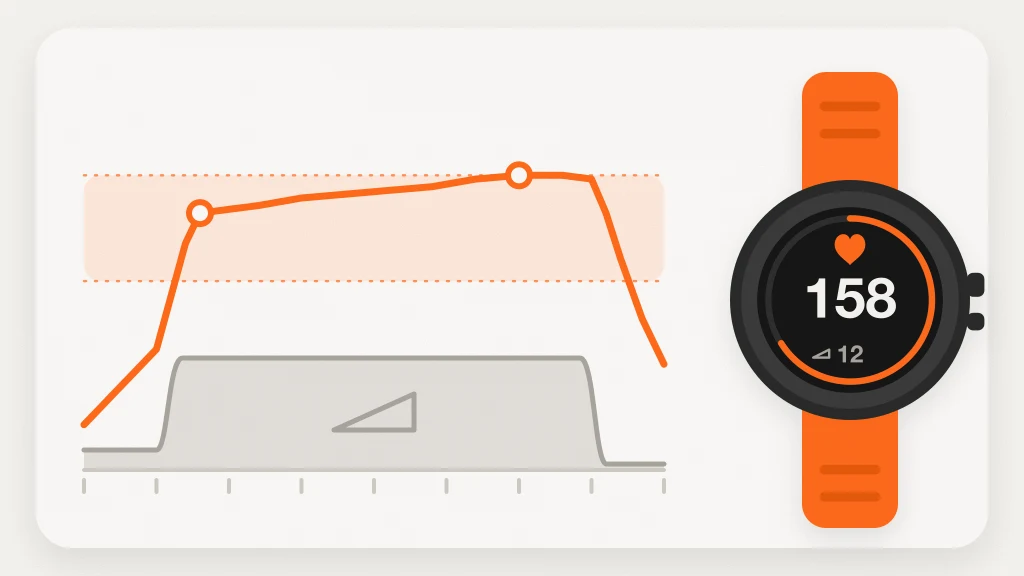
Illustrative scenario. Priya, 34, weighs 62 kg, works at a desk and has a treadmill that goes to 12%. She starts at 5% for 20 minutes, three times a week, moves to 8% for 25 minutes in weeks 3–4 and 10% for 30 minutes in weeks 5–6, and does her first 12-3-30 in week 7. In week 8 her heart rate climbs from about 100 bpm in the first minutes to 148 by minute 8 and drifts to about 158 by minute 30, around 85% of an estimated maximum of 186; effort is 7 out of 10 and she touches the rails with her fingertips only. The equation gives about 255 kcal in total, roughly 225 above resting, while her watch says 300; she treats the gap as normal error. Calf tightness in weeks 2–3 settles with five minutes of calf and ankle work, and she stays at three sessions a week. After 12 weeks the same settings give 142–150 bpm, and she judges progress by that rather than by calories. Figures are illustrative.
Action steps
- Warm up for five minutes on the flat, then walk 20 minutes at 5–8% incline and about 4.8 km/h without leaning on the rails.
- Add 2–3 points of incline or five minutes every two weeks, one change at a time, and go up to 12% for 30 minutes only if calves and Achilles tendons feel fine.
- Check heart rate after minute five, because it lags, and keep effort around 6–7 out of 10: short sentences, no singing.
- Start with two or three sessions a week with a rest day between them, and finish with five minutes of calf and ankle mobility.
- Judge progress by heart rate at the same incline and speed, not by the watch's calorie figure, and stop and get advice if you feel chest pain, faintness or unusual breathlessness.
Related guides
- Walking for fitness and weight loss: pace, heart rate zones and how much is enough
- Japanese interval walking: the 3-minute fast / 3-minute slow method, step by step
- Heart rate zones explained: how to set and use them
- Calories burned by activity: MET values, per-hour tables and how wearables estimate them
- Ankle mobility: the knee-to-wall test and exercises that work
FAQ
Does the 12-3-30 workout work for weight loss? It burns roughly 250–375 kcal per session depending on body weight, which helps when it is a habit you keep up alongside sensible eating. No study shows 12-3-30 results beyond what regular exercise and an energy deficit would give, so judge it by your weight trend over several weeks (body weight).
Is incline walking better than running? It costs about as much energy per minute as jogging at 8 km/h with lower impact, but it covers less distance and does not train running speed. For many people it is a gentler alternative or a complement.
Is 12-3-30 too hard for beginners? It can be. Start at 5% and build up as above. If your treadmill does not reach 12%, 8–10% at 4.8–5.5 km/h gives a similar workout.
How often should I do it? Two to four times a week is typical, with at least a day between sessions at first. Mix in easy flat walks, and see zone 2 training for the easy side of the week.
Is incline walking bad for my knees or Achilles? Impact is low, but steep grades load the calves and Achilles tendons more than flat walking. Build up gradually, and see a clinician if pain at the heel, Achilles or knee persists.
References
- Minetti et al. (2002). Energy cost of walking and running at extreme uphill and downhill slopes. Journal of Applied Physiology. https://doi.org/10.1152/japplphysiol.01177.2001
- American College of Sports Medicine (2021). ACSM's Guidelines for Exercise Testing and Prescription, 11th edition: metabolic equations for walking and running. Wolters Kluwer.
- Ainsworth et al. (2011). 2011 Compendium of Physical Activities: a second update of codes and MET values. Medicine & Science in Sports & Exercise. https://doi.org/10.1249/MSS.0b013e31821ece12
- Bull et al. (2020). World Health Organization 2020 guidelines on physical activity and sedentary behaviour. British Journal of Sports Medicine. https://doi.org/10.1136/bjsports-2020-102955
- Shcherbina et al. (2017). Accuracy in wrist-worn, sensor-based measurements of heart rate and energy expenditure in a diverse cohort. Journal of Personalized Medicine. https://doi.org/10.3390/jpm7020003
For general information only. This is not medical advice — talk to a qualified professional about your health.
Keep reading
Devices & setup
Strava and MoveVitals: workouts, streams and devices that arrive via Strava
3 min read
Sports
Hiking and trekking: heart rate on climbs, pacing and how to train for it
8 min read
Metrics explained
VO2 max: what it means and how to improve it
4 min read
Sports
Trail running with a watch: heart rate, climbs and pacing by effort
7 min read
Metrics explained
Heart rate zones explained: how to set and use them
4 min read
Metrics explained
Maximum heart rate: formulas, field tests and why age-based estimates fail
4 min read