

Sports
HYROX training: stations, run splits and how to use your watch on race day
HYROX is eight 1 km runs, each followed by a functional station, so a good HYROX training plan treats it as an endurance event with heavy intervals rather than a strength contest. This guide covers the format, an 8–12 week structure, pacing and heart-rate strategy, and how to set up your watch for race day.
Written by MoveVitals Editorial Collective
Community-authored educational content. Individual clinical review is identified only when a named review is actually recorded.
Editorial standards & corrections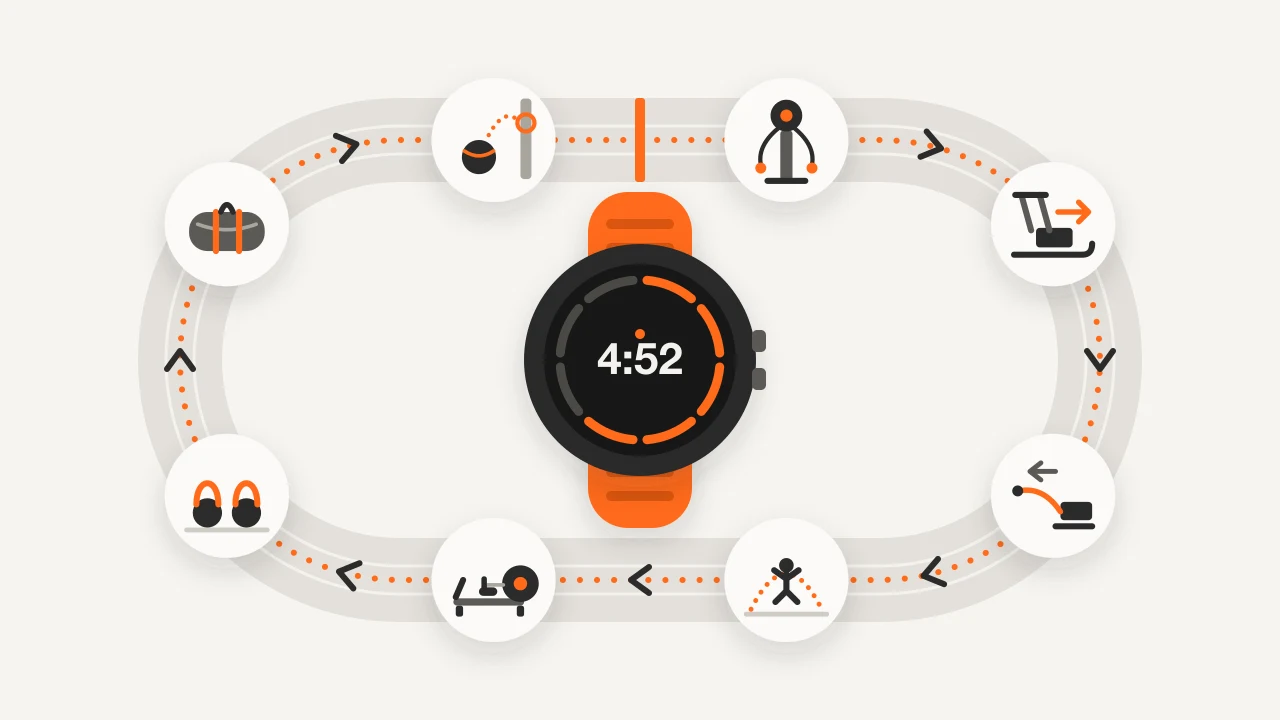
Key takeaways
- The eight HYROX stations, in order, are a 1,000 m SkiErg, 50 m sled push, 50 m sled pull, 80 m burpee broad jumps, 1,000 m row, 200 m farmers carry, 100 m sandbag lunges and 100 wall balls.
- About half of a HYROX race is running, so aerobic fitness and running under fatigue matter at least as much as raw strength.
- A compromised session of 4–6 × (1 km run + a 3–5 min station block) trains running on tired legs.
- Expect heart rate of about 75–85 % of max on laps 1–3, 80–90 % on laps 4–6 and 85–95 % on laps 7–8, with spikes on burpees and wall balls.
- Press the lap button at each of the 16 boundaries to get 16 splits, because GPS pace is unreliable in an indoor hall.
The format: eight runs, eight stations
You run 1 km, do a station, run 1 km, do the next station, and so on, eight times, always in this order:
| # | Station (after the run) | Distance or reps | Mainly taxes |
|---|---|---|---|
| 1 | SkiErg | 1,000 m | Upper-body pulling, breathing |
| 2 | Sled push | 50 m | Legs, drive, trunk |
| 3 | Sled pull | 50 m | Back, arms, grip |
| 4 | Burpee broad jumps | 80 m | Whole body; heart rate spikes |
| 5 | Rowing | 1,000 m | Legs, back, aerobic engine |
| 6 | Farmers carry | 200 m | Grip, trunk, posture |
| 7 | Sandbag lunges | 100 m | Quads, glutes, balance |
| 8 | Wall balls | 100 reps | Legs, shoulders, breathing |
Loads depend on the category (Open, Pro, doubles, relay) and are revised between seasons, so check the organiser's current rules. The transitions are timed too, so moving efficiently between run and station counts. With 8 km of running and a typical recreational finish of roughly 1¼–1¾ hours, about half of your time is spent running — which is why this is an endurance event.
An 8–12 week plan for beginners
If you can run 5 km comfortably and have some gym experience, 8–12 weeks is a reasonable window. Three or four sessions a week are enough:
| Session | Purpose | Example |
|---|---|---|
| Easy aerobic run | Base, recovery | 40–60 min in zone 2 |
| Run intervals | Run speed at race effort | 5–8 × 1 km at goal run pace, 60–90 s jog |
| Station and strength | Station skills and strength | 4 rounds of 250 m SkiErg, 20 m sled push, 20 wall balls, 100 m carry; plus squats and lunges |
| Compromised session | Running on tired legs | 4–6 × (1 km run + a 3–5 min station block) |
| Weeks | Phase | Focus |
|---|---|---|
| 1–3 | Base | Easy running, station technique at light loads, 1–2 strength sessions |
| 4–7 | Build | 1 km repeats, station intervals at race loads, one compromised session a week |
| 8–9 | Specific | A half simulation (4 run-and-station pairs), then a longer one at about 85–90 % effort |
| 10 | Taper | Cut volume by roughly 40–50 %, keep a few short race-pace efforts |
With 8 weeks, shorten the base phase; with 12, add two weeks of base and strength. Heavy sled work and lunges cause soreness that ruins the next run, so keep hard leg sessions apart from key run days where you can. Combining strength and endurance works well if volume is sensible — see hybrid training for running and lifting and strength training for endurance athletes.
Pacing strategy and heart rate
- Run pace: choose a pace you can repeat eight times. A common starting point is roughly 15–30 s/km slower than your fresh 10 km pace. Runs straight after the sleds feel much worse than the first one, so expect to slow, not to hold.
- Stations: treat the first SkiErg like a warm-up lap. Burpee broad jumps and wall balls are often where newcomers lose the most time, so practise them most.
- Heart rate: it will be high for most of the race, with spikes on burpees and wall balls. The aim is to avoid sustained zone 5 in the first third. Percentages below are starting points of maximum heart rate — see heart rate zones and race pacing.
| Part of the race | Effort | Heart rate (approx.) |
|---|---|---|
| Laps 1–3 | Controlled; short sentences possible | Top of zone 3 to low zone 4 (~75–85 %) |
| Laps 4–6 | Steady and hard | Zone 4 (~80–90 %) |
| Laps 7–8 | Spend what is left | Zone 4–5 (~85–95 %) |
Also use RPE: heart rate lags behind sudden effort and is thrown off by grip, heat and excitement. For efforts of 60–90 minutes, 30–60 g of carbohydrate per hour is a common recommendation — see carbohydrate fuelling.
Using your watch on race day
- What it can do: record heart rate, total time and lap times, and estimate energy. It cannot count sled metres or wall-ball reps reliably.
- Wrist heart rate: usually fine on steady runs, weaker when you grip heavy handles or bounce through burpees and wall balls. A chest strap such as the Polar H10 is generally more reliable; some people use an optical armband instead.
- Profiles: some brands have added HYROX-style or hybrid-fitness modes (COROS and Amazfit, for example); availability varies by model and firmware, so check yours. Otherwise use a multisport profile if your watch offers one, or a single run or cardio profile with manual laps.
- Laps: press the lap button at each of the 16 boundaries to get 16 splits and see where your time goes. Races are mostly indoors, so use lap times rather than GPS pace.
- Setup: lock the screen or buttons (sleeves, sleds and sweat cause accidental presses), turn off auto-pause, show only lap time, heart rate and total time, and do not install updates or change settings on race morning.
In MoveVitals
HYROX sessions and training from Garmin, COROS, Polar, Suunto, Apple Health, Strava and WHOOP arrive as running, strength or other activities depending on the profile you used. MoveVitals stores them with duration, heart rate and energy, removes duplicates when a watch and Strava carry the same session, and shows run and gym weeks together. Heart-rate load underestimates sled and carry work, so add session RPE — see training load.
Worked example
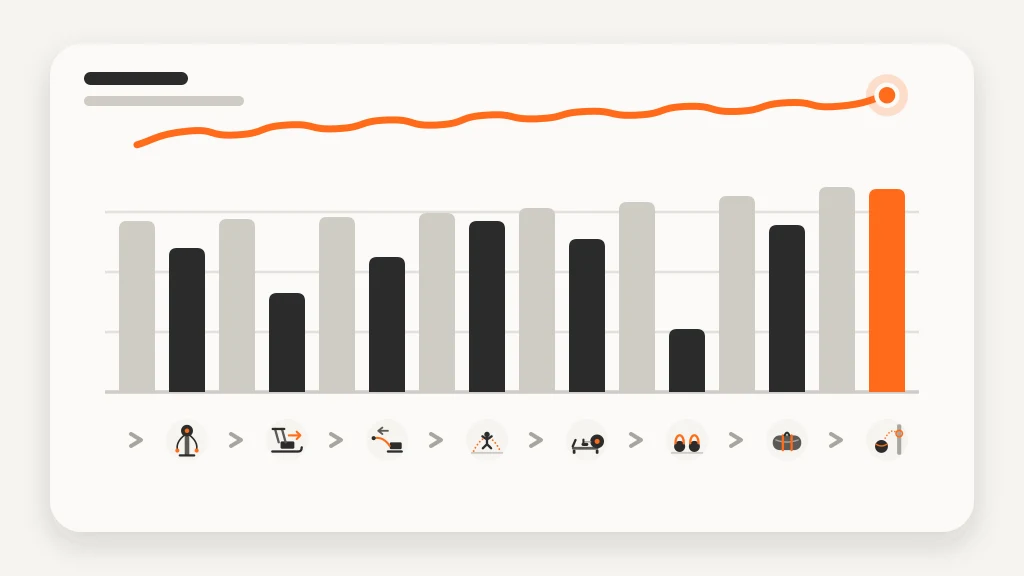
Illustrative scenario. Sofia, 34, runs 10 km in about 52:00 (5:12/km) and enters her first HYROX with a goal of about 1:20. She picks a run pace of 5:35/km, roughly 20–25 s/km slower than her fresh 10k pace: 8 km in 44:40. Her station goals are SkiErg 4:20, sled push 2:10, sled pull 3:10, burpee broad jumps 5:30, row 4:30, farmers carry 1:40, sandbag lunges 4:50 and wall balls 6:30, a total of 32:40. With about 3 minutes of transitions that adds up to roughly 1:20:20. Her measured maximum is 188 bpm, so laps 1–3 target 141–160 bpm. She trains four times a week for 10 weeks, wears a chest strap on race day and presses the lap button at all 16 boundaries.
Action steps
- Read the current rules for your category and practise each station at a light load.
- Build the run first: easy aerobic running plus 1 km repeats, and one or two strength sessions a week.
- Add one compromised session a week in the build phase and one or two longer simulations before race day.
- Set run pace from your 10 km time and heart-rate targets from a measured maximum; use a chest strap.
- Set up your watch with a profile you know, lap presses at each boundary and a locked screen — nothing new on race morning.
- Taper for the last 7–10 days and practise your race-day fuelling in training.
Related guides
- Hybrid training: running and lifting without the interference effect
- Strength training for endurance athletes
- Interval training and HIIT: designing sessions that work
- Race pacing: why even splits usually win
- Heart rate zones explained: how to set and use them
- CrossFit and functional fitness: heart rate, WODs and wearable accuracy
FAQ
Is HYROX more running or strength? Both, but about half the race is running, so aerobic fitness and running under fatigue matter at least as much as raw strength.
How long should a beginner train for HYROX? Eight to twelve weeks is typical if you can already run 5 km comfortably and have some gym experience; start earlier if you are new to both.
What heart rate should I aim for in HYROX? Expect to spend most of the race in zones 3–4 (roughly 75–90 % of your maximum), with spikes on burpees and wall balls. Base it on a measured maximum, not a formula alone.
What is the best watch for HYROX? Features matter more than brand: a lap button you can press with sweaty hands, a screen lock, strap pairing, a profile you have practised and battery life for warm-up plus race. Some brands offer dedicated hybrid or HYROX modes; check your model.
Can I rely on wrist heart rate? For a rough picture, yes, but gripping and bouncing add noise. A chest strap is generally more reliable during sleds, carries and wall balls.
References
- Wilson et al. (2012). Concurrent Training: A Meta-Analysis Examining Interference of Aerobic and Resistance Exercises. Journal of Strength and Conditioning Research. https://doi.org/10.1519/JSC.0b013e31823a3e2d
- Abbiss & Laursen (2008). Describing and Understanding Pacing Strategies during Athletic Competition. Sports Medicine. https://doi.org/10.2165/00007256-200838030-00004
- Burke et al. (2011). Carbohydrates for training and competition. Journal of Sports Sciences. https://doi.org/10.1080/02640414.2011.585473
- Gillinov et al. (2017). Variable Accuracy of Wearable Heart Rate Monitors during Aerobic Exercise. Medicine & Science in Sports & Exercise. https://doi.org/10.1249/MSS.0000000000001284
For general information only. This is not medical advice — talk to a qualified professional about your health.
Keep reading
Sports
Trail running with a watch: heart rate, climbs and pacing by effort
7 min read
Metrics explained
VO2 max: what it means and how to improve it
4 min read
Metrics explained
Heart rate zones explained: how to set and use them
4 min read
Training science
Zone 2 training: the science and how to do it right
4 min read
Mobility & stretching
Mobility vs flexibility: what's the difference and what do you need?
3 min read
Devices & setup
Strava and MoveVitals: workouts, streams and devices that arrive via Strava
3 min read