

Training science
Hybrid training: running and lifting without the interference effect
Hybrid training combines running and lifting in one week, and the interference effect is smaller than its reputation if you manage order, spacing and load. Here is how to schedule runs and lifts and monitor the combined load.
Written by MoveVitals Editorial Collective
Community-authored educational content. Individual clinical review is identified only when a named review is actually recorded.
Editorial standards & corrections
Key takeaways
- Put a heavy leg lift and a hard run on separate days, or at least 6 hours apart on the same day, and do the session that matters more first.
- Keep the long run about 48 hours from heavy squats and deadlifts, because fatigued legs make it harder to do well.
- Easy runs fit on any lifting day in either order, and upper-body lifts have little overlap with the muscles running uses.
- Log RPE × minutes for every run and lift, add no more than about 10% a week, and take a lighter week every 3–4 weeks.
What the interference effect actually is
In 1980 Hickson reported that training for strength and endurance together blunted strength gains compared with strength training alone, and the idea of an interference effect stuck. A 2012 meta-analysis found that the penalty to size, strength and power grew with the frequency and duration of endurance training, and was larger with running than with cycling. A larger 2022 update of 43 studies found that concurrent training did not compromise muscle growth or maximal strength, while explosive strength gains may be blunted, especially when both are done in the same session.
So the interference is real but small for most recreational lifters, and it matters most if you chase peak power or run a lot. Part of it is molecular signalling, which is mostly lab evidence. The part you can control is plain fatigue: tired legs lift less, and sore legs run worse.
Same day or separate days? Order and spacing
| Situation | What to do | Why |
|---|---|---|
| Heavy leg lift and a hard run (intervals, tempo) | Separate days, or the same day at least 6 hours apart; do the more important session first | In one 7-week study, strength gains were smaller with no gap than with 6 or 24 hours |
| Easy run and any lift | Same day is fine, in either order | Easy running costs little recovery |
| Long run | Keep it about 48 hours from heavy squats and deadlifts when you can | Fatigued legs make the long run harder to do well |
| Upper-body lift | Any day, including with a hard run | Little overlap with the muscles running uses |
| Hard days | Stack them together and keep the other days easy | Leaves real recovery days |
Whether to run or lift first has no universal answer, and the evidence on order is mixed, so use priority: lift first when strength is the goal that day, run first when pace work matters. If you cannot split a day, ask which session you most want to do well, and do that one fresh.
How much running blunts lifting, and the reverse
Dose matters more than order. The meta-analysis found larger penalties with more frequent and longer endurance sessions, so extra runs cost lifting progress and extra lifting costs running quality. As a rough rule of thumb, not a study cutoff, two to four runs a week with only one or two of them hard coexists well with two to three lifts. Strength is also easier to keep than to build: studies of reduced training volume suggest it holds for weeks on far less work than it took to gain, so one session a week at a similar load can maintain it during a race build. Lifting in turn tends to improve running economy — see strength training for endurance athletes. Pick one focus per block, as in periodization, and keep the other lane in maintenance.
Three sample weekly splits for a hybrid athlete
| Day | A: Endurance first (4 runs, 2 lifts) | B: Balanced (3 runs, 3 lifts) | C: Strength first (4 lifts, 3 easy runs) |
|---|---|---|---|
| Mon | Rest | Upper-body lift | Heavy lower-body lift |
| Tue | Intervals (AM) + full-body lift (PM) | Quality run (AM) + heavy lower-body lift (PM) | Easy run + upper-body lift |
| Wed | Easy run, 40 min | Rest or easy walk | Rest |
| Thu | Easy run, 40 min + upper-body and core lift | Easy run, 40 min + full-body lift (moderate) | Lighter lower-body lift |
| Fri | Rest | Rest | Easy run, 30–40 min |
| Sat | Long run | Long run | Upper-body or full-body lift |
| Sun | Easy run, 30 min, or rest | Rest or easy walk | Easy run, 45–60 min |
Each split has at least one full rest day and keeps heavy leg work about two days before the long run. Take a lighter week every 3–4 weeks — see deload weeks — and adjust the days to your life.
Monitoring the combined load
Wrist optical heart rate is generally less reliable during lifting because gripping and muscle contraction disturb the signal, and heart-rate-based load underestimates heavy low-rep sets. Use session RPE (RPE × minutes) for lifting, and heart rate or pace for running; for hard intervals a chest strap is generally more accurate than a wrist sensor. Then read the week as a whole:
| Signal | How to use it |
|---|---|
| Weekly load (RPE × minutes for every run and lift) | Add gradually, commonly no more than about 10% a week, and plan a lighter week every 3–4 weeks — see training load |
| Overnight HRV (7-day average vs your baseline) | A trend that stays below your normal range for several days after a hard block says ease off; one low night is noise |
| Resting heart rate | A rise of several beats above baseline together with low HRV suggests accumulated fatigue, though illness, alcohol and poor sleep do the same |
| Session quality | Run pace at the same heart rate and lift load at the same RPE; if both slip for a week, back off |
These are training signals, not diagnoses. If you have chest pain, fainting, palpitations with dizziness, or fatigue that does not lift after rest, stop training and see a doctor. For the longer-term picture, see overreaching and overtraining.
Common mistakes
- Stacking three hard days in a row: heavy legs, intervals, then a long run.
- Raising running volume and lifting volume in the same week.
- Training legs to failure before key runs.
- Making every session hard, with no truly easy days.
In MoveVitals
Runs from Strava, Garmin, COROS, Apple Health or Polar are combined into one weekly view, deduplicated, so a run recorded by both a watch and Strava is counted once. Strength workouts from Apple Health, Garmin and WHOOP are stored as activities. Because heart-rate load underestimates lifting, add session RPE as well. HRV and resting heart rate arrive from the same devices, so you can read them against the week's training instead of in isolation.
Worked example
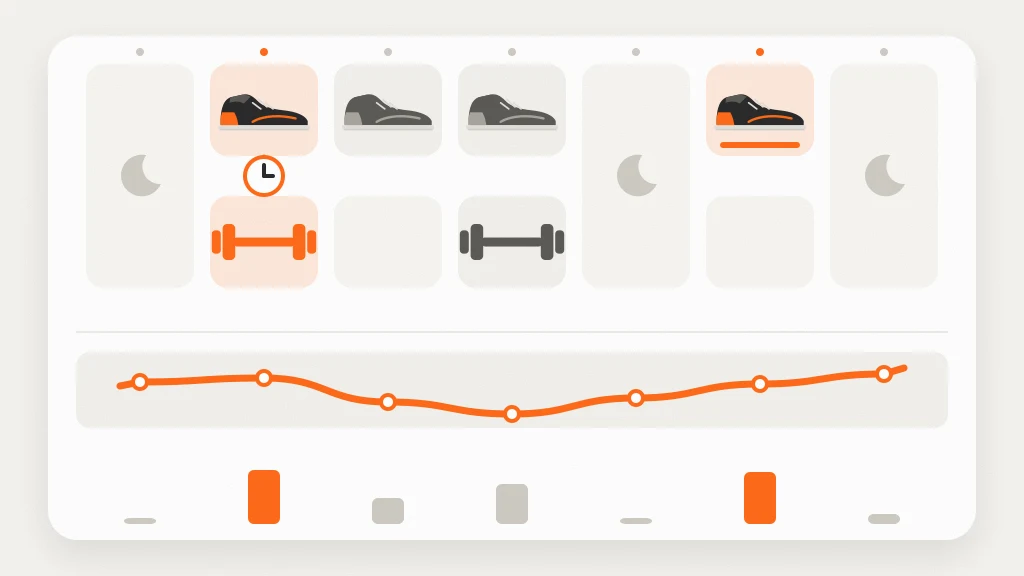
Illustrative scenario. Leo, 34, is training for a half marathon while trying to add 10 kg to his squat. He follows split B: intervals on Tuesday morning, an easy run on Thursday and a long run on Saturday, with lifts on Monday, Tuesday evening (seven hours after the intervals) and Thursday. Using RPE × minutes, a normal week comes to about 1,900 AU: roughly 900 from running and 1,000 from lifting. In week four he adds a fourth run and a fourth lift, about 2,400 AU, 28% more. By midweek his 7-day average overnight HRV has slipped from about 64 ms to 53 ms (his own watch's values, not comparable with anyone else's) and his resting heart rate has risen from 52 to 57 bpm. He cuts back to about 1,400 AU the next week, sees HRV return to around 62 ms, and then resumes about 1,900 AU with only one extra easy run. Figures are illustrative.
Action steps
- Pick a focus for the block, running or lifting, and treat the other as maintenance.
- Stack hard sessions: put the key run and the heavy lift on the same day at least 6 hours apart, or on separate days, and keep the next day easy.
- Keep heavy leg work about 48 hours from long or fast runs whenever you can.
- Log RPE × minutes for every run and lift, and review the weekly total with your 7-day HRV and resting heart rate trend against your baseline.
- Raise total load gradually and take a lighter week every 3–4 weeks.
Related guides
- Strength training for endurance athletes
- Progressive overload: the principle behind every improvement
- Training load explained: TRIMP, TSS, strain and relative effort
- Periodization: planning a training year
- Deload weeks: why planned easy weeks make you fitter
- HYROX training: stations, run splits and how to use your watch on race day
FAQ
Should I run or lift first? Do the session that matters more that day first. If both matter equally, split them by at least 6 hours; if you cannot, an easy run after lifting costs little.
Will running kill my gains? For most recreational lifters, no. Meta-analysis finds little effect on muscle size or maximal strength, with the clearest cost on explosive strength and with high running volume.
Can I lift and run on the same day? Yes. Pair a hard run with a heavy lift only when you can separate them, and keep the other days easy.
Is HRV enough to decide whether to train? No. Use the trend alongside resting heart rate, sleep and how you feel, and see a clinician about persistent unexplained fatigue.
References
- Schumann et al. (2022). Compatibility of Concurrent Aerobic and Strength Training for Skeletal Muscle Size and Function: An Updated Systematic Review and Meta-Analysis. Sports Medicine. https://doi.org/10.1007/s40279-021-01587-7
- Wilson et al. (2012). Concurrent training: a meta-analysis examining interference of aerobic and resistance exercises. Journal of Strength and Conditioning Research. https://doi.org/10.1519/JSC.0b013e31823a3e2d
- Robineau et al. (2016). Specific Training Effects of Concurrent Aerobic and Strength Exercises Depend on Recovery Duration. Journal of Strength and Conditioning Research. https://doi.org/10.1519/JSC.0000000000000798
- Hickson (1980). Interference of strength development by simultaneously training for strength and endurance. European Journal of Applied Physiology and Occupational Physiology. https://doi.org/10.1007/BF00421333
- Bickel et al. (2011). Exercise dosing to retain resistance training adaptations in young and older adults. Medicine & Science in Sports & Exercise. https://doi.org/10.1249/MSS.0b013e318207c15d
- Soligard et al. (2016). How much is too much? (Part 1) International Olympic Committee consensus statement on load in sport and risk of injury. British Journal of Sports Medicine. https://doi.org/10.1136/bjsports-2016-096581
For general information only. This is not medical advice — talk to a qualified professional about your health.
Keep reading
Mobility & stretching
Mobility vs flexibility: what's the difference and what do you need?
3 min read
Training science
Zone 2 training: the science and how to do it right
4 min read
Recovery & sleep
Overreaching and overtraining: warning signs and what to do
4 min read
Training science
Polarized training (80/20): easy most of the time, hard some of the time
4 min read
Recovery & sleep
Deload weeks: why planned easy weeks make you fitter
3 min read
Training science
Interval training and HIIT: designing sessions that work
4 min read