

Training science
Half marathon training: a 12-week plan built around your own data
A half marathon training plan of 10–12 weeks and three or four runs a week is enough for most healthy runners. Your watch turns that template into your own plan, from paces to recovery checks.
Written by MoveVitals Editorial Collective
Community-authored educational content. Individual clinical review is identified only when a named review is actually recorded.
Editorial standards & corrections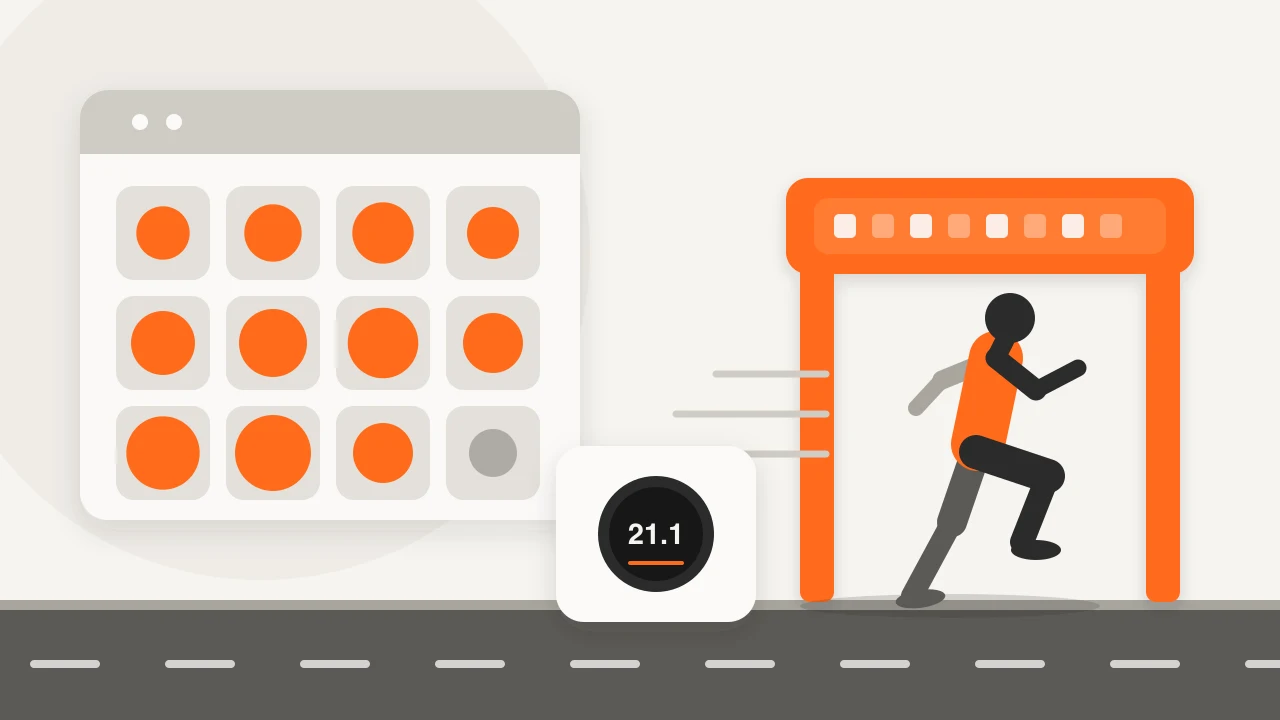
Key takeaways
- Riegel-type predictions put a half marathon at roughly 2.2 × your 10K time or 4.6 × your 5K time.
- A sub-2-hour half marathon means 5:41/km at exactly 2:00:00, so set goal pace at about 5:40/km (9:07/mile), which gives 1:59:33.
- Long runs peak at 14–16 km for beginners and 17–19 km for intermediates, so you do not need to run 21 km or 30+ km before race day.
- Keep roughly 80 % of your running easy, add one threshold session of 20–40 minutes a week and taper for 7–10 days.
- Start the first 2–3 km at goal pace or 5–10 s/km slower, then aim for even or slightly negative splits.
The half marathon sits between the 10K and the marathon: long enough to need real endurance (most finishers take 1:30–2:30), short enough to train for with four runs a week, a long run of about two hours at most and a short taper. It also needs far less fuelling logistics than a marathon. If you are aiming for 42.2 km, see marathon training instead.
How long to train for a half marathon, and how many runs a week
| Where you start | Plan length | Runs per week | Weekly distance | Peak long run |
|---|---|---|---|---|
| Beginner: can run 30 minutes non-stop (for example after the beginner 5K plan) | 12 weeks | 3 | 15–30 km | 14–16 km |
| Intermediate: already running 20–30 km a week | 10–12 weeks | 4 | 30–45 km | 17–19 km |
| Experienced, chasing a time | 10–12 weeks | 4–5 | 40–60 km | 19–21 km |
Most healthy runners need 10–12 weeks of specific training on top of a base of roughly 15–20 km a week. If you cannot yet run 30 minutes comfortably, build that first. Three runs a week is enough to finish; four or five suit a time goal. The first row is the half marathon training plan for beginners: 12 weeks, three runs a week.
The four building blocks
| Session | What it is | Effort | How often |
|---|---|---|---|
| Easy runs | Conversational running that builds the aerobic base and helps you recover | RPE 3–4, zone 2, about 45–90 s/km slower than goal pace | 1–3 per week |
| Long run | Your longest run, growing from about 8–10 km to 16–20 km (90–120 minutes) | Easy; later weeks add blocks at goal pace | Weekly, lighter every 3–4 weeks |
| Threshold / tempo | 20–40 minutes in total, for example 3 × 8 min or 25 min continuous | RPE 6–7, between 10K and half marathon pace | Weekly in build weeks |
| Race-pace work | 2–3 blocks of 3–5 km at goal pace inside a run | RPE about 6 | Last 4–6 weeks |
Keep roughly 80 % of your running easy (see polarized training). Add a few short strides and one or two strength sessions a week (strength training for endurance athletes).
Set your paces: a half marathon pace chart
Riegel-type predictions give a half marathon time of roughly 2.2 × your 10K time, or 4.6 × your 5K time. They assume you have trained for the distance and tend to be optimistic with low weekly mileage, hills or warm weather. Treat the result as a first target and confirm it with a long run that finishes at that pace.
| Goal time | Pace per km | Pace per mile | 10K that predicts it |
|---|---|---|---|
| 1:30 | 4:16 | 6:52 | about 40:45 |
| 1:45 | 4:59 | 8:01 | about 47:35 |
| 2:00 | 5:41 | 9:09 | about 54:20 |
| 2:15 | 6:24 | 10:18 | about 1:01:10 |
| 2:30 | 7:07 | 11:27 | about 1:08:00 |
For a safe sub-2-hour half marathon plan, set goal pace at about 5:40/km (9:07/mile), which gives 1:59:33. Easy runs sit roughly 45–90 s/km slower than goal pace.
A 12-week half marathon training plan
| Weeks | Phase | Weekly distance | Long run | Key sessions |
|---|---|---|---|---|
| 1–4 | Base | 25 → 32 km | 9 → 12 km | Easy running, strides, 10–15 min steady in weeks 3–4 |
| 5–8 | Build | 33 → 40 km | 13 → 16 km | Weekly threshold, 20 → 30 min in total |
| 9–10 | Specific | 40–42 km | 17–19 km | 2–3 × 3–4 km at goal pace; last 4–5 km of one long run at goal pace |
| 11–12 | Taper and race | about 30 km, then about 20 km before race day | 12 km, then an easy shake-out | Short goal-pace reps (for example 3 × 1 km), then race |
These numbers suit an intermediate runner; scale them down by about a third for the beginner row. Make weeks 4 and 8 lighter (roughly 20–25 % less distance) — see deload weeks. The taper is shorter than for a marathon: 7–10 days, with volume cut by roughly 30–50 % and some race pace kept. For runs over about 75–90 minutes, practise 30–60 g of carbohydrate an hour and water at aid stations — see carbohydrate fuelling.
What your watch adds
- Weekly load and ramp. Track weekly distance or time and avoid big jumps. A rise of roughly 10 % a week is a common guard-rail, not a proven limit; studies of novice runners link very large jumps (around 30 % or more) with more injuries (Nielsen 2014). See training load if you also cross-train.
- Pace at the same heart rate. On easy runs, hold heart rate in zone 2 and watch pace improve over weeks.
- Drift on the long run. Compare the first and second half of a steady long run at constant pace. Under about 5 % decoupling is a good sign at this distance; more in heat or when under-fuelled is information, not failure (cardiac drift).
- HRV and resting heart rate before key sessions. If HRV has sat well below your usual range for a few days, resting heart rate is several beats up and your legs feel flat, swap the hard session for an easy run. One reading is not a verdict (HRV, resting heart rate).
- Know the limits. GPS pace wobbles between tall buildings and in tunnels (running pace), and wrist heart rate can lag in short intervals (Bent 2020), where a chest strap such as the Polar H10 is more reliable.
Race week, race day and common mistakes
Start the first 2–3 km at goal pace or 5–10 s/km slower, settle in and aim for even or slightly negative splits (race pacing). Nothing new on race day: shoes, kit, breakfast and gels should all have been tested on long runs.
- Running every run at tempo effort. Most runs should be easy.
- Making the long run too fast. It builds endurance at an easy effort.
- Jumping distance after one good week.
- Copying a marathon plan. You do not need 30+ km long runs or a three-week taper.
- Setting goal pace from an old or best-ever 5K.
In MoveVitals
Runs from Strava, Garmin, COROS, Polar and Suunto — and Apple Watch workouts you share to Strava — are combined into one weekly view, with duplicates removed, long-run progression and pace trends. Because MoveVitals keeps full heart rate and pace streams, you can compare the first and second half of a steady long run and follow easy-run pace at the same heart rate across weeks. Next to them sit HRV and resting heart rate from WHOOP, Oura, Garmin, Polar or COROS, so you can check recovery before a key session.
Worked example
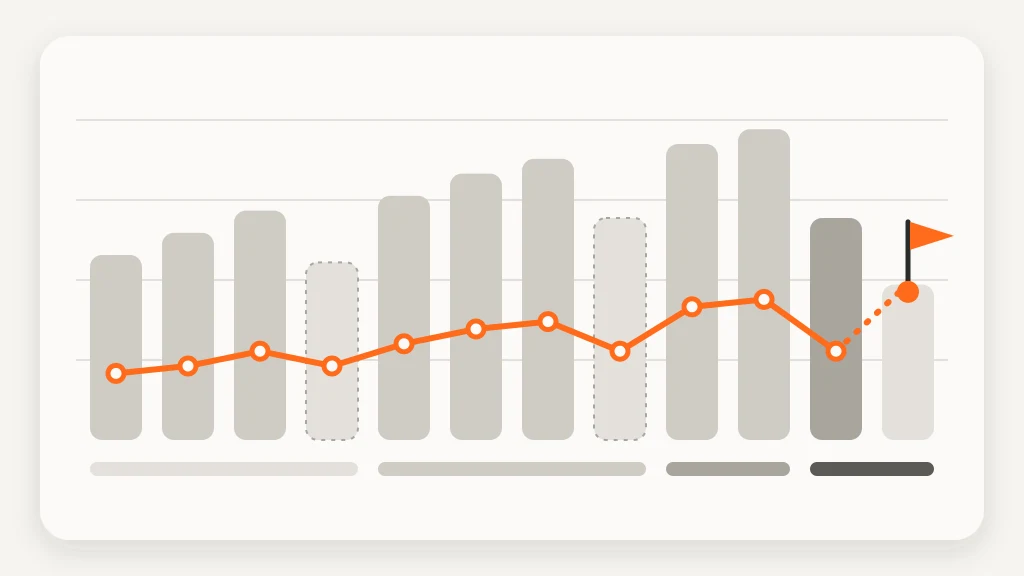
Illustrative scenario. Lena, 38, runs a 10K in 53:30 (5:21/km). The × 2.2 rule predicts about 1:58, so she targets 5:35/km — about 1:57:50 — for a comfortable sub-2:00. She runs four days a week: easy runs at 6:30–7:00/km, a weekly threshold session at 5:20–5:30/km and a long run that grows from 10 to 19 km, with weekly distance rising from about 25 to 42 km and lighter weeks 4 and 8. In week 2 an easy run is 6:50/km at 148 bpm; in week 9 the same heart rate gives 6:35/km. Her steady week-9 long run shows 148 bpm in the first half and 154 bpm in the second at the same pace: about 4 % drift. In week 6 her HRV is 36 ms against a usual 44–50 ms and resting heart rate is 5 bpm up after a poor week of sleep, so she turns the threshold session into 40 easy minutes; HRV is back near 45 ms two days later and she does the threshold run then. After a 10-day taper she runs the first 10 km in 56:00 (5:36/km) and finishes in 1:57:24 (5:34/km average), a slight negative split. Figures are illustrative.
Action steps
- Count back 10–12 weeks from race day and check that you can already run about 30 minutes comfortably and 15–20 km a week; if not, build that base first.
- Set goal pace from a recent 5K or 10K with the pace chart, then test it with a long run that finishes at that pace.
- Run three or four days a week: one long run, one threshold or race-pace session, and easy runs — about 80 % of running easy.
- Make every third or fourth week lighter and taper for 7–10 days before the race.
- Use the watch for trends — easy pace at the same heart rate, drift on long runs, morning HRV and resting heart rate — and adjust key sessions rather than skipping them on one reading.
Related guides
- Marathon training: building a plan that gets you to the finish
- The long run: building endurance safely
- Tempo runs: how fast, how long and why they work
- Race pacing: why even splits usually win
- Tapering before a race: how to arrive fresh and fit
FAQ
How long does it take to train for a half marathon? About 10–12 weeks for runners who already have a base of 15–20 km a week. From zero, add 6–8 weeks of building up to a 5K first.
How many times a week should I run for a half marathon? Three runs are enough to finish; four or five suit a time goal. Keep one long run and one harder session either way.
What pace do I need for a sub-2-hour half marathon? 5:41/km (9:09/mile) is exactly 2:00:00, so aim for about 5:40/km (9:07/mile) or slightly faster, which gives 1:59:33.
Do I need to run 21 km before race day? No. Most plans peak at 16–20 km (90–120 minutes), which leaves you fresh and still builds the endurance you need.
Can I use a marathon plan for a half marathon? You can borrow the structure, but shorten it: long runs peak at 16–20 km rather than 30+, the taper lasts 7–10 days, and there is far less fuelling to practise.
References
- Seiler (2010). What is Best Practice for Training Intensity and Duration Distribution in Endurance Athletes?. International Journal of Sports Physiology and Performance. https://doi.org/10.1123/ijspp.5.3.276
- Esteve-Lanao et al. (2007). Impact of Training Intensity Distribution on Performance in Endurance Athletes. The Journal of Strength and Conditioning Research. https://doi.org/10.1519/R-19725.1
- Nielsen et al. (2014). Excessive Progression in Weekly Running Distance and Risk of Running-Related Injuries: An Association Which Varies According to Type of Injury. Journal of Orthopaedic & Sports Physical Therapy. https://doi.org/10.2519/jospt.2014.5164
- Bosquet et al. (2007). Effects of Tapering on Performance. Medicine & Science in Sports & Exercise. https://doi.org/10.1249/mss.0b013e31806010e0
- Bent et al. (2020). Investigating sources of inaccuracy in wearable optical heart rate sensors. npj Digital Medicine. https://doi.org/10.1038/s41746-020-0226-6
For general information only. This is not medical advice — talk to a qualified professional about your health.
Keep reading
Devices & setup
Strava and MoveVitals: workouts, streams and devices that arrive via Strava
3 min read
Metrics explained
VO2 max: what it means and how to improve it
4 min read
Metrics explained
Heart rate zones explained: how to set and use them
4 min read
Training science
Zone 2 training: the science and how to do it right
4 min read
Training science
Polarized training (80/20): easy most of the time, hard some of the time
4 min read
Sports
Hiking and trekking: heart rate on climbs, pacing and how to train for it
8 min read