

Training science
Strength training for endurance athletes
Heavy strength training improves running economy, cycling efficiency and injury resilience — without making you bulky. Two short sessions a week are enough.
Written by MoveVitals Editorial Collective
Community-authored educational content. Individual clinical review is identified only when a named review is actually recorded.
Editorial standards & corrections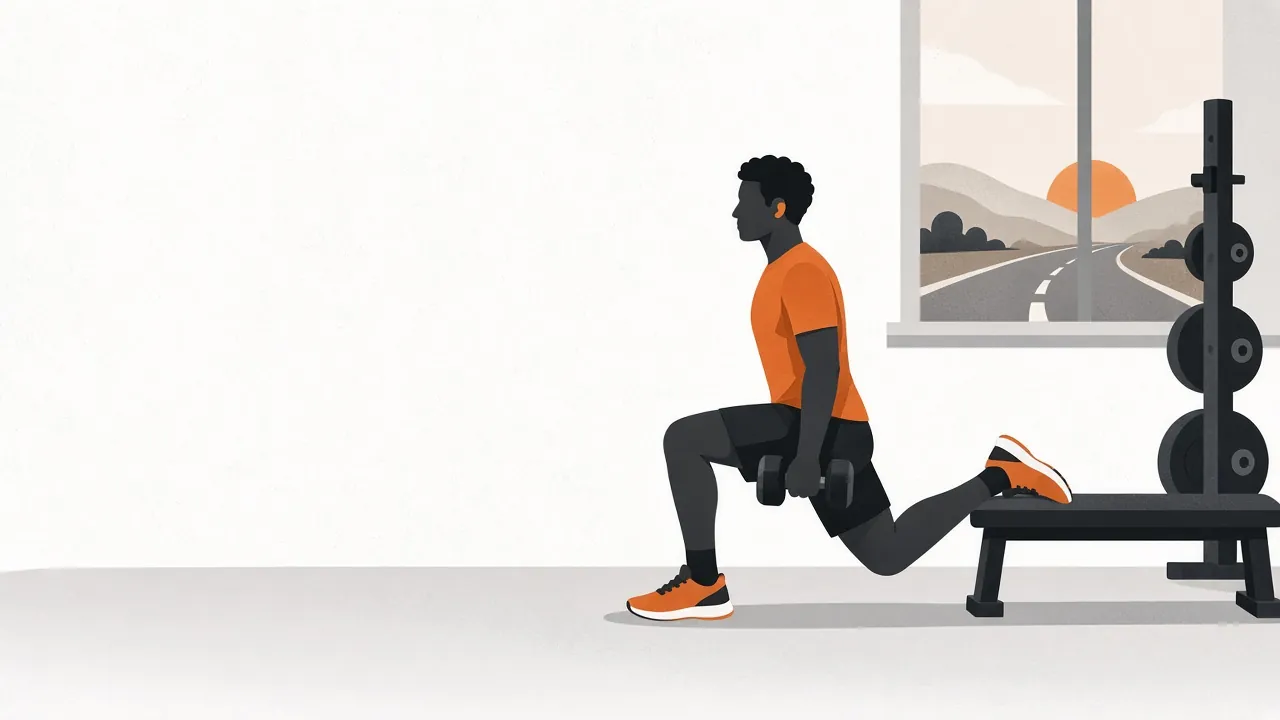
Key takeaways
- Heavy strength training improves running economy by roughly 2–8 %, and cycling gains better sprint power and fatigue resistance late in long rides.
- A simple program is squats at 3–4 × 4–6, Romanian deadlifts at 3 × 6, Bulgarian split squats at 3 × 6–8 per leg, calf raises at 3 × 10–15 and planks at 3 × 30–45 seconds.
- Do 2 strength sessions a week in base phases and 1 in race phases, placed on hard endurance days to protect easy days.
- Start with lighter loads for 2–4 weeks, keep 1–2 reps in reserve, and expect some soreness in the first weeks that fades quickly.
Many runners and cyclists avoid the gym for fear of gaining weight. Research shows the opposite of what they fear: heavy, low-repetition strength training improves performance by making each stride or pedal stroke more economical, with minimal muscle gain when combined with endurance training.
Benefits
- Running economy improves by roughly 2–8 %.
- Cycling: better sprint power and fatigue resistance late in long rides.
- Injury prevention: stronger tendons, hips and calves — see injury prevention for runners.
- Bone health — especially important for cyclists and swimmers (bone mass).
- Healthy ageing: preserves muscle mass.
A simple program (2× per week)
| Exercise | Sets × reps | Notes |
|---|---|---|
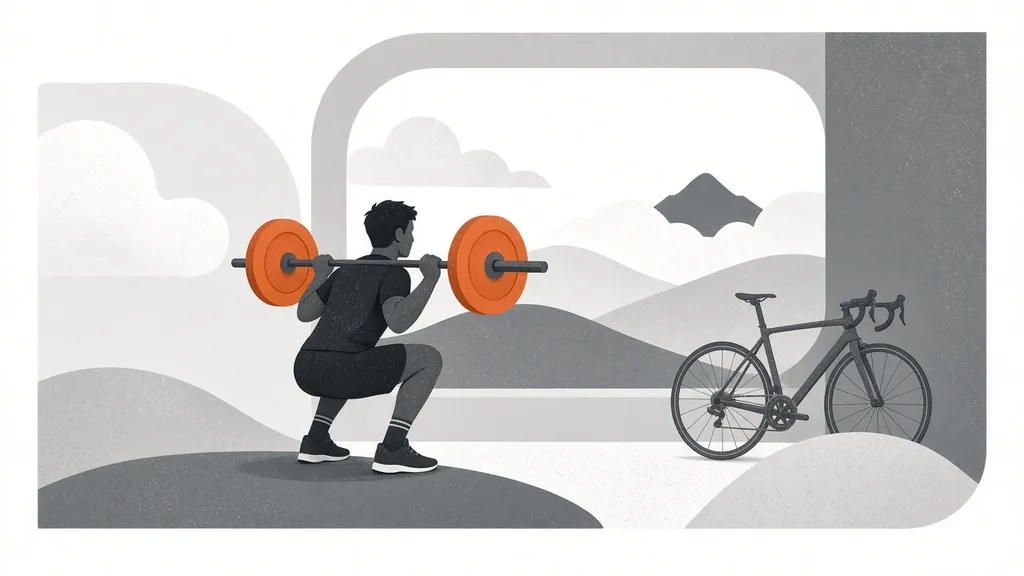
| Back or goblet squat | 3–4 × 4–6 | Heavy but with perfect form |
| Romanian deadlift | 3 × 6 | Hamstrings and glutes |
| Bulgarian split squat | 3 × 6–8 per leg | Single-leg strength |
| Calf raise (straight and bent knee) | 3 × 10–15 | Achilles and soleus |
| Plank / side plank | 3 × 30–45 s | Trunk stability |
| Box jumps or pogo hops (runners) | 3 × 5–8 | Stiffness and power |
Start with lighter loads for 2–4 weeks, then progress — see progressive overload.
Fitting it into training
- Put strength on hard days (after intervals) or on separate days far from key sessions.
- Reduce volume during race weeks; keep one short session to maintain.
- Expect some soreness in the first weeks; it fades quickly.
In MoveVitals
Strength workouts from Apple Health, Garmin and WHOOP are stored as activities. Because heart-rate load underestimates lifting, consider session RPE as well — see training load.
Worked example
Illustrative scenario. Sam, a 10K runner, adds two 40-minute strength sessions a week in base season: back squats, Romanian deadlifts, step-ups and calf raises, 3–4 sets of 4–6 reps at a challenging load, plus a few box jumps. He schedules them on hard-run days (strength after running, 6+ hours apart where possible) to keep easy days easy. After 12 weeks his squat rises from 70 to 95 kg and his heart rate at 4:45/km drops a few beats, consistent with studies showing improved running economy. In race season he drops to one maintenance session a week. Figures are illustrative.
Action steps
- Do 2 strength sessions a week in base phases, 1 in race phases.
- Focus on compound lower-body lifts with heavy loads (about 4–6 reps) plus some plyometrics.
- Pair strength with hard endurance days to protect easy days.
- Progress load gradually and keep 1–2 reps in reserve.
- Expect little to no muscle bulk at this volume; the goal is force and stiffness, not size.
Related guides
- Progressive overload: the principle behind every improvement
- Injury prevention for runners: load, strength and listening early
- Periodization: planning a training year
- Muscle mass: what smart scales report and why it matters
- Hybrid training: running and lifting without the interference effect
- Strength training heart rate: what your wearable shows — and what it can’t
FAQ
Will I gain weight? Very little when combined with endurance training and normal eating.
Bodyweight only? A good start, but most athletes need external load to keep progressing.
Will strength work slow me down? Studies generally show heavy strength training improves or maintains endurance performance when total load is managed.
Should I lift before or after a run? If both are on one day, prioritise the session that matters most and separate them by several hours if possible.
References
- Rønnestad et al. (2014). Optimizing strength training for running and cycling endurance performance: A review. Scandinavian Journal of Medicine & Science in Sports. https://doi.org/10.1111/sms.12104
- Schoenfeld et al. (2017). Dose-response relationship between weekly resistance training volume and increases in muscle mass: A systematic review and meta-analysis. Journal of Sports Sciences. https://doi.org/10.1080/02640414.2016.1210197
- Wilson et al. (2012). Concurrent Training. Journal of Strength and Conditioning Research. https://doi.org/10.1519/JSC.0b013e31823a3e2d
For general information only. This is not medical advice — talk to a qualified professional about your health.
Keep reading
Training science
Zone 2 training: the science and how to do it right
4 min read
Mobility & stretching
Mobility vs flexibility: what's the difference and what do you need?
3 min read
Training science
Polarized training (80/20): easy most of the time, hard some of the time
4 min read
Training science
Interval training and HIIT: designing sessions that work
4 min read
Mobility & stretching
Hip mobility for runners and cyclists: a 10-minute routine
3 min read
Devices & setup
Strava and MoveVitals: workouts, streams and devices that arrive via Strava
3 min read