

Training science
Progressive overload: the principle behind every improvement
To keep adapting, training must gradually become more demanding. Progressive overload is how you do that without getting hurt.
Written by MoveVitals Editorial Collective
Community-authored educational content. Individual clinical review is identified only when a named review is actually recorded.
Editorial standards & corrections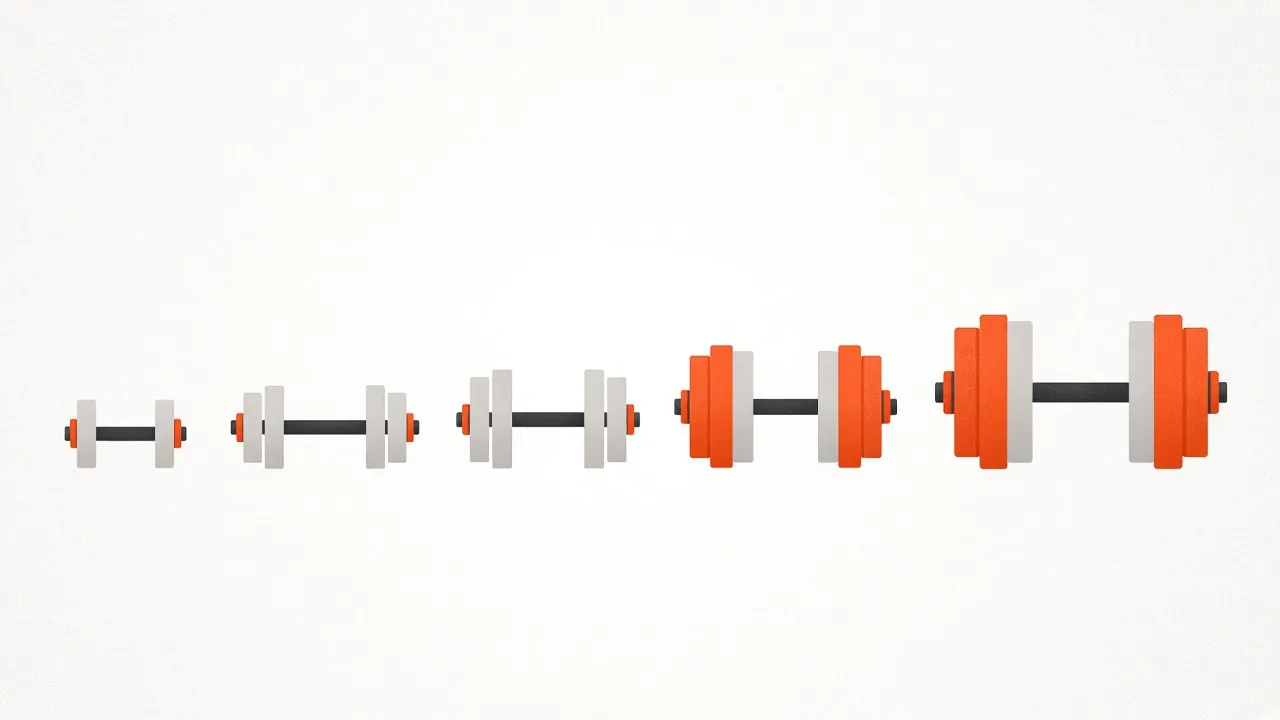
Key takeaways
- The five levers of overload are load, volume, frequency, density and complexity, and you should change one at a time.
- In strength work, add load when you can complete all sets with 1–2 reps in reserve, in small steps of 2–5%.
- Running volume can rise about 5–10 % a week for most people, with an easier week every 3–4 weeks, and the 10 % rule is only a rough guide.
- Persistent soreness or joint pain, falling HRV, rising resting heart rate, poor sleep and stalled performance are signs you are progressing too fast.
Your body adapts to the demands placed on it. Once a workload becomes routine, it stops driving change. Progressive overload means increasing the stimulus in small, planned steps.
Ways to progress
| Lever | Strength example | Endurance example |
|---|---|---|
| Load | +2.5 kg on the bar | Higher power or faster pace |
| Volume | One more set | Longer long run |
| Frequency | Extra session per week | One more run per week |
| Density | Shorter rest | Shorter recoveries between intervals |
| Complexity | Single-leg variations | Hills, trails |
Change one lever at a time.
Sensible rates
- Strength: add load when you can complete all sets with 1–2 reps in reserve.
- Running volume: about 5–10 % more per week for most people, with an easier week every 3–4 weeks.
- Cycling load: a fitness (CTL) ramp of ~3–7 points a week.
Signs you are progressing too fast
- Persistent soreness or joint pain
- Falling HRV, rising resting heart rate
- Poor sleep, low motivation, frequent colds
- Stalled or declining performance
See overtraining.
In MoveVitals
Weekly volume and load from every platform are combined, so you can see whether your progression is steady or spiky.
Worked example

Illustrative scenario. Ivy uses double progression on her goblet squat: 3 sets of 8–12 reps. Week 1 she manages 12/10/9 with 16 kg. She keeps the weight until she hits 12/12/12 (week 3), then moves to 20 kg and drops back to about 8 reps per set. Over 12 weeks her working weight climbs from 16 kg to 28 kg. She also tracks weekly hard sets per muscle group (about 10–12 for legs), in line with the dose-response relationship reported by Schoenfeld et al. (2017), and takes a lighter week when her sleep or HRV trend dips.
Action steps
- Log every session: weight, sets, reps and RPE.
- Use a rep range (e.g., 8–12) and add load only when you reach the top on all sets.
- Increase load in small steps (2–5%).
- Build weekly volume gradually, roughly 10–20 hard sets per muscle group.
- Plan a deload every 4–8 weeks or when progress stalls.
Related guides
- Strength training for endurance athletes
- Deload weeks: why planned easy weeks make you fitter
- RPE (rate of perceived exertion): the sensor you always carry
- Muscle mass: what smart scales report and why it matters
- Recovery after strength training: rest days, DOMS and what HRV and resting heart rate show
- Calisthenics and bodyweight training: tracking progress without a barbell
FAQ
Can I progress every week forever? No — plan plateaus and deloads; progress is wave-like.
Is the 10 % rule law? It's a rough guide; beginners may need less, experienced athletes can sometimes handle more.
Can I overload without adding weight? Yes: more reps, more sets, slower tempo, shorter rest or a harder variation all add stimulus.
How fast should weights go up? Beginners can add load almost weekly; experienced lifters may progress month to month.
Does progressive overload apply to running? Yes, through gradual increases in weekly distance, long-run length or interval volume.
References
- Schoenfeld et al. (2017). Dose-response relationship between weekly resistance training volume and increases in muscle mass: A systematic review and meta-analysis. Journal of Sports Sciences. https://doi.org/10.1080/02640414.2016.1210197
- Garber et al. (2011). Quantity and Quality of Exercise for Developing and Maintaining Cardiorespiratory, Musculoskeletal, and Neuromotor Fitness in Apparently Healthy Adults. Medicine & Science in Sports & Exercise. https://doi.org/10.1249/MSS.0b013e318213fefb
- Gabbett (2016). The training—injury prevention paradox: should athletes be training smarter and harder?. British Journal of Sports Medicine. https://doi.org/10.1136/bjsports-2015-095788
For general information only. This is not medical advice — talk to a qualified professional about your health.
Keep reading
Training science
Zone 2 training: the science and how to do it right
4 min read
Mobility & stretching
Mobility vs flexibility: what's the difference and what do you need?
3 min read
Sports
Japanese interval walking: the 3-minute fast / 3-minute slow method, step by step
8 min read
Recovery & sleep
Overreaching and overtraining: warning signs and what to do
4 min read
Training science
Polarized training (80/20): easy most of the time, hard some of the time
4 min read
Training science
Interval training and HIIT: designing sessions that work
4 min read