

Sports
Calisthenics and bodyweight training: tracking progress without a barbell
Calisthenics builds strength with push-ups, pull-ups, squats and holds, and it only keeps working if you make the moves harder over time. Here is how to progress a bodyweight workout plan, what your watch can and can't see, and what to log instead.
Written by MoveVitals Editorial Collective
Community-authored educational content. Individual clinical review is identified only when a named review is actually recorded.
Editorial standards & corrections
Key takeaways
- Double progression means working in a rep range such as 6–12, then moving to a harder variation once you reach the top of the range on all sets.
- A beginner calisthenics plan is three non-consecutive days of 30–45 minutes: a push-up variation, inverted rows or pull-up negatives, split squats and a plank, 3 sets each.
- Stop 1–3 reps before failure, because failure on every set costs elbows, shoulders and recovery.
- Gripping a bar and bent wrists in push-ups disturb optical heart rate, so log the variation, reps or hold time and reps in reserve instead of trusting wrist numbers.
Calisthenics (also called bodyweight training or street workout) uses your own mass as the load. With a barbell, progress is obvious: add 2.5 kg. With bodyweight the load stays the same, so you change the lever: how hard the exercise is for the muscles involved. That one idea explains almost everything below.
Calisthenics vs weights: does bodyweight training build strength?
For most people, yes, as long as the sets are hard enough. Reviews find that muscle growth does not require heavy loads when sets are taken close to failure, while heavier loads tend to be better for maximal strength (Schoenfeld 2017). In a small trial in young men, push-ups and a low-load bench press, both trained to failure, gave similar gains in muscle size and strength (Kikuchi 2017). Guidelines ask for muscle-strengthening work on at least two days a week (WHO 2020).
The trade-offs are practical. Bodyweight needs almost no equipment, but it progresses in big steps: a push-up to an archer push-up is a much larger jump than adding 2.5 kg. And legs are strong relative to body weight, so lower-body work needs single-leg variations, slow tempo or eventually added load. It does not have to be either/or: a doorway bar plus a few dumbbells covers most needs, and runners and cyclists can combine it with strength training for endurance athletes or hybrid training.
How to progress without plates
| Lever | How | Example |
|---|---|---|
| Leverage | Change body angle or lever length | Incline push-up → push-up → feet-elevated → archer |
| Tempo | Slow the lowering, add a pause | 3 s down, 1 s pause at the bottom |
| Reps in reserve | Stop 1–3 reps before failure | Last set with about 2 reps left |
| Load or volume | Backpack, extra set, shorter rest | Weighted split squat; 3 → 4 sets |
Use double progression: work in a rep range such as 6–12. When you reach the top of the range on every set with about 1–2 reps in reserve and the same tempo, move to the next variation and drop back to the bottom of the range. Change one lever at a time — see progressive overload.
| Pattern | Easier | Standard | Harder |
|---|---|---|---|
| Push | Incline push-up (hands on a table) | Push-up | Feet-elevated or archer push-up |
| Pull | Inverted row (table or low bar) | Negative pull-up (3–5 s lowering), then pull-up | Archer or weighted pull-up |
| Legs | Squat to a chair | Split squat | Bulgarian split squat, assisted pistol |
| Core | Dead bug | Plank | Hollow hold, L-sit — see core training |
A simple calisthenics workout plan for beginners
Train three non-consecutive days (for example Monday, Wednesday, Friday) for 30–45 minutes. Start with a 5–8 minute warm-up, then do four movements of 3 sets each with 1–2 minutes of rest:
- Push-up variation, 3 × 6–12
- Inverted row or pull-up negatives, 3 × 6–10
- Split squat, 3 × 8–12 per leg
- Plank or hollow hold, 3 × 20–40 s
Tendons and joints tend to adapt more slowly than muscle, so raise pulling, dips and straight-arm skill work gradually and back off if elbow or wrist pain builds. Plan an easier week every 4–8 weeks (deload weeks).
Bodyweight workout heart rate: what a watch can and can't see
| Signal | Reliability | Why |
|---|---|---|
| Start, end and duration | Good | Simple timing |
| Wrist heart rate | Mixed | Gripping a bar, bent wrists in push-ups and sudden effort disturb the optical signal; a chest strap is better — see wrist vs strap accuracy |
| Calories | Rough | Estimated from heart rate, motion and body data |
| Next-morning HRV, resting heart rate, sleep | Good | Measured while you are still |
Heart rate depends on the format. A circuit with 30–45 seconds of rest can keep it moderate to high, whereas heavy pull-up sets or holds with long rests look low even when the work is hard. Do not chase a zone; use reps in reserve. The Compendium of Physical Activities rates light-to-moderate calisthenics at roughly 3.5 METs and vigorous at about 8, so very roughly 250–560 kcal per hour for a 70 kg person, including what you would burn at rest anyway. See strength training heart rate and calories burned by activity.
What to log, and common mistakes
Log the variation and tempo, reps per set or hold time, reps in reserve on the last set (RPE), rest, session RPE × minutes and body weight, since every bodyweight move gets harder or easier with it. Every 4–6 weeks retest one number: strict push-ups in a row, or a slow pull-up negative in seconds.
- Endless easy reps. Fifty push-ups is cardio, not a progression. Move to a harder variation.
- Failure on every set. It costs elbows, shoulders and recovery. Keep 1–3 reps in reserve most of the time.
- Skipping legs and pulling. No bar? Use rows under a sturdy table or backpack rows.
- Skills before strength. Planche and muscle-up work needs a solid base of pushing and pulling first, and recovery matters too — see recovery after strength training.
In MoveVitals
Workouts from Garmin, WHOOP, Polar, COROS, Strava or Apple Health arrive as activities with the duration, heart rate and calories the source supplies. MoveVitals groups them into sport types such as Strength, HIIT or Other. Choose Strength or a similar profile on your watch so bodyweight sessions sit with your lifting; a name it does not recognise, such as a custom "Calisthenics" label, is filed under Other. If two devices record the same session, MoveVitals can group them into one activity and let a chest strap outrank a wrist reading (how MoveVitals resolves conflicts). Variations and reps stay in your own log; the next morning's HRV, resting heart rate and sleep appear beside the session.
Worked example
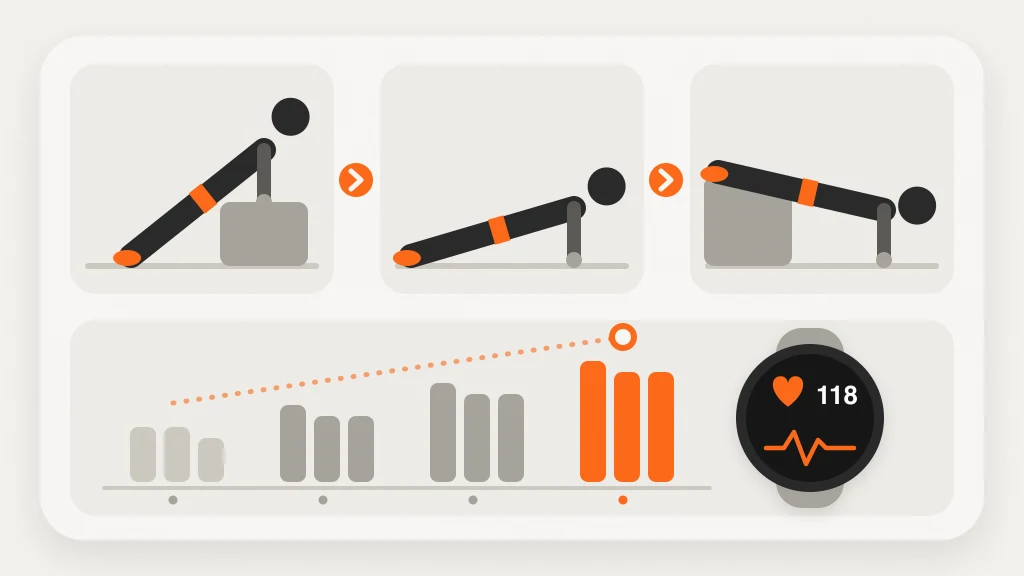
Illustrative scenario. Marta, 34, 68 kg, trains at home on Monday, Wednesday and Friday for about 40 minutes with a doorway bar and a sturdy table. In week 1 she does incline push-ups 3 × 10, table rows 3 × 8, split squats 3 × 8 per leg and a 25-second plank, stopping each set with about 2 reps left. Her watch shows 41 minutes, an average of 112 bpm (about 60 % of an estimated maximum of 186), a wrist peak of 149 bpm during rows and 215 kcal. She treats those as side notes; her log says more: session RPE 7 × 41 minutes is 287 units. By week 4 she reaches 3 × 12 incline push-ups with 2 reps left, so she moves to floor push-ups and drops back to 3 × 6. By week 8 she does floor push-ups 3 × 10, feet-elevated rows 3 × 8, pull-up negatives 3 × 5 with a 5-second lowering and a 45-second plank. Figures are illustrative.
Action steps
- Pick one variation per pattern (push, pull, legs, core) that you can do for 8–12 clean reps with about 2 reps in reserve.
- Train three non-consecutive days a week: four movements, 3 sets each, 1–2 minutes of rest.
- After every session log the variation, reps or hold time, reps in reserve and session RPE.
- When you hit the top of your rep range on all sets, move to the next variation and drop back to the bottom of the range.
- Use a chest strap if you want reliable heart rate; otherwise treat wrist heart rate and calories as rough, and take an easier week every 4–8 weeks.
Related guides
- Progressive overload: the principle behind every improvement
- RPE (rate of perceived exertion): the sensor you always carry
- Strength training for endurance athletes
- Strength training heart rate: what your wearable shows — and what it can’t
- Core training that matters: planks, anti-rotation and what a wearable can tell you
FAQ
Is calisthenics enough to build muscle? Yes for most beginners and many intermediates, as long as you move to harder variations and train close to failure. Heavy external loads remain more efficient for maximal leg strength.
How many days a week should a beginner do calisthenics? Three full-body sessions with a rest day between them is a solid start. Add a fourth day only when recovery is good.
Is a bodyweight workout at home as good as the gym? For general strength, muscle and health, it can be. A gym makes small steps easier to measure; at home you rely on variations, tempo and reps in reserve.
How do I track progress if I cannot do a pull-up yet? Log inverted rows, band-assisted pulls or slow negatives, with the lowering time in seconds. More seconds or reps at the same difficulty is progress.
References
- Schoenfeld et al. (2017). Strength and Hypertrophy Adaptations Between Low- vs. High-Load Resistance Training: A Systematic Review and Meta-analysis. Journal of Strength and Conditioning Research. https://doi.org/10.1519/JSC.0000000000002200
- Kikuchi & Nakazato (2017). Low-load bench press and push-up induce similar muscle hypertrophy and strength gain. Journal of Exercise Science & Fitness. https://doi.org/10.1016/j.jesf.2017.06.003
- Bull et al. (2020). World Health Organization 2020 guidelines on physical activity and sedentary behaviour. British Journal of Sports Medicine. https://doi.org/10.1136/bjsports-2020-102955
- Ainsworth et al. (2011). 2011 Compendium of Physical Activities. Medicine & Science in Sports & Exercise. https://doi.org/10.1249/MSS.0b013e31821ece12
For general information only. This is not medical advice — talk to a qualified professional about your health.
Keep reading
Training science
Zone 2 training: the science and how to do it right
4 min read
Training science
Polarized training (80/20): easy most of the time, hard some of the time
4 min read
Sports
Japanese interval walking: the 3-minute fast / 3-minute slow method, step by step
8 min read
Training science
Interval training and HIIT: designing sessions that work
4 min read
Sports
Trail running with a watch: heart rate, climbs and pacing by effort
7 min read
Sports
Walking for fitness and weight loss: pace, heart rate zones and how much is enough
9 min read