

Training science
Core training that matters: planks, anti-rotation and what a wearable can tell you
Core strength exercises work best when they teach your trunk to resist movement — planks, side planks, anti-rotation presses and carries — rather than endless crunches. Here is how to build a core training workout, how often to do it, and what a watch can and can't measure.
Written by MoveVitals Editorial Collective
Community-authored educational content. Individual clinical review is identified only when a named review is actually recorded.
Editorial standards & corrections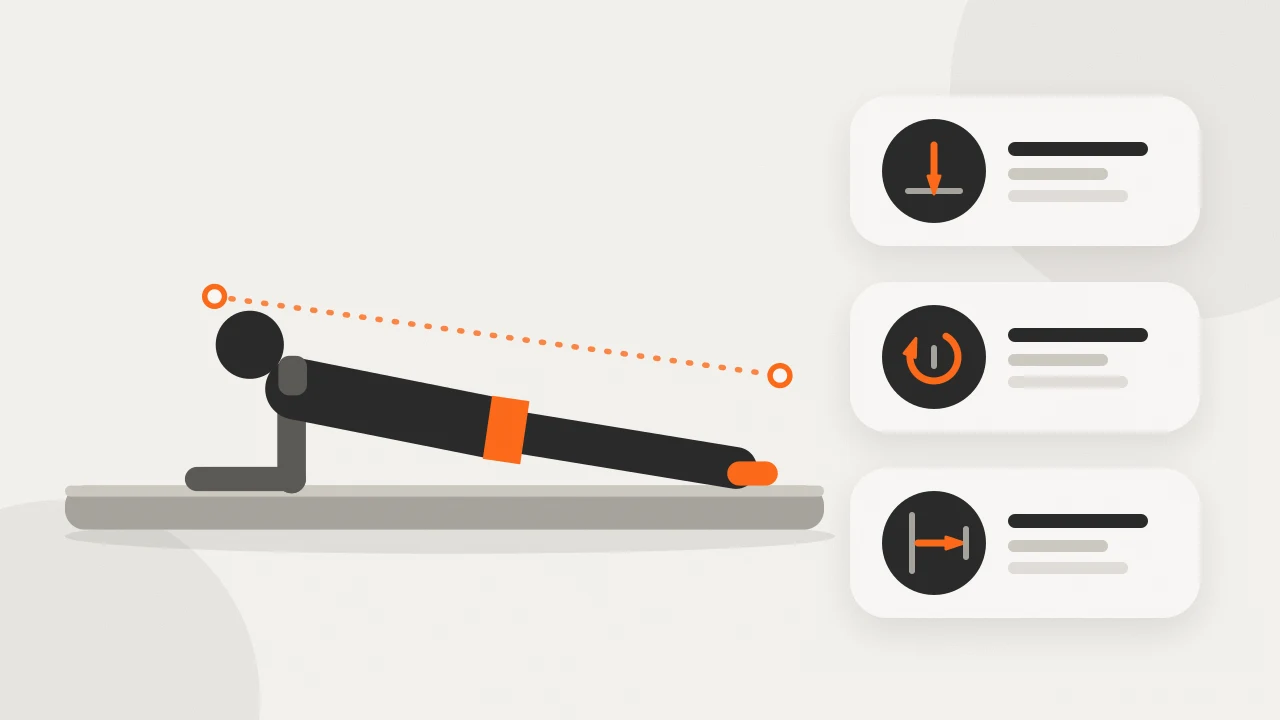
Key takeaways
- Core training works in three directions: anti-extension such as the dead bug, anti-rotation such as the Pallof press, and anti-lateral flexion such as the side plank, while carries train all three.
- A useful plank benchmark is 45–60 seconds of clean form for a front plank and 30–45 seconds per side for a side plank; beyond that, make the exercise harder instead of longer.
- Two or three sessions a week of 10–15 minutes are enough, placed after main lifts or an easy run rather than before heavy squats and deadlifts.
- A wearable cannot measure core strength, so retest plank holds every 4–6 weeks under identical rules.
- Get medical advice for back pain with numbness or weakness in a leg, pain after a fall, or severe pain at night.
The "core" is more than the abs. It is the trunk muscles (rectus abdominis, obliques, transversus abdominis, the deep back muscles, diaphragm and pelvic floor) working with the hips to keep the spine stable while arms and legs move (McGill 2010). Most sport and daily life ask the trunk to stay stiff and pass force along, not to bend over and over. That is why the best core exercises mostly look like holding still.
The three anti-movements, plus carries
| Direction | What it resists | Exercises | Starting dose | How to progress |
|---|---|---|---|---|
| Anti-extension | Lower back arching, ribs flaring | Dead bug, front plank, ab wheel | 2–3 × 6–8 per side or 20–30 s | Longer lever, slower reps |
| Anti-rotation | Twisting | Pallof press, bird dog | 2–3 × 8–10 per side, 2 s pause | Narrower base, half-kneeling, more load |
| Anti-lateral flexion | Side-bending | Side plank, suitcase carry | 2–3 × 15–30 s per side; 20–30 m carry | Leg lift, heavier carry |
Carries (suitcase, farmer) train all three at once and are easy to fit in. Crunches still have a place if you enjoy them, but you do not need them. Reviews of exercise for chronic low back pain find modest benefit and no clear winner among exercise types (Hayden 2021), so pick what you will do consistently. If you have back pain, ask a clinician before starting. Bodyweight versions come first; see calisthenics and bodyweight training.
Plank hold time by age: what is a good time?
There is no validated plank hold time by age chart. Published endurance-hold norms exist only for specific research test positions (McGill 1999), and times depend heavily on how strictly form is judged: ribs down, hips level, no breath-holding. Treat these as rules of thumb, not norms:
| Level | Front plank (forearms) | Side plank (each side) |
|---|---|---|
| Starting | 15–30 s | 10–20 s |
| Solid | 45–60 s | 30–45 s |
| Strong | 60–90 s | 45–60 s |
Hold times tend to fall with age and differ between people, so compare with your past self. Stop the clock when hips sag or pike, ribs flare or you hold your breath. Beyond about 90 seconds, make the exercise harder (feet elevated, longer lever, slower reps) rather than longer. Many coaches prefer repeated 10-second holds with short rests to one long hold (McGill 2010). Older adults can use an incline plank with hands on a counter; see exercise for older adults.
Core stability for runners, cyclists and desk workers
- Runners: side planks, single-leg strength and carries fit on a strength day. Evidence that core work alone improves running economy is limited, but trunk control is part of the general strength that helps tissues tolerate load — see injury prevention for runners and strength training for endurance athletes.
- Cyclists spend hours flexed over the bars. Anti-extension work, bird dogs and side planks balance that, along with thoracic mobility.
- Desk workers: movement matters more than perfect posture (desk posture). A minute of dead bugs or bird dogs and some hip mobility between meetings beats one hard weekly session.
Put core work after your main lifts or an easy run, not before heavy squats and deadlifts, when fatigue would affect your bracing.
How often to train core, and a 12-minute session
Two or three sessions a week of 10–15 minutes, one exercise per direction, 2–3 sets, 30–60 seconds of rest. Change one thing every 1–2 weeks: lever, then tempo, then load, then time. A sample session, breathing normally throughout:
- Dead bug, 2 × 8 per side
- Side plank, 2 × 25 s per side
- Pallof press, 2 × 10 per side
- Suitcase carry, 2 × 30 m per side
Safety. Get medical advice for back pain with numbness or weakness in a leg, pain after a fall, or severe pain at night. After pregnancy or surgery, get individual guidance before loading the trunk.
What a wearable can and can't tell you
| Signal | What you get |
|---|---|
| Session logged | Duration and start time; choose Strength or a similar profile |
| Heart rate | Usually low; static holds barely move it, and breath-holding can spike it. The wrist reading tells you little |
| Reps, holds, carries | Not reliably counted; use a timer and your log |
| Core strength | Not measured: retest holds every 4–6 weeks under identical rules |
| Running dynamics | Ground contact time, vertical oscillation and more from supported watches or pods. Comparing the first and last thirds of long runs at similar pace can hint at form fatigue, but pace, terrain, shoes and tiredness also move them — see running dynamics |
| Posture or back pain | Not measured |
In MoveVitals
Core sessions logged on your watch reach MoveVitals from Garmin, Polar, COROS, WHOOP, Strava or Apple Health as activities with the duration and heart rate the source supplies. Choose Strength or a similar profile so they sit with your lifting; Pilates profiles are filed under Yoga, and a name MoveVitals does not recognise under Other. When the source provides them (for example Garmin, COROS or Apple Health), running-dynamics values are stored with the run, so you can compare early and late parts of long runs over weeks. Hold times and reps stay in your own log.
Worked example
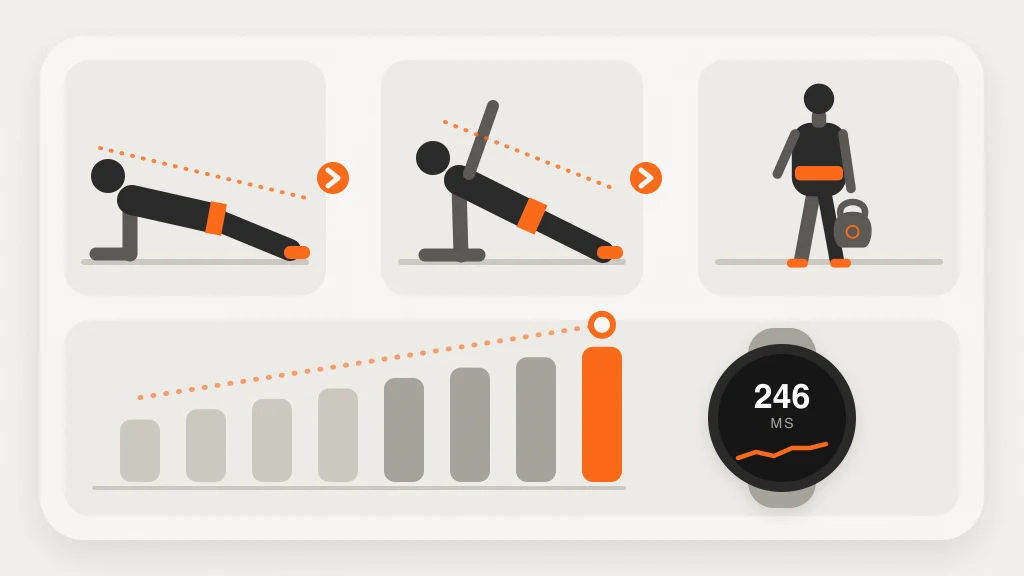
Illustrative scenario. Tom, 41, works at a desk and runs three times a week. He starts with three 12-minute sessions: front plank 3 × 30 s, side plank 2 × 20 s per side, dead bug 2 × 8 per side, Pallof press 2 × 10 per side with a light band and a 16 kg suitcase carry 2 × 30 m. By week 6 he holds a clean front plank for 60 s, so he swaps it for a slow body saw 3 × 8, lengthens the side plank to 40 s and raises the carry to 24 kg. On his Sunday 16 km run, ground contact time in the last 3 km is 14 ms longer than in the first 3 km at the start (252 vs 238 ms). After eight weeks the gap is 7 ms (246 vs 239 ms). He treats that as a hint rather than proof, because pace, route and tiredness change it too, and trusts his hold times more. Figures are illustrative.
Action steps
- Pick one exercise per direction — dead bug, side plank, Pallof press — and learn the form before adding time or load.
- Train two or three times a week for 10–15 minutes, after main lifts or an easy run.
- When you can hold 45–60 s with clean form, make the exercise harder instead of longer.
- Retest front and side plank every 4–6 weeks under the same rules and log the times.
- If you run, compare early and late running-dynamics values on long runs at similar pace, with caution.
Related guides
- Injury prevention for runners: load, strength and listening early
- Strength training for endurance athletes
- Running dynamics: ground contact time, vertical oscillation and stride length
- Desk work and posture: moving more matters more than sitting perfectly
- Hip mobility for runners and cyclists: a 10-minute routine
- Pilates and your wearable: why calories look low and what to track instead
- Calisthenics and bodyweight training: tracking progress without a barbell
FAQ
What are the best ab exercises? Dead bug, front and side plank, Pallof press and carries cover most needs. Add a hanging knee raise or ab wheel later. Choose a few and progress them.
How long should I hold a plank? Aim for 45–60 seconds of clean form, then make it harder. There is no validated chart by age; compare with your own earlier times.
How often should I do core training? Two or three short sessions a week are enough. Daily high-repetition core work is not needed.
Can a smartwatch measure core strength? No. It can log the session and heart rate; hold tests and, for runners, late-run running-dynamics trends are better clues.
References
- McGill (2010). Core Training: Evidence Translating to Better Performance and Injury Prevention. Strength & Conditioning Journal. https://doi.org/10.1519/SSC.0b013e3181df4521
- McGill, Childs & Liebenson (1999). Endurance times for low back stabilization exercises: Clinical targets for testing and training from a normal database. Archives of Physical Medicine and Rehabilitation. https://doi.org/10.1016/S0003-9993(99)90087-4
- Hayden et al. (2021). Exercise therapy for chronic low back pain. Cochrane Database of Systematic Reviews. https://doi.org/10.1002/14651858.CD009790.pub2
For general information only. This is not medical advice — talk to a qualified professional about your health.
Keep reading
Mobility & stretching
Mobility vs flexibility: what's the difference and what do you need?
3 min read
Mobility & stretching
The ideal warm-up: raise, activate, mobilise, potentiate
3 min read
Mobility & stretching
The cool-down: what it does (and doesn't do)
3 min read
Training science
Zone 2 training: the science and how to do it right
4 min read
Training science
Polarized training (80/20): easy most of the time, hard some of the time
4 min read
Sports
Japanese interval walking: the 3-minute fast / 3-minute slow method, step by step
8 min read