

Mobility & stretching
The cool-down: what it does (and doesn't do)
A cool-down helps your heart rate and breathing settle and is a good moment for mobility work. It doesn't prevent next-day soreness, but it still has value.
Written by MoveVitals Editorial Collective
Community-authored educational content. Individual clinical review is identified only when a named review is actually recorded.
Editorial standards & corrections
Key takeaways
- A simple 10-minute cool-down is 5–10 minutes of easy jogging, walking or spinning, 3–5 minutes of calf, hip flexor and hamstring stretches, and a few slow breaths.
- Light movement after very hard efforts helps prevent dizziness from blood pooling in the legs, and it clears blood lactate slightly faster.
- Heart rate recovery in the first minute after stopping is a useful fitness marker, and a steady 2–3 minute walk at the end of runs makes it easier to compare over time.
- Refuelling and rehydrating matter more for recovery than the cool-down itself, and easy runs need no separate cool-down.
What research says
- Doesn't significantly reduce delayed-onset muscle soreness (DOMS) or speed up recovery of performance the next day.
- Does help gradually lower heart rate and breathing, reducing dizziness after very hard efforts.
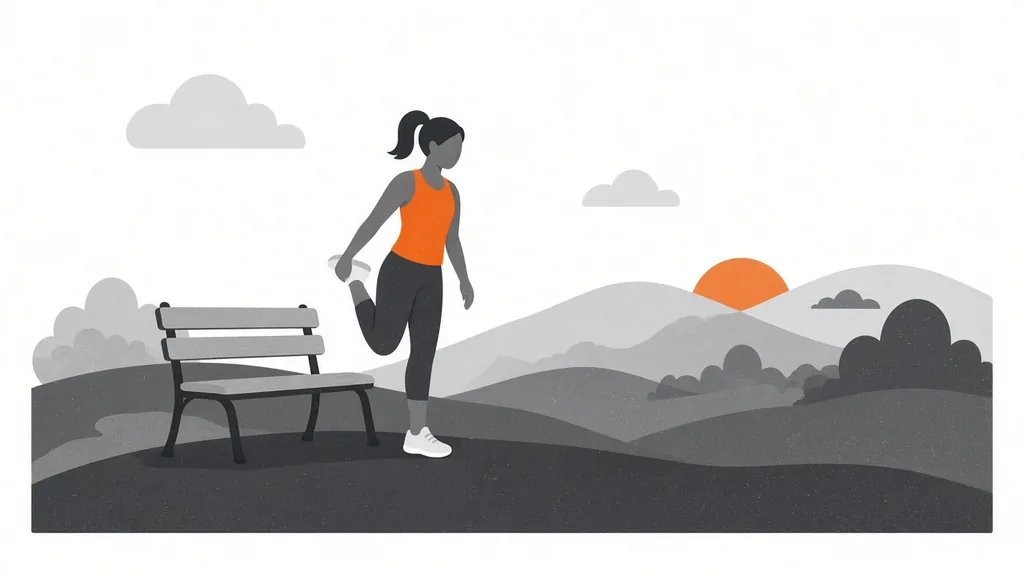
- Is a practical time for mobility and stretching when muscles are warm.
- Light movement after intervals or racing helps clear lactate faster — useful if you compete again soon.
A simple 10-minute cool-down
| Step | Time |
|---|---|
| Easy jog, walk or spin | 5–10 min |
| Calf, hip flexor and hamstring stretches | 3–5 min |
| A few slow breaths, 6 per minute | 1–2 min — see breathing and HRV |
Use it as a data moment
Your heart rate recovery in the first minute after stopping is a useful fitness marker; a steady 2–3 minute walk at the end of runs makes it easier to compare over time.
Worked example
Illustrative scenario. After a session of 6 × 800 m intervals, Priya's heart rate is 178 bpm. She jogs slowly for 8 minutes, then walks 2 minutes. Her watch records heart rate recovery as a fall to 140 bpm in the first minute and under 110 bpm by the end. She knows the review by Van Hooren and Peake found that cool-downs don't reliably reduce next-day soreness, so she doesn't expect that; instead she uses the time to bring her breathing down gradually, avoid dizziness, and do 5 minutes of hip and calf mobility while she is warm. She compares her heart-rate drop after similar sessions over a training block.
Action steps
- After hard sessions, jog, spin or walk easily for 5–10 minutes rather than stopping abruptly.
- Keep intensity low enough that you can breathe through your nose.
- Add 3–5 minutes of mobility for the areas you trained.
- Note your one-minute heart rate drop after similar workouts to track a trend.
- Refuel and rehydrate afterwards; that matters more for recovery than the cool-down itself.
Related guides
- Heart rate recovery: how fast your heart rate drops after exercise
- Foam rolling: what it does and how to use it
- The ideal warm-up: raise, activate, mobilise, potentiate
- Static vs dynamic stretching: which, when and how long?
- Active recovery: when easy movement beats complete rest
FAQ
Is stopping abruptly dangerous? After very hard efforts, light movement helps prevent dizziness from blood pooling in the legs.
Can I skip the cool-down after easy runs? Yes — easy runs already end gently.
Does a cool-down remove lactate? It can clear blood lactate slightly faster, but lactate returns to normal within an hour anyway and isn't the cause of next-day soreness.
Is stretching part of a cool-down? It can be. Gentle stretching or mobility feels good for many people, but it isn't required.
References
- Van Hooren & Peake (2018). Do We Need a Cool-Down After Exercise? A Narrative Review of the Psychophysiological Effects and the Effects on Performance, Injuries and the Long-Term Adaptive Response. Sports Medicine. https://doi.org/10.1007/s40279-018-0916-2
- Dupuy et al. (2018). An Evidence-Based Approach for Choosing Post-exercise Recovery Techniques to Reduce Markers of Muscle Damage, Soreness, Fatigue, and Inflammation: A Systematic Review With Meta-Analysis. Frontiers in Physiology. https://doi.org/10.3389/fphys.2018.00403
For general information only. This is not medical advice — talk to a qualified professional about your health.
Keep reading
Training science
Zone 2 training: the science and how to do it right
4 min read
Mobility & stretching
Mobility vs flexibility: what's the difference and what do you need?
3 min read
Sports
Japanese interval walking: the 3-minute fast / 3-minute slow method, step by step
8 min read
Training science
Polarized training (80/20): easy most of the time, hard some of the time
4 min read
Training science
Interval training and HIIT: designing sessions that work
4 min read
Sports
Trail running with a watch: heart rate, climbs and pacing by effort
7 min read