

Metrics explained
Heart rate recovery: how fast your heart rate drops after exercise
Heart rate recovery (HRR) is how many beats your heart rate falls in the first minute or two after you stop exercising. A faster drop reflects good fitness and healthy autonomic function.
Written by MoveVitals Editorial Collective
Community-authored educational content. Individual clinical review is identified only when a named review is actually recorded.
Editorial standards & corrections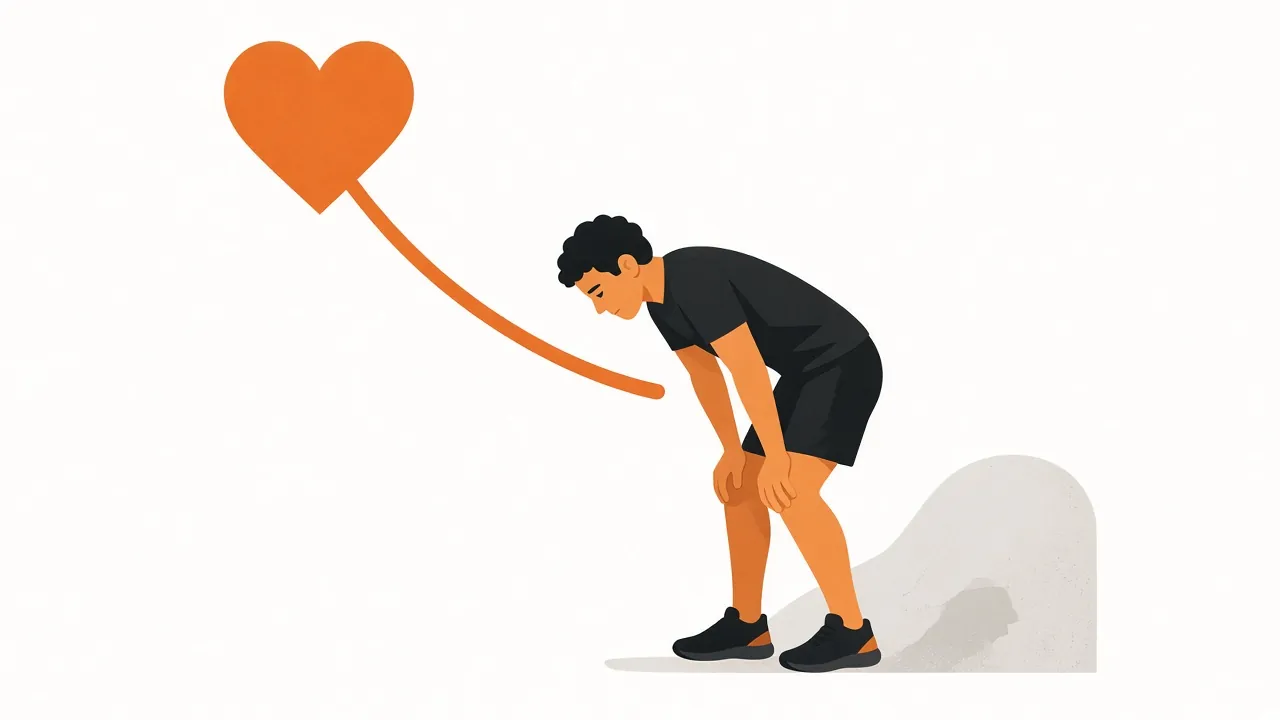
Key takeaways
- A heart rate drop of under 12 bpm in the first minute after hard effort is low and linked to higher cardiovascular risk in studies, 12–20 bpm is average, 20–30 bpm is good and over 30 bpm is very good.
- To test HRR consistently, do a hard effort of 3–5 minutes, record heart rate at the end and exactly 60 seconds later, and use the same recovery position each time.
- The under-12 threshold comes from clinical tests where people stop and stand or sit, and active cool-downs give smaller drops.
- Heat, dehydration, caffeine, fatigue and medications such as beta-blockers all change heart rate recovery; consult a doctor if it is unusually slow along with symptoms.
When you stop exercising, the parasympathetic nervous system quickly slows the heart. Heart rate recovery (HRR) measures that drop — typically over 1 minute (HRR1) or 2 minutes (HRR2). Apple Watch reports cardio recovery after workouts; Garmin, Polar and others can show it too.
Reference values (HRR1, after hard effort)
| Drop in first minute | Interpretation |
|---|---|
| < 12 bpm | Low — associated with higher cardiovascular risk in studies |
| 12–20 bpm | Average |
| 20–30 bpm | Good |
| > 30 bpm | Very good, typical of fit athletes |
The < 12 bpm threshold comes from clinical exercise tests where people stop and stand or sit; active cool-downs give smaller drops.
How to test it consistently
- Do a hard effort of at least 3–5 minutes (e.g. the end of an interval).
- Note your heart rate at the moment you stop.
- Stand still or walk slowly for 1–2 minutes.
- Note the heart rate again — ideally with a chest strap such as the Polar H10.
- Repeat the same test every few weeks.
What affects it
- Fitness: improves with aerobic training.
- Fatigue and overreaching: recovery can slow — or paradoxically speed up — with heavy accumulated fatigue; compare with HRV and how you feel.
- Heat, dehydration and caffeine.
- Medications such as beta-blockers.
In MoveVitals
With second-by-second heart rate streams from Strava, Polar, Garmin or the Polar H10, MoveVitals can show the heart rate drop at the end of each effort, and Apple's cardio recovery is stored when available.
Worked example
Worked example. At the end of a 4-minute hard hill effort, Ana's heart rate is 178 bpm. She stops and stands still; 60 seconds later it is 146 bpm, so HRR1 = 178 − 146 = 32 bpm. In a large clinical cohort, a 1-minute drop of 12 bpm or less after a treadmill test was associated with higher mortality risk (Cole 1999) — her value is well above that. More useful for her is the trend: after 3 months of consistent aerobic training, the same test gives about 36 bpm. HRR here is a fitness signal, not a diagnosis.

Action steps
- Use the same hard effort each time (e.g. 3–5 minutes near max).
- Record heart rate at the end of the effort and exactly 60 seconds later.
- Use the same recovery position every time (standing still or walking).
- Wear a chest strap for accurate rapid changes.
- Compare monthly; consult a doctor if recovery is unusually slow along with symptoms.
Related guides
- Resting heart rate: normal ranges and what changes it
- Maximum heart rate: formulas, field tests and why age-based estimates fail
- VO2 max: what it means and how to improve it
- Normal heart rate variability (HRV) by age: RMSSD vs SDNN
FAQ
Is HRR the same as resting heart rate? No — it's a dynamic measure after effort; resting heart rate is at rest.
My HRR varies a lot between workouts. Different end intensities and cool-downs change it; use a standard test.
Does heat or caffeine affect HRR? Yes, heat, dehydration, caffeine and fatigue can all slow recovery, so test in similar conditions.
Is a 2-minute HRR useful too? Yes; some protocols use 2 minutes, which is less sensitive to timing errors. Just use the same window every time.
References
- Cole et al. (1999). Heart-Rate Recovery Immediately after Exercise as a Predictor of Mortality. New England Journal of Medicine. https://doi.org/10.1056/NEJM199910283411804
- Buchheit et al. (2013). High-Intensity Interval Training, Solutions to the Programming Puzzle. Sports Medicine. https://doi.org/10.1007/s40279-013-0029-x
- Shaffer et al. (2017). An Overview of Heart Rate Variability Metrics and Norms. Frontiers in Public Health. https://doi.org/10.3389/fpubh.2017.00258
For general information only. This is not medical advice — talk to a qualified professional about your health.
Keep reading
Metrics explained
Resting heart rate: normal ranges and what changes it
4 min read
Metrics explained
Normal heart rate variability (HRV) by age: RMSSD vs SDNN
6 min read
Metrics explained
VO2 max: what it means and how to improve it
4 min read
Devices & setup
How MoveVitals handles multiple devices: provenance, duplicates and conflicts
5 min read
Sports
Walking for fitness and weight loss: pace, heart rate zones and how much is enough
9 min read
Training science
Zone 2 training: the science and how to do it right
4 min read