

Mobility & stretching
Thoracic spine mobility: for cyclists, rowers and desk workers
The upper back is built to rotate and extend. When it stiffens, the neck, shoulders and lower back compensate. A few drills restore it.
Written by MoveVitals Editorial Collective
Community-authored educational content. Individual clinical review is identified only when a named review is actually recorded.
Editorial standards & corrections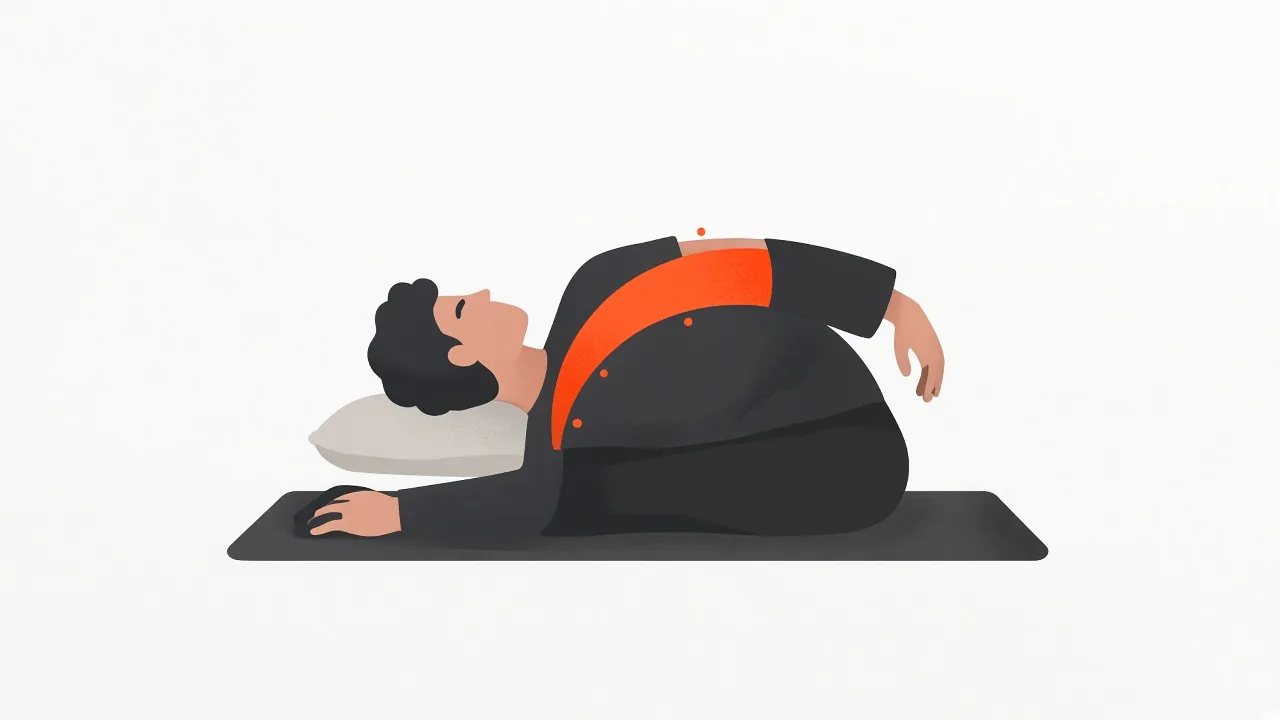
Key takeaways
- A five-drill routine takes 8–10 minutes: open books 8–10 per side, thread the needle 8 per side, foam roller extensions 8–10, quadruped rotations 8 per side and wall slides 2 × 10.
- Signs of a stiff thoracic spine include neck or shoulder tension on long rides, limited overhead reach and rotation coming mostly from the lower back.
- Rows, face pulls and Y-T-W raises strengthen the upper back so you can hold better posture.
- Desk workers should set screens at eye level, take a movement break every 30–60 minutes and do one or two drills during the day.
- Back pops are usually harmless, but pain is a reason to stop, and evidence that thoracic work eases neck or shoulder discomfort is limited.
The thoracic spine (mid and upper back) should provide most of your trunk rotation and extension. Long hours on a bike, at a desk or on a rowing machine encourage a rounded upper back.
Signs of stiffness
- Neck or shoulder tension on long rides
- Difficulty getting into an aero position without lower-back discomfort
- Limited overhead reach
- Rotation coming mostly from the lower back
Five drills (8–10 minutes)
| Drill | Dose | Notes |
|---|---|---|
| Open books (side-lying rotation) | 8–10 per side | Keep knees stacked |
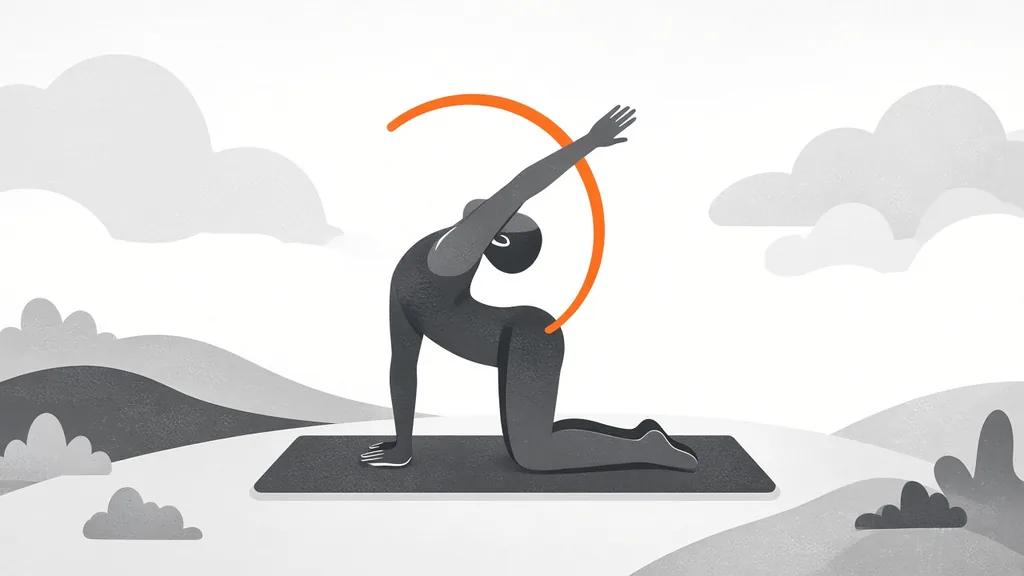
| Thread the needle | 8 per side | From all fours |
| Foam roller extensions | 8–10 | Roller across the upper back, support the head |
| Quadruped rotations (hand behind head) | 8 per side | Move from the mid-back |
| Wall slides / angels | 2 × 10 | Back and arms against wall |
Pair with strength
Rows, face pulls and Y-T-W raises strengthen the upper back so you can hold better posture — see strength training.
For desk workers
Set screens at eye level, take a movement break every 30–60 minutes, and do one or two drills during the day — see desk posture.
Worked example
Illustrative scenario. Dev sits 9 hours a day and finds overhead presses uncomfortable. He does a 6-minute routine most days: open-book rotations (8 per side), thoracic extensions over a foam roller (10 slow reps), and cat–camel (10 reps). After four weeks his seated rotation, measured with a stick across his shoulders, improves from about 35° to 45° per side, and overhead pressing feels smoother. He also sets a timer to stand every 45 minutes. Results are illustrative; persistent pain or numbness should be assessed by a clinician.
Action steps
- Do 5–10 minutes of thoracic work on most days.
- Include rotation (open books) and extension (foam roller or bench) movements.
- Breathe out slowly at end range to relax into the position.
- Break up long sitting every 30–60 minutes.
- Retest rotation every 2–4 weeks to track change.
Related guides
- Desk work and posture: moving more matters more than sitting perfectly
- Mobility vs flexibility: what's the difference and what do you need?
- Hip mobility for runners and cyclists: a 10-minute routine
- Foam rolling: what it does and how to use it
- Core training that matters: planks, anti-rotation and what a wearable can tell you
FAQ
Is a rounded back on the bike bad? Some rounding is normal and aerodynamic; what matters is comfort and control.
Will my back crack? Harmless pops are common; pain is a reason to stop.
Can thoracic mobility help neck or shoulder discomfort? It may help some people by sharing movement more evenly, but evidence is limited and pain has many causes.
Should I crack my back on the foam roller? Pops can happen and are usually harmless, but don't force movement into pain.
References
- Behm et al. (2016). Acute effects of muscle stretching on physical performance, range of motion, and injury incidence in healthy active individuals: a systematic review. Applied Physiology, Nutrition, and Metabolism. https://doi.org/10.1139/apnm-2015-0235
- Garber et al. (2011). Quantity and Quality of Exercise for Developing and Maintaining Cardiorespiratory, Musculoskeletal, and Neuromotor Fitness in Apparently Healthy Adults. Medicine & Science in Sports & Exercise. https://doi.org/10.1249/MSS.0b013e318213fefb
For general information only. This is not medical advice — talk to a qualified professional about your health.
Keep reading
Mobility & stretching
Mobility vs flexibility: what's the difference and what do you need?
3 min read
Mobility & stretching
Hip mobility for runners and cyclists: a 10-minute routine
3 min read
Mobility & stretching
The ideal warm-up: raise, activate, mobilise, potentiate
3 min read
Training science
Zone 2 training: the science and how to do it right
4 min read
Training science
Polarized training (80/20): easy most of the time, hard some of the time
4 min read
Devices & setup
Strava and MoveVitals: workouts, streams and devices that arrive via Strava
3 min read