

Mobility & stretching
Foam rolling: what it does and how to use it
Foam rolling can briefly increase range of motion and reduce perceived soreness, with no clear downside. It doesn't "break up" tissue — but it feels good and helps you move.
Written by MoveVitals Editorial Collective
Community-authored educational content. Individual clinical review is identified only when a named review is actually recorded.
Editorial standards & corrections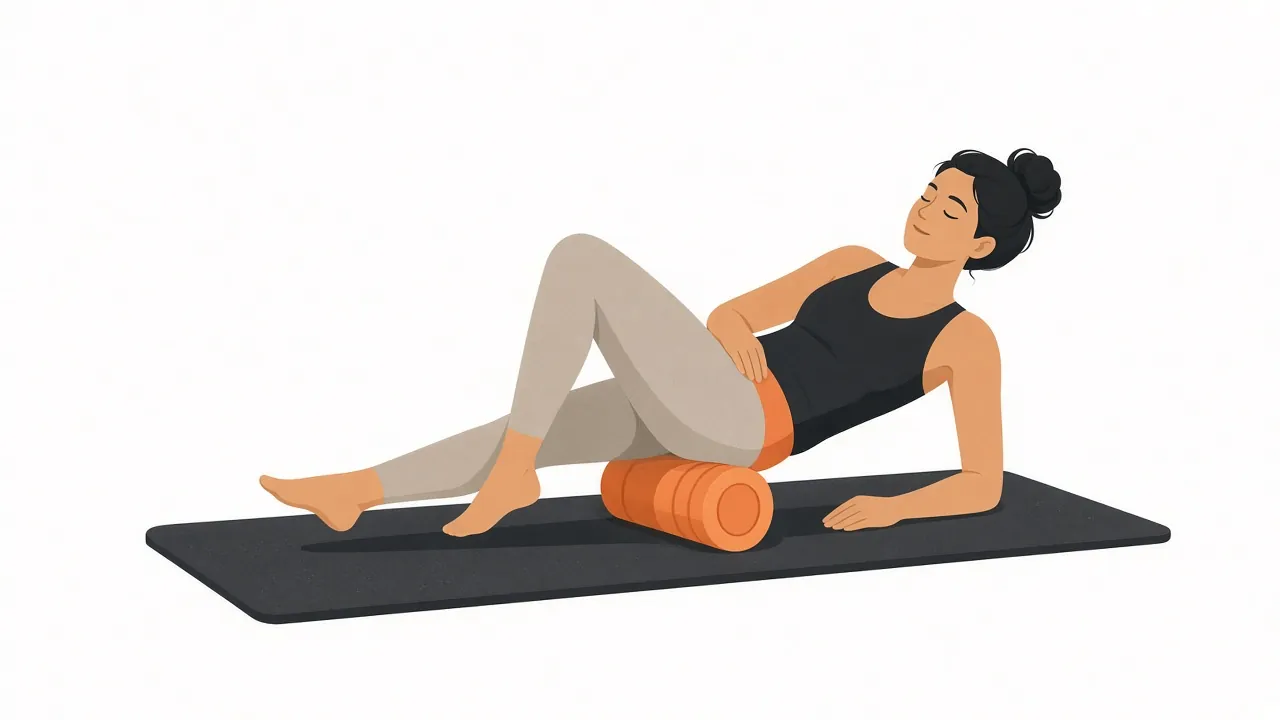
Key takeaways
- Foam rolling increases range of motion for 10–30 minutes without reducing strength, which makes it useful in a warm-up.
- Roll each muscle group for 30–90 seconds at moderate pressure, around 5–7 out of 10 discomfort, moving about 2–3 cm per second.
- Foam rolling does not lengthen fascia or break up knots; its effects come mostly through the nervous system and tissue sensitivity.
- Avoid rolling directly on the lower back, over bones and joints, or on an acute injury, bruise or swelling, and seek advice for sharp, burning or worsening pain.
What the evidence shows
- Short-term range of motion increases for 10–30 minutes, without reducing strength — useful in a warm-up.
- Perceived soreness after hard sessions can be modestly reduced.
- It does not physically lengthen fascia or "break up knots"; effects are mostly through the nervous system and tissue sensitivity.
How to roll
| Area | How | Time |
|---|---|---|
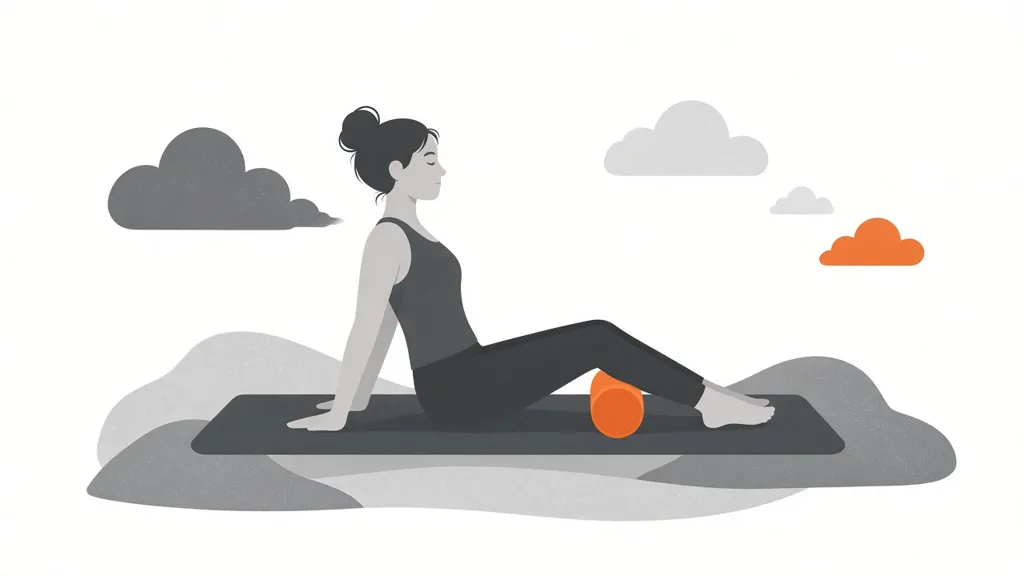
| Calves | Sit, roller under calves, roll ankle to knee; turn feet in/out | 60–90 s per leg |
| Quads | Face down, roll hip to above knee | 60–90 s |
| Glutes | Sit on roller, cross ankle over knee, lean to one side | 60 s per side |
| Upper back | Roller across upper back, hands behind head, small extensions | 60 s — see thoracic mobility |
| Adductors | Face down, one leg out to the side over roller | 60 s per side |
Use moderate pressure (around 5–7 out of 10 discomfort), move slowly, and breathe.
What to avoid
- Rolling directly on the lower back or over bones and joints
- Rolling an acute injury, bruise or swelling
- The IT band: rolling it is very uncomfortable and offers little; roll the surrounding muscles (glutes, quads) instead
When to roll
- Before training: 30–60 s per area as part of the warm-up.
- After or on rest days: longer, relaxed rolling for comfort and active recovery.
Worked example
Illustrative scenario. After a long run, Nina's calves feel tight and her ankle range drops. Before her next run she rolls each calf for about 60 seconds at a moderate pressure (around 5–6/10 discomfort), moving slowly. Her knee-to-wall test improves by about 1–2 cm for the session. A meta-analysis found that foam rolling before exercise gives small short-term gains in flexibility and sprint performance, and rolling after exercise can modestly reduce perceived soreness (Wiewelhove 2019) — so she uses it as a warm-up and comfort tool, not a fix for injuries.
Action steps
- Roll each muscle group for 30–90 seconds.
- Move slowly, about 2–3 cm per second, and breathe.
- Keep pressure moderate; avoid rolling directly over bones, joints or the lower back.
- Use it before training as part of a warm-up, then add dynamic moves.
- Stop and seek advice for sharp, burning or worsening pain.
Related guides
- The ideal warm-up: raise, activate, mobilise, potentiate
- Active recovery: when easy movement beats complete rest
- Static vs dynamic stretching: which, when and how long?
- Ankle mobility: the knee-to-wall test and exercises that work
FAQ
Soft or hard roller? Start soft; firmer or textured rollers suit experienced users.
Massage guns? Similar short-term effects; use the same rules.
Does foam rolling break up fascia or scar tissue? Probably not; the forces are too small. Effects are more likely related to nervous-system tolerance to stretch and short-term comfort.
Is daily foam rolling safe? For most healthy people, short moderate sessions are fine; avoid rolling over bruises, varicose veins or acute injuries.
References
- Wiewelhove et al. (2019). A Meta-Analysis of the Effects of Foam Rolling on Performance and Recovery. Frontiers in Physiology. https://doi.org/10.3389/fphys.2019.00376
- Behm et al. (2016). Acute effects of muscle stretching on physical performance, range of motion, and injury incidence in healthy active individuals: a systematic review. Applied Physiology, Nutrition, and Metabolism. https://doi.org/10.1139/apnm-2015-0235
For general information only. This is not medical advice — talk to a qualified professional about your health.
Keep reading
Mobility & stretching
Mobility vs flexibility: what's the difference and what do you need?
3 min read
Mobility & stretching
Hip mobility for runners and cyclists: a 10-minute routine
3 min read
Mobility & stretching
The ideal warm-up: raise, activate, mobilise, potentiate
3 min read
Training science
Zone 2 training: the science and how to do it right
4 min read
Devices & setup
Strava and MoveVitals: workouts, streams and devices that arrive via Strava
3 min read
Training science
Polarized training (80/20): easy most of the time, hard some of the time
4 min read