

Metrics explained
VO2 max: what it means and how to improve it
VO2 max is the maximum amount of oxygen your body can use during exercise. It is the best single number for cardiorespiratory fitness and a strong predictor of long-term health.
Written by MoveVitals Editorial Collective
Community-authored educational content. Individual clinical review is identified only when a named review is actually recorded.
Editorial standards & corrections
Key takeaways
- At age 30–39, a good VO2 max is 44–47 ml/kg/min for men and 38–41 for women, while elite endurance athletes reach 70–85+ and 60–75+.
- Watches estimate it from the relationship between heart rate and pace or power, with average errors of a few ml/kg/min, so trends are more useful than absolute values.
- VO2 max declines by roughly 10 % per decade after 30 in inactive people, and training can slow that dramatically.
- Add intervals once or twice a week, such as 4–6 × 4 minutes at 90–95 % of maximum heart rate with 3 minutes easy, after a medical check if you have heart risk factors.
- Beginners can improve 15–20 % in a few months, while trained athletes see smaller gains.
VO2 max is the highest rate at which your body can take in, transport and use oxygen, expressed in millilitres of oxygen per kilogram of body weight per minute (ml/kg/min). The higher it is, the more aerobic energy you can produce.
How it is measured
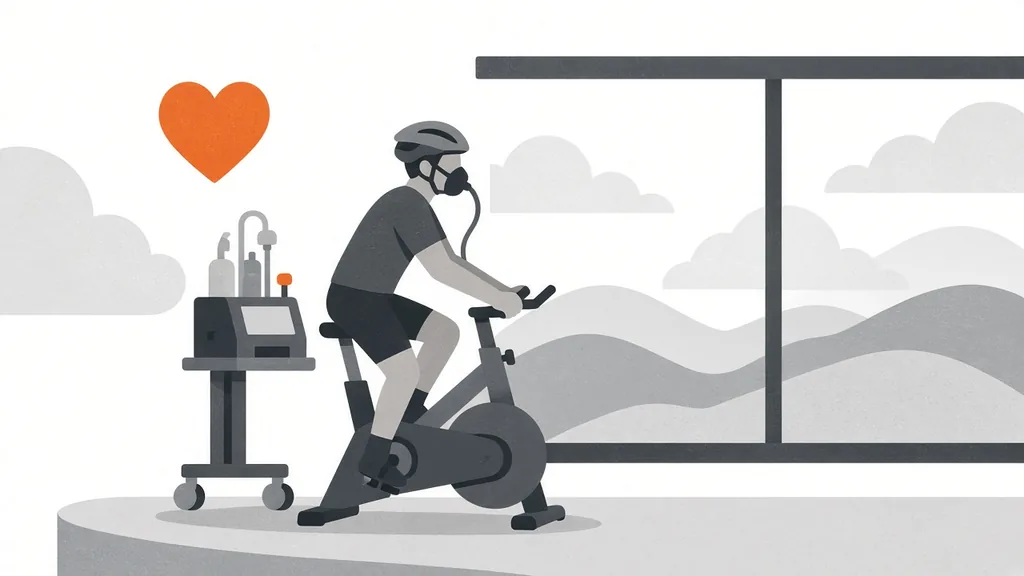
- Lab test: you run or ride to exhaustion while a mask measures the gases you breathe. This is the reference method.
- Wearable estimate: Apple Watch, Garmin, Polar and COROS estimate VO2 max from the relationship between heart rate and pace (or power) during outdoor runs, walks or rides. Good estimates are typically within about 5–10 % of a lab value for runners, less reliable for people with unusual heart rate responses.
- Field tests: the Cooper 12-minute run or a 5 km time trial can be converted into an estimate.
Estimates improve with accurate data: a chest strap, correct maximum heart rate, GPS runs on flat ground and an up-to-date weight.
Typical values
| Rating | Men 30–39 | Women 30–39 |
|---|---|---|
| Poor | < 41 | < 34 |
| Fair | 41–43 | 34–37 |
| Good | 44–47 | 38–41 |
| Excellent | 48–53 | 42–46 |
| Superior | ≥ 54 | ≥ 47 |
| Elite endurance athletes | 70–85+ | 60–75+ |
For every age group, see the VO2 max chart by age and sex. The values above follow the same percentile scheme (Cooper Institute data, as used by Garmin) for ages 30–39.
VO2 max declines by roughly 10 % per decade after 30 in inactive people; training can slow that dramatically.
Why it matters
Cardiorespiratory fitness is one of the strongest predictors of all-cause mortality — moving from the lowest fitness group to even the next one is associated with a large reduction in risk. For athletes, VO2 max sets the ceiling of endurance performance, together with lactate threshold and running economy.
How to improve it
- Build an aerobic base with plenty of easy, zone 2 volume.
- Add VO2 max intervals once or twice a week: for example 4–6 × 4 minutes at 90–95 % of maximum heart rate with 3 minutes easy between.
- Be consistent. Beginners can improve 15–20 % in a few months; trained athletes see smaller gains.
- Lose excess body fat if appropriate — because the unit is per kilogram, weight changes move the number.
In MoveVitals
VO2 max estimates from Apple Health and other sources are stored with their source and date, so you can follow the trend without mixing two vendors' algorithms.
Worked example
Illustrative scenario. Elena's watch estimates her VO2max at 38 ml/kg/min. She keeps three easy runs a week and adds one session of 4 × 4 minutes at about 90–95% of max heart rate with 3 minutes of active recovery, a protocol studied by Helgerud and colleagues. After 10 weeks her estimate reads 41 and her 5K is about 90 seconds faster. Large cohort studies link higher cardiorespiratory fitness with lower mortality risk, though wearable estimates can be off by several units versus lab testing. Figures are illustrative.
Action steps
- Build an easy aerobic base of 3–4 sessions a week.
- Add one VO2max session weekly, e.g. 4 × 4 min hard with 3 min easy.
- Keep hard intervals at an effort you could hold for about 6–8 minutes.
- Use the same device and similar conditions to track the estimate.
- Get a medical check before hard intervals if you have heart risk factors.
Related guides
- Interval training and HIIT: designing sessions that work
- Heart rate zones explained: how to set and use them
- Zone 2 training: the science and how to do it right
- Maximum heart rate: formulas, field tests and why age-based estimates fail
- VO2 max by age and sex: norms, fitness age and what a good score looks like
FAQ
Why did my VO2 max drop after a hot run? Heat raises heart rate at the same pace, which the algorithm reads as lower fitness. One run rarely matters; watch the trend.
Is a watch estimate good enough? For trends, yes. For an exact value, only a lab test.
How accurate are watch VO2max estimates? Studies show errors of a few ml/kg/min on average, larger for some individuals; trends are more useful than absolute values.
Does VO2max decline with age? Yes, typically by around 10% per decade after 30, but regular training can slow the decline substantially.
References
- Kodama (2009). Cardiorespiratory Fitness as a Quantitative Predictor of All-Cause Mortality and Cardiovascular Events in Healthy Men and Women. JAMA. https://doi.org/10.1001/jama.2009.681
- Mandsager et al. (2018). Association of Cardiorespiratory Fitness With Long-term Mortality Among Adults Undergoing Exercise Treadmill Testing. JAMA Network Open. https://doi.org/10.1001/jamanetworkopen.2018.3605
- Helgerud et al. (2007). Aerobic High-Intensity Intervals Improve V˙O2max More Than Moderate Training. Medicine & Science in Sports & Exercise. https://doi.org/10.1249/mss.0b013e3180304570
For general information only. This is not medical advice — talk to a qualified professional about your health.
Keep reading
Metrics explained
Resting heart rate: normal ranges and what changes it
4 min read
Devices & setup
Strava and MoveVitals: workouts, streams and devices that arrive via Strava
3 min read
Training science
Interval training and HIIT: designing sessions that work
4 min read
Sports
Trail running with a watch: heart rate, climbs and pacing by effort
7 min read
Devices & setup
Polar watches and MoveVitals: Polar Flow sync explained
3 min read
Training science
Zone 2 training: the science and how to do it right
4 min read