

Metrics explained
VO2 max by age and sex: norms, fitness age and what a good score looks like
VO2 max by age matters because the same number means different things at 25 and at 55: a man aged 40–49 is rated "Good" from about 42 ml/kg/min, a woman of the same age from about 36. Here is the full chart for ages 20–79 and how your watch rates you.
Written by MoveVitals Editorial Collective
Community-authored educational content. Individual clinical review is identified only when a named review is actually recorded.
Editorial standards & corrections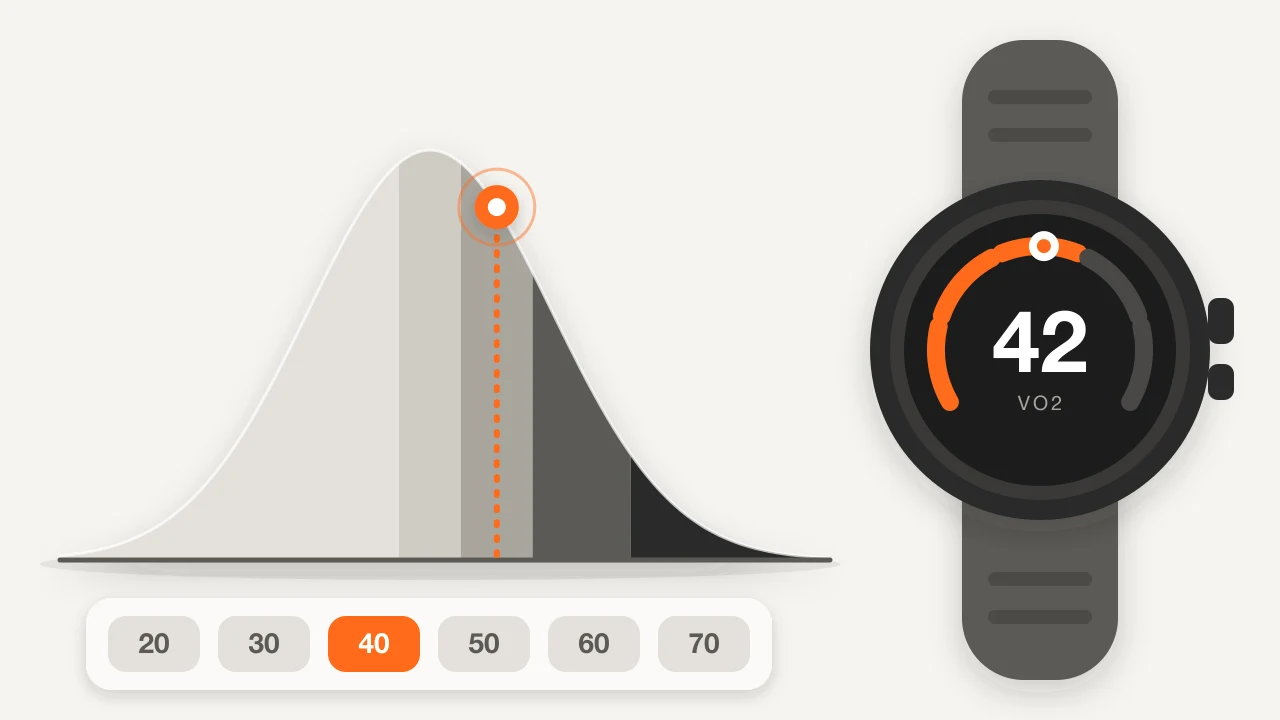
Key takeaways
- The "Good" band drops with age: from 44 ml/kg/min for men and 38 for women at 30–39 to 36 and 30 at 60–69.
- Ratings are percentiles for your age and sex: Fair is the 40th–60th, Good the 60th–80th, Excellent the 80th–95th and Superior the top 5 %.
- Garmin, Apple, Polar and COROS use different methods and rating scales, and estimates are typically within about 5–10 % of a lab value for runners, so follow one device's trend.
- To move up a category, combine 3–4 easy sessions a week with one interval session, such as 4 × 4 minutes hard with 3 minutes easy, for 8–12 weeks.
- A low rating is a prompt to build fitness, not a diagnosis, but chest pain, fainting or palpitations with dizziness during exercise call for a doctor.
How to read the charts
VO2 max is the most oxygen your body can use per kilogram of body weight per minute (ml/kg/min). See VO2 max for what it is and how it is measured. The ratings below follow the percentile scheme Garmin publishes for its watches, which credits the Cooper Institute, rounded to whole numbers:
- Poor: below the 40th percentile for your age and sex.
- Fair: 40th–60th percentile. Good: 60th–80th. Excellent: 80th–95th. Superior: the top 5 %.
Each cell shows the lowest value that earns that rating; anything below the Fair column is Poor. "Poor" only means "below the 40th percentile of the reference group", not unhealthy. The reference group was mostly healthy, middle-to-upper-income adults tested at one US clinic, so these bars may be higher than for the general population, and other published tables differ by a few ml/kg/min. Treat the chart as orientation, not a verdict.
VO2 max chart for men (ml/kg/min)
| Age | Fair (40th) | Good (60th) | Excellent (80th) | Superior (95th) |
|---|---|---|---|---|
| 20–29 | 42 | 45 | 51 | 55 |
| 30–39 | 41 | 44 | 48 | 54 |
| 40–49 | 39 | 42 | 46 | 53 |
| 50–59 | 36 | 39 | 43 | 49 |
| 60–69 | 32 | 36 | 40 | 46 |
| 70–79 | 29 | 32 | 37 | 42 |
VO2 max chart for women (ml/kg/min)
| Age | Fair (40th) | Good (60th) | Excellent (80th) | Superior (95th) |
|---|---|---|---|---|
| 20–29 | 36 | 40 | 44 | 50 |
| 30–39 | 34 | 38 | 42 | 47 |
| 40–49 | 33 | 36 | 40 | 45 |
| 50–59 | 30 | 33 | 37 | 41 |
| 60–69 | 28 | 30 | 33 | 38 |
| 70–79 | 26 | 28 | 31 | 37 |
What the charts tell you
- It falls with age. In the treadmill-based FRIEND registry of laboratory tests, the median (50th percentile) drops from about 48 to 24 ml/kg/min in men and from about 38 to 18 in women between the 20s and the 70s. Regular training can slow that decline substantially.
- Women's values are lower on average per kilogram, partly because of differences in body composition, haemoglobin and heart size. Always read your own sex's chart.
- It is a snapshot of fitness, not a diagnosis. A value is one number from one method; use it with your trend and how you feel.
Why it matters
Cardiorespiratory fitness is one of the strongest predictors of long-term health. A meta-analysis found that each 1-MET higher fitness (3.5 ml/kg/min) was associated with roughly 13 % lower all-cause mortality and 15 % lower cardiovascular risk. In a large cohort of adults who had treadmill tests, survival improved step by step with fitness with no clear upper limit, and the lowest-fitness group had several times the mortality risk of the elite group. These are associations, not proof that raising your number alone changes your risk, but the largest gains are usually seen when people move out of the lowest fitness group.
Fitness age and watch ratings: how brands differ
| Watch | What you see | Good to know |
|---|---|---|
| Garmin | VO2 max, a rating from Poor to Superior and a Fitness Age | Estimated from heart rate against pace or power in runs and rides. Fitness Age compares you with others of your sex; depending on the watch and software, it may also use vigorous activity, resting heart rate and BMI or body fat, so weight changes can move it. |
| Apple Watch | Cardio Fitness in Health: Low, Below Average, Above Average or High for your age and sex (age 20+) | Uses heart and motion data from outdoor walk, run or hike workouts, plus age, sex, weight, height and medications that affect heart rate. Indoor and gym workouts do not count. Supported range is 14–65 ml/kg/min. |
| Polar, COROS | Their own VO2 max estimates from workouts | Methods and rating labels differ from Garmin's table, so check which scale your app uses. |
Estimates are typically within about 5–10 % of a lab value for runners and can be less reliable if your heart rate responds unusually, for example with medication that limits heart rate. Two brands can disagree by several units and both be reasonable, so compare trends, not brands. Weight is part of the unit, so keep body weight up to date.
How to move up a category
- Build an easy aerobic base: 3–4 sessions a week, mostly at a conversational effort (zone 2).
- Add one interval session a week, for example 4 × 4 minutes hard with 3 minutes easy (interval training), and keep the rest easy (polarized training).
- Check the inputs: a realistic maximum heart rate, a chest strap if you can, outdoor GPS runs on fairly flat ground.
- Give it 8–12 weeks. Beginners can improve 15–20 % in a few months; trained athletes see smaller gains. A falling resting heart rate often goes along with it.
- From your 50s onward the realistic goal is often to stay in your current band as the chart drifts down with age.
In MoveVitals
VO2 max estimates from Apple Health (Cardio Fitness), Garmin, Polar and COROS are stored with their source and date, so you can follow the trend for each source without mixing different algorithms. Use this chart to put each source's number in context rather than comparing a Garmin value with an Apple one.
Worked example
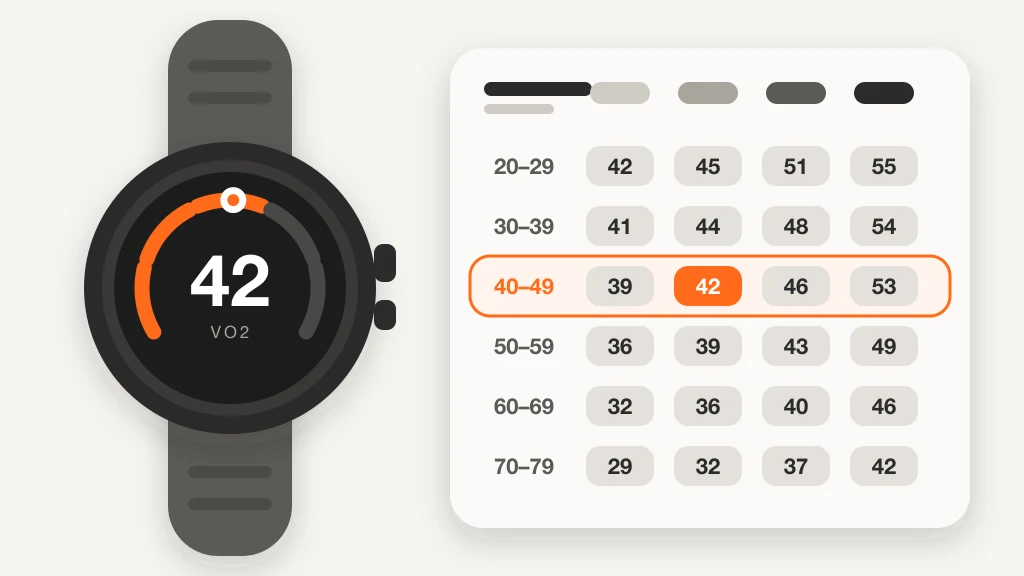
Illustrative scenario. Daniel, 45, sees an estimated VO2 max of 40 on his watch. In the men's chart the 40–49 row reads Fair 39, Good 42, Excellent 46, so he is just above Fair and needs about 2 more units (around 5 %) to reach Good. He keeps three easy runs a week, adds one 4 × 4-minute interval session and loses 2 kg. After 12 weeks the estimate reads 43: Good, still 3 below Excellent. Part of the rise is the lower weight, since the number is per kilogram, and part is fitness; he watches the monthly trend rather than single runs. The same 43 in a woman aged 40–49 would be Excellent (40 and above), because each chart compares you only with your own sex. Figures are illustrative, and a 3-unit rise in 12 weeks is on the optimistic side.
Action steps
- Find your age and sex in the charts, note your rating, then check which scale your watch uses.
- Track one device's trend monthly and ignore single runs after heat, illness or hills.
- Check the inputs: maximum heart rate, current weight, outdoor GPS runs or walks.
- To move up a category, combine easy aerobic volume with one interval session a week for 8–12 weeks.
- Treat a low rating as a prompt to build fitness, not a diagnosis. See a doctor for chest pain, fainting or palpitations with dizziness during exercise, and get a check before hard intervals if you have heart risk factors.
Related guides
- VO2 max: what it means and how to improve it
- Interval training and HIIT: designing sessions that work
- Zone 2 training: the science and how to do it right
- Maximum heart rate: formulas, field tests and why age-based estimates fail
- Resting heart rate: normal ranges and what changes it
FAQ
What is a good VO2 max for my age? In these charts "Good" starts at the 60th percentile for your age and sex, for example 44 ml/kg/min for men and 38 for women aged 30–39. "Excellent" means roughly the top 20 %.
Why are women's VO2 max values lower than men's? On average, women have lower values per kilogram, partly because of body composition, haemoglobin concentration and heart size. That is why each sex has its own chart.
What is Garmin Fitness Age? It translates your fitness into the age at which that level is typical for your sex. Depending on the watch and software it may rely on VO2 max alone or also on vigorous activity, resting heart rate and BMI or body fat, so check the description in Garmin Connect.
Why do my Garmin and my Apple Watch show different levels? They use different algorithms, inputs and rating tables. Apple only learns from outdoor walk, run and hike workouts and has four levels; Garmin has five. Follow each trend separately.
Can I raise my VO2 max after 60? Yes. Regular endurance and interval training can improve it at any age, even though absolute values are lower than in younger people. Get medical clearance before hard intervals if you have heart risk factors.
References
- Kodama (2009). Cardiorespiratory Fitness as a Quantitative Predictor of All-Cause Mortality and Cardiovascular Events in Healthy Men and Women. JAMA. https://doi.org/10.1001/jama.2009.681
- Mandsager et al. (2018). Association of Cardiorespiratory Fitness With Long-term Mortality Among Adults Undergoing Exercise Treadmill Testing. JAMA Network Open. https://doi.org/10.1001/jamanetworkopen.2018.3605
- Kaminsky et al. (2015). Reference Standards for Cardiorespiratory Fitness Measured With Cardiopulmonary Exercise Testing: Data From the Fitness Registry and the Importance of Exercise National Database. Mayo Clinic Proceedings. https://doi.org/10.1016/j.mayocp.2015.07.026
- Ross et al. (2016). Importance of Assessing Cardiorespiratory Fitness in Clinical Practice: A Case for Fitness as a Clinical Vital Sign. Circulation. https://doi.org/10.1161/CIR.0000000000000461
For general information only. This is not medical advice — talk to a qualified professional about your health.
Keep reading
Metrics explained
VO2 max: what it means and how to improve it
4 min read
Metrics explained
Heart rate zones explained: how to set and use them
4 min read
Metrics explained
Normal heart rate variability (HRV) by age: RMSSD vs SDNN
6 min read
Metrics explained
Resting heart rate: normal ranges and what changes it
4 min read
Sports
Padel with a wearable: heart rate, calories and recovery between matches
7 min read
Devices & setup
How MoveVitals handles multiple devices: provenance, duplicates and conflicts
5 min read