

Metrics explained
AFib and ECG on a smartwatch: what irregular-rhythm alerts can and can’t tell you
Smartwatch irregular-rhythm notifications and single-lead ECG can flag a pattern that may be atrial fibrillation (AFib), but they cannot diagnose it, and a quiet watch does not rule it out.
Written by MoveVitals Editorial Collective
Community-authored educational content. Individual clinical review is identified only when a named review is actually recorded.
Editorial standards & corrections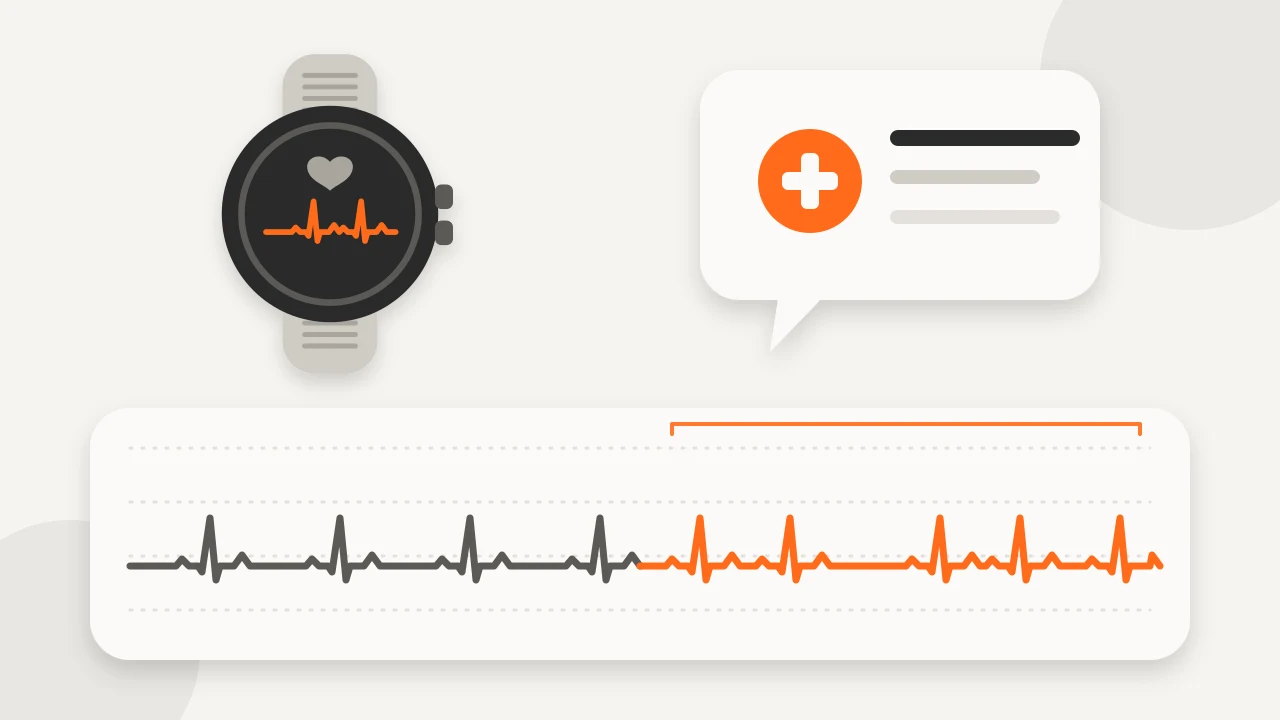
Key takeaways
- Atrial fibrillation is an irregular, often fast heart rhythm that starts in the upper chambers of the heart.
- In the Apple Heart Study, 0.52 % of 419,297 participants received an irregular pulse notification; in the Fitbit Heart Study, about 1 % of 455,699 had a detection, rising to 4 % at 65 and over.
- In the BASEL clinic study of 201 cardiology patients, five consumer devices had sensitivity of 58–85 % and specificity of 69–79 %, and 17–26 % of single-lead tracings were inconclusive.
- Call your local emergency number for chest pain, fainting, severe shortness of breath or signs of stroke, whatever the watch shows.
- Do not start, stop or change any medicine or supplement because of a watch alert; note the time and symptoms, export the PDF and contact a clinician.
What AFib is, and why a watch might help
Atrial fibrillation is an irregular, often fast heart rhythm that starts in the upper chambers of the heart. It raises the risk of stroke, it can come and go, and some people feel nothing at all, which is why catching it early is attractive. A doctor confirms it by reading an ECG; a watch can only suggest that a pattern is worth checking. AFib becomes more common with age, so alerts are more frequent in older adults.
Two tools: the irregular rhythm notification and single-lead ECG
| Irregular rhythm notification | ECG app | |
|---|---|---|
| Sensor | Optical pulse sensor (PPG) on the back of the watch | Electrodes: the back of the watch plus a fingertip on a button or crown |
| When it runs | In the background, usually when you are still or asleep | On demand, about 30 seconds, when you start it |
| Result | A notification after several irregular readings | Sinus rhythm, AFib or inconclusive, plus a PDF trace you can share |
| Main limits | Not constantly checking; cannot catch every episode; may flag another irregular rhythm | One lead only; cannot show a heart attack or most other conditions |
Apple describes its notification as an occasional check, usually when you are still, that alerts only after several readings; it says the feature cannot detect all AFib and that an alert may reflect another irregular rhythm. In the large Fitbit study an alert needed 11 consecutive irregular five-minute windows. Apple's ECG app cannot detect heart attack, blood clots, stroke, high blood pressure, heart failure or other arrhythmias, and Apple Watch SE does not have it.
How accurate are smartwatch AFib alerts?
- Apple Heart Study (2019, funded by Apple). Of 419,297 participants, 2,161 (0.52 %) received an irregular pulse notification. Among 450 who returned a usable ECG patch, worn on average 13 days after the alert, AFib was found in 34 %. Of the notifications, 84 % matched AFib on a simultaneous patch recording.
- Fitbit Heart Study (2022). Of 455,699 participants, about 1 % had an irregular-rhythm detection, rising to 4 % in those aged 65 and over. AFib was present in 32.2 % of the 1,057 flagged people with an analysable patch, and a repeat detection during patch monitoring matched AFib 98.2 % of the time.
- BASEL clinic study (2023). In 201 cardiology patients (median age 66.7, 31 % with AFib), five consumer devices, four watches and one handheld ECG, had sensitivity of 58–85 % and specificity of 69–79 %. Between 17 % and 26 % of single-lead tracings were inconclusive, and manual review was needed in about a quarter of cases. Models have changed since, so read it as a pattern, not a brand ranking.
Read these numbers with care. A patch worn days after an alert can miss an episode that has stopped, so "34 %" does not mean 66 % were false alarms. Predictive value is higher where AFib is common, and young healthy wearers rarely get an alert at all. Algorithms also tend to be tuned to avoid false alarms, which is the flip side of missed episodes: a quiet watch is not clearance.
Smartwatch AFib false positives and missed episodes: why they happen
- False alarms: motion, loose or dry contact and cold hands can disturb the signal, and frequent extra beats or other irregular rhythms can look irregular to the algorithm.
- Missed episodes: AFib comes and goes, the watch has to be on your wrist, and checks often run only while you are still. On Apple Watch, Low Power Mode turns the irregular-rhythm and heart-rate notifications off.
- Inconclusive ECGs: very fast or slow heart rates, electrical noise or a poorly placed finger can stop the app from classifying a recording.
Who the features are for, and where they exist
Makers generally set the minimum age at 22, and notifications are not designed for people already diagnosed with AFib, who follow their clinician's plan. Because this is regulated medical software, approval is granted country by country (the FDA in the United States, CE marking in Europe and other national regulators). Apple publishes a country list for its ECG app and notifications, WHOOP says availability varies by region, and the Garmin ECG app is limited to selected models and countries, so check your maker's page for your model and country. Many rings and fitness bands report only heart rate and HRV, which are not rhythm tests.
What to do after an alert or an AFib result
- Call your local emergency number (for example 911, 999 or 112) for chest pain, pressure or tightness, fainting or near-fainting, severe shortness of breath, or signs of stroke such as a drooping face, arm weakness or trouble speaking, whatever the watch shows.
- Palpitations with dizziness, breathlessness or unusual tiredness: see a doctor promptly.
- No symptoms: do not ignore it. Arrange an appointment, and bring the exported PDF, the date and time, and what you were doing.
- Do not start, stop or change any medicine or supplement because of a watch alert. That decision belongs to a clinician.
- A normal clinic ECG does not cancel an alert, because AFib may be absent at that moment. Clinicians may use longer monitoring, such as a patch worn for a week.
- A quiet watch plus symptoms: see a doctor anyway.
In MoveVitals
MoveVitals does not read ECG recordings or irregular-rhythm notifications, does not detect AFib and does not interpret traces. Those stay in the maker's app (for example Apple's Health app or Samsung Health Monitor), where you can export a PDF for your clinician. What MoveVitals shows is context from your connected sources: resting heart rate and HRV from sources such as WHOOP, Oura, Polar, Garmin and COROS, with respiratory rate and SpO2 where a source provides them. Each value keeps its source, and HRV methods (RMSSD and SDNN) are never mixed. A sustained shift from your personal baseline is a reason to look at sleep, load, illness and alcohol, and to talk to a clinician if it comes with symptoms. It is not a rhythm result. See how MoveVitals resolves conflicts.
Worked example
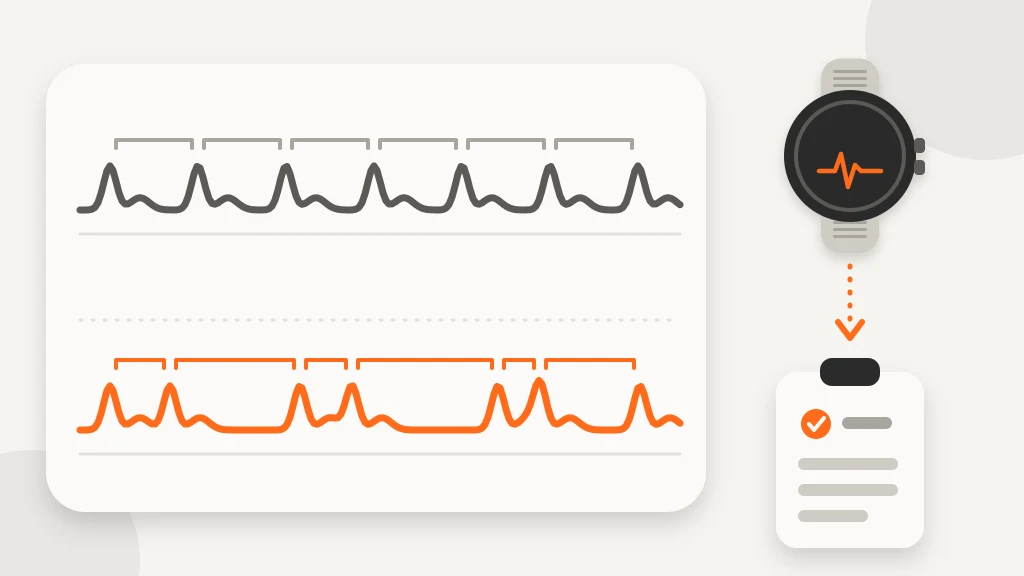
Illustrative scenario. Tom, 67, wears his smartwatch day and night. One evening at 21:40, while watching television, he gets an irregular-rhythm notification. He feels fine. He records a 30-second ECG, which the app labels as AFib, exports the PDF and notes the time and what he was doing. He calls his doctor, who sees him the next day. The 12-lead ECG in the clinic looks normal, which is possible because AFib can come and go, so the doctor arranges a week of patch monitoring and will interpret the findings. If Tom had felt chest pain or faint, he would have called the emergency number instead. His resting heart rate trend (around 58 bpm for a month) is background he can mention, not part of the decision. All details are illustrative.
Action steps
- Check that your watch model and your country support the feature, and read the maker's limits on age and prior diagnosis.
- Wear the watch regularly, keep its software updated, and know which settings (such as Low Power Mode) pause notifications.
- If you get an alert or an AFib result, note the time, symptoms and activity, export the PDF and contact a clinician.
- Call the emergency number for chest pain, fainting, severe breathlessness or stroke signs, whatever the watch shows.
- Treat a normal result as one data point, not clearance, and mention symptoms to a doctor even if the watch stays quiet.
Related guides
- Resting heart rate: normal ranges and what changes it
- Normal heart rate variability (HRV) by age: RMSSD vs SDNN
- Why is my heart rate so high when I exercise? Causes, normal ranges and when to worry
- Your personal baseline: why "normal for you" beats population averages
- Using health data without obsession (orthosomnia and data anxiety)
FAQ
How reliable is Apple Watch AFib detection, and what about Apple Watch ECG accuracy? In Apple's own materials and several studies it classifies clean recordings well, but a share of recordings come back inconclusive, which lowers real-world accuracy. In the BASEL clinic study, 17–26 % of tracings across five devices were inconclusive. Treat it as a prompt for a doctor's ECG.
Why did my watch flag an irregular rhythm when my doctor's ECG was normal? AFib can come and go, so it may not be present during a short clinic recording. A flag can also come from other irregular rhythms or from poor signal. Tell your doctor about the alert so they can decide on longer monitoring.
Do I need an ECG watch if I feel fine? Not necessarily. The features are optional, and who benefits most from rhythm screening is a question for your clinician, especially if you are older or have risk factors. If you have palpitations, dizziness or fainting, see a doctor regardless of any watch.
References
- Perez et al. (2019). Large-Scale Assessment of a Smartwatch to Identify Atrial Fibrillation. New England Journal of Medicine. https://doi.org/10.1056/NEJMoa1901183
- Lubitz et al. (2022). Detection of Atrial Fibrillation in a Large Population Using Wearable Devices: The Fitbit Heart Study. Circulation. https://doi.org/10.1161/CIRCULATIONAHA.122.060291
- Mannhart et al. (2023). Clinical Validation of 5 Direct-to-Consumer Wearable Smart Devices to Detect Atrial Fibrillation: BASEL Wearable Study. JACC: Clinical Electrophysiology. https://doi.org/10.1016/j.jacep.2022.09.011
- Apple. Heart health notifications on your Apple Watch. https://support.apple.com/en-us/120276
- Apple. Take an ECG with the ECG app on Apple Watch. https://support.apple.com/en-us/120278
- U.S. FDA (2018). De Novo classification DEN180044: ECG App. https://www.accessdata.fda.gov/cdrh_docs/reviews/DEN180044.pdf
For general information only. This is not medical advice — talk to a qualified professional about your health.
Keep reading
Metrics explained
Resting heart rate: normal ranges and what changes it
4 min read
Devices & setup
How MoveVitals handles multiple devices: provenance, duplicates and conflicts
5 min read
Metrics explained
Normal heart rate variability (HRV) by age: RMSSD vs SDNN
6 min read
Metrics explained
Heart rate zones explained: how to set and use them
4 min read
Recovery & sleep
Your personal baseline: why "normal for you" beats population averages
4 min read
Devices & setup
WHOOP and MoveVitals: what syncs and how to get the most from it
3 min read