

Metrics explained
Why is my heart rate so high when I exercise? Causes, normal ranges and when to worry
If your heart rate seems too high during exercise, the cause is most often heat, short sleep, caffeine, stress, an oncoming illness or a sensor error. Here is what counts as normal, what to check first and when to see a doctor.
Written by MoveVitals Editorial Collective
Community-authored educational content. Individual clinical review is identified only when a named review is actually recorded.
Editorial standards & corrections
Key takeaways
- A gap of 10 bpm or more at the same effort that lasts for days deserves attention, while a few beats of daily variation is normal.
- A flat plateau near your step cadence, for example 170–180 on an easy run, points to an optical sensor error; check by wearing a chest strap or counting your pulse for 15 seconds and multiplying by four.
- Check the last 7–14 days of resting heart rate, HRV and sleep against your own baseline before changing training.
- Call your local emergency number if you have chest pain, pressure or tightness, fainting or near-fainting, or severe breathlessness during or after exercise.
- Book a medical appointment if your heart races or feels irregular at rest or at easy effort without a clear reason, because wearables cannot diagnose a rhythm problem.
What counts as a "high" heart rate?
Maximum heart rate falls with age and varies a lot between people. The Tanaka estimate, 208 − 0.7 × age, gives about 190 bpm at 25 and 166 bpm at 60, and an individual's true maximum can sit 10 bpm or more from any formula — see maximum heart rate. So "is a heart rate of 180 while running normal?" has no single answer: it is ordinary near the end of a hard 5 km at 25, but worth investigating on an easy jog at 60.
More useful than the raw number:
- Your heart rate relative to your own maximum, which is the zone you are in.
- Your heart rate at the same pace versus recent weeks. A few beats of daily variation is normal; a gap of 10 bpm or more at the same effort that lasts for days deserves an explanation.
- Lag. Heart rate takes 1–3 minutes to settle at the start of a session or a hill, so early readings often look off.
What to check first
Open the last 7–14 days of resting heart rate, HRV and sleep, plus skin temperature and respiratory rate if your device records them.
| Check | What to look for | Likely meaning |
|---|---|---|
| Sensor | A flat plateau near your step cadence (for example 170–180 on an easy run), or a much lower number on a chest strap | Optical sensor error ("cadence lock"), not your heart |
| Heat and fluids | Higher heart rate at the same pace on warm days or in long, sweaty sessions, climbing through the run | Heat strain and dehydration add to cardiac drift; see hydration and electrolytes |
| Caffeine | Strong coffee, an energy drink or a pre-workout 1–3 hours before | Can raise heart rate in some people — see caffeine timing |
| Sleep and stress | Short or broken sleep, a stressful day; resting heart rate above and HRV below your norm | Your body is already under load |
| Illness coming on | Resting heart rate several beats above baseline, HRV down, higher respiratory rate or temperature, a scratchy throat | Skip hard training — see training when sick |
| Accumulated fatigue | Weeks of rising load, resting heart rate up, HRV down, heavy legs | Possible overreaching — see overtraining |
| Altitude | The first days at a higher location | Acclimatising — see altitude |
| Pace and fitness | Your "easy" pace sits in a hard zone after a break, illness or a hot week | Run by effort or heart rate, not by an old pace |
Is it your sensor?
Wrist optical sensors estimate heart rate from blood-volume changes under the skin. They are generally fine at steady effort but more error-prone during intervals, with a loose strap or in the cold, and they can lock onto cadence, giving a flat reading near your step rate. Chest straps pick up the heart's electrical signal and are generally more accurate during exercise.
To check, wear a chest strap such as the Polar H10 for one run, or count your pulse for 15 seconds after stopping and multiply by four. For the wrist sensor, wear the band snug about two finger widths above the wrist bone and warm up before trusting the numbers.
When to see a doctor
Stop and get urgent help (call your local emergency number) if during or after exercise you have chest pain, pressure or tightness; fainting or near-fainting; severe shortness of breath that does not ease when you stop; or palpitations with dizziness, confusion or pain.
Book a medical appointment if your heart races or feels irregular at rest or at easy effort without a clear reason; if it stays well above your usual for the same effort for more than a week or two despite rest; if it takes many minutes to settle after you stop; if you notice new, unexplained breathlessness; or if a close relative died suddenly of a heart condition at a young age.
Wearables show patterns, but they cannot diagnose a heart rhythm problem or tell you that symptoms are safe to ignore.
In MoveVitals
Workout heart rate arrives from Garmin, COROS, Polar, Strava and Apple Health, including chest-strap data recorded through those platforms. If two devices record the same session, MoveVitals keeps both records and groups them, and by default prefers chest-strap heart rate over wrist optical, so heart rate can come from the strap and the rest from the watch. Resting heart rate, HRV, sleep and — where your device provides them — respiratory rate and temperature deviation sit on one timeline and are compared with your own baseline from the previous 60 days. A flag appears only when the last three readings sit well outside your normal band or several recovery signals move the wrong way together — see your personal baseline. These thresholds are software settings, not clinical limits.
Worked example
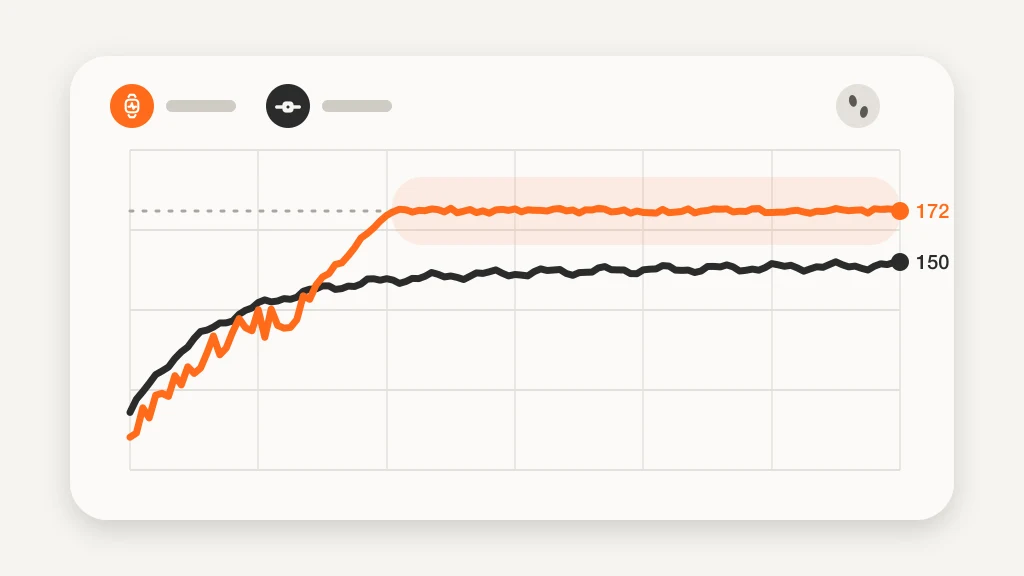
Illustrative scenario. Daniel, 38, usually jogs at 6:00/km (about 9:40/mile) with a heart rate near 148 bpm. On Tuesday his watch shows 172 bpm ten minutes in, a flat line that matches his cadence of 171 steps per minute. He feels fine and can talk, so he fits a chest strap: it reads 150 bpm, so the wrist reading was a cadence lock. On Friday, at 31 °C after 5.5 hours of sleep and two strong coffees, the strap itself shows 165 bpm at the same pace. His morning data explains it: resting heart rate 56 against a usual 51, HRV 38 ms against 52. He slows to 6:40/km, drinks and shortens the run, and his heart rate settles near 152. With a sore throat he would have skipped the run; with chest pressure or faintness he would have stopped and sought care. Figures are illustrative.
Action steps
- Compare the reading with a chest strap or a manual pulse count before worrying about the number.
- Check the last 7–14 days of resting heart rate, HRV and sleep against your own baseline.
- Account for heat, fluids, caffeine and altitude, then slow down until easy really feels easy — see zone 2 training.
- If several markers are off for more than a few days, cut intensity or rest; if you feel unwell, skip training.
- Seek medical advice for any symptom listed in the box above.
Related guides
- Maximum heart rate: formulas, field tests and why age-based estimates fail
- Cardiac drift (decoupling): why heart rate rises at the same pace
- Resting heart rate: normal ranges and what changes it
- Polar H10 chest strap with MoveVitals: accurate heart rate and HRV
- Overreaching and overtraining: warning signs and what to do
- AFib and ECG on a smartwatch: what irregular-rhythm alerts can and can’t tell you
FAQ
Is a heart rate of 180 while running normal? It depends on age, fitness and effort. Near the end of a hard effort it is common at 20–30; on an easy run it is a reason to check the sensor, heat, sleep and your recent trend, and to seek advice if symptoms appear.
Why is my heart rate so high on easy runs? Usual reasons are running faster than your current easy pace, heat, short sleep, caffeine, an oncoming illness or an optical sensor error. Easy-pace heart rate tends to fall over weeks of consistent easy running.
Why does my heart rate take so long to come down? After hard efforts it can take several minutes, and heat, dehydration, fatigue and illness slow it — see heart rate recovery. Get it checked if it stays high long after you stop or comes with symptoms.
Can caffeine or dehydration raise heart rate during exercise? Yes, as can heat and poor sleep. Change one factor at a time and note the effect.
Can my watch tell me if a high heart rate is dangerous? No. It shows numbers and trends, not a diagnosis; symptoms matter more than the figure.
References
- Tanaka et al. (2001). Age-predicted maximal heart rate revisited. Journal of the American College of Cardiology. https://doi.org/10.1016/S0735-1097%2800%2901054-8
- Racinais et al. (2015). Consensus recommendations on training and competing in the heat. British Journal of Sports Medicine. https://doi.org/10.1136/bjsports-2015-094915
- Bent et al. (2020). Investigating sources of inaccuracy in wearable optical heart rate sensors. npj Digital Medicine. https://doi.org/10.1038/s41746-020-0226-6
- Meeusen et al. (2013). Prevention, diagnosis and treatment of the overtraining syndrome: Joint consensus statement of the European College of Sport Science (ECSS) and the American College of Sports Medicine (ACSM). European Journal of Sport Science. https://doi.org/10.1080/17461391.2012.730061
For general information only. This is not medical advice — talk to a qualified professional about your health.
Keep reading
Metrics explained
Resting heart rate: normal ranges and what changes it
4 min read
Recovery & sleep
Your personal baseline: why "normal for you" beats population averages
4 min read
Devices & setup
How MoveVitals handles multiple devices: provenance, duplicates and conflicts
5 min read
Metrics explained
Normal heart rate variability (HRV) by age: RMSSD vs SDNN
6 min read
Training science
Zone 2 training: the science and how to do it right
4 min read
Devices & setup
WHOOP and MoveVitals: what syncs and how to get the most from it
3 min read