

Metrics explained
Sleeping heart rate: what’s normal, why it differs from resting heart rate and when it rises
Sleeping heart rate is your pulse while you sleep, and its lowest point is what most wearables report as resting heart rate. It rises with alcohol, illness, heat, late meals and heavy training.
Written by MoveVitals Editorial Collective
Community-authored educational content. Individual clinical review is identified only when a named review is actually recorded.
Editorial standards & corrections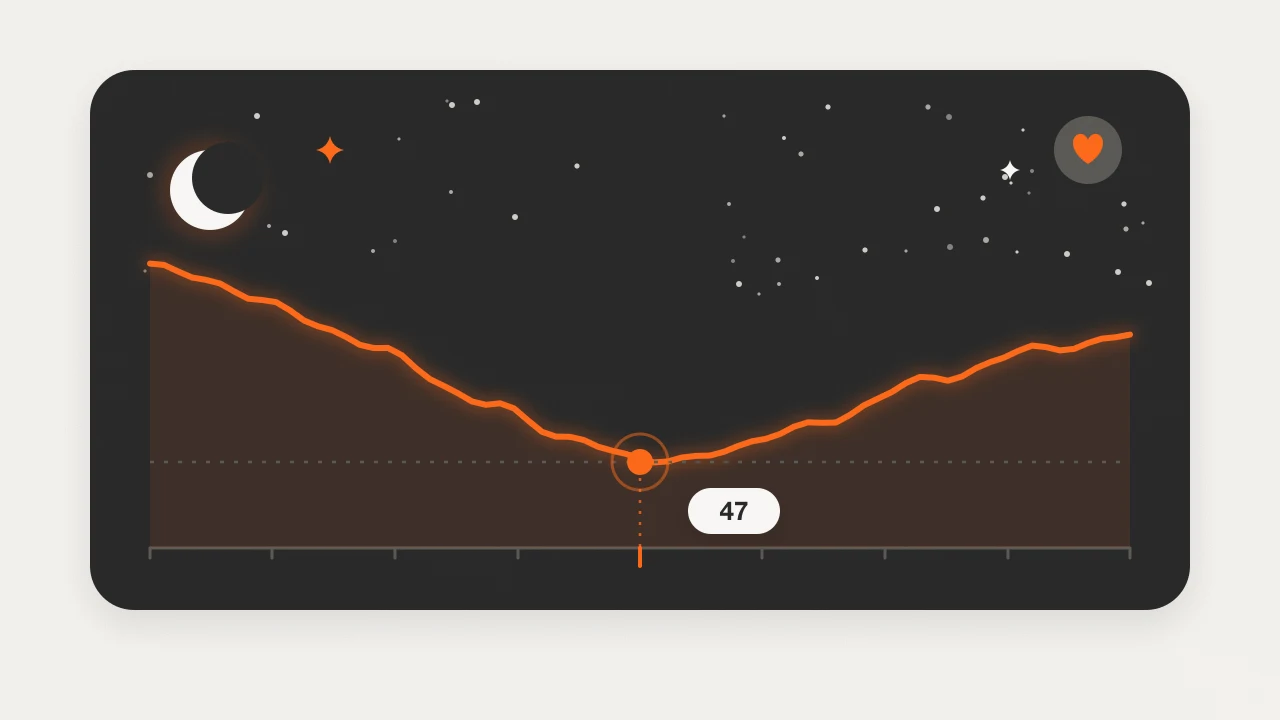
Key takeaways
- The lowest stable overnight value, which WHOOP and Oura report as resting heart rate, is often 3–8 bpm below daytime rest, so a ring and a watch can disagree without either being wrong.
- Typical lowest overnight heart rate is 36–50 bpm for endurance-trained adults, 44–58 for active adults and 50–68 for the general adult population.
- Alcohol typically adds 3 to 10 bpm with a later low, and illness or fever often adds 5 bpm or more, sometimes a day or two before symptoms.
- About 5 bpm or more above your baseline for two or more nights, especially with falling HRV, is a cue to train easier and check for symptoms.
- See a doctor for sustained rates above 100 bpm, or for palpitations, chest pain, dizziness or fainting.
Sleeping heart rate is your pulse while asleep. It usually falls through the first part of the night, reaches its lowest point somewhere around the middle of the night and drifts up again toward morning. It is lowest and steadiest in deep sleep and bumps up in REM sleep and brief awakenings (Trinder et al. 2001). See sleep stages for how those stages fit together. For what actually moves deep sleep, see how to increase deep sleep.
Sleeping heart rate vs resting heart rate: which number is which?
| Term | What it is | Compared with daytime rest |
|---|---|---|
| Average sleeping heart rate | The mean across the whole night, including REM bumps and awakenings | Close to, or a few bpm below, your daytime resting rate |
| Lowest sleeping heart rate | The lowest stable value overnight; WHOOP and Oura report it as resting heart rate | Often 3–8 bpm below a daytime reading |
| Daytime resting heart rate | Awake, seated and relaxed; Apple Watch and Garmin estimate it from quiet periods | The usual reference point |
Because the definitions differ, a ring and a watch can disagree by several beats without either being wrong.
What is a normal sleeping heart rate? Ranges and age
| Group | Typical lowest overnight (bpm) | Typical overnight average (bpm) |
|---|---|---|
| Endurance-trained adults | 36–50 | 42–58 |
| Active adults | 44–58 | 50–65 |
| General adult population | 50–68 | 55–75 |
These are rough, population-level ranges based on what wearables commonly report, not medical limits.
Sleeping heart rate by age. In healthy adults, resting heart rate changes only modestly with age, so adult age charts are of limited use. Fitness, body size, medications, thyroid problems, alcohol and illness usually matter more than your decade of life. Children have faster heart rates that slow as they grow; this guide covers adults, so ask a paediatrician about a child's numbers. If you take a medication that affects heart rate, such as a beta-blocker, your range shifts and generic charts do not apply.
What raises your sleeping heart rate
| Cause | What you may see |
|---|---|
| Alcohol | Typically +3 to +10 bpm, with the low arriving later in the night (alcohol, HRV and sleep) |
| Illness or fever | Often 5 bpm or more above baseline, sometimes a day or two before symptoms (training when sick) |
| Large or late meals | Higher overnight rate and a later low |
| Heat, a warm bedroom, dehydration | Higher rate; the body works to shed heat |
| Hard or long training the day before | A raised rate for a night or two |
| Stress, short or fragmented sleep | Higher rate and lower HRV |
| Luteal phase of the menstrual cycle | Typically 1–4 bpm higher |
A sustained rise over weeks, together with falling HRV and poor sleep, can point to overreaching; see overreaching and overtraining.
Sleeping heart rate, HRV and recovery scores
Sleeping heart rate and HRV are two views of the same autonomic balance. When you are well recovered, sleeping heart rate tends to be lower and HRV higher; after hard training, alcohol or illness, the reverse. Because both are measured at rest, they are less noisy than daytime readings.
Recovery scores build on them. WHOOP Recovery weighs HRV, resting heart rate, sleep and respiratory rate against your baselines, and Oura Readiness looks at your lowest heart rate, when it occurred and how long after falling asleep your heart rate settled.
A practical rule: about 5 bpm or more above your baseline for two or more nights, with HRV below baseline and perhaps a higher respiratory rate or skin temperature, is a prompt to train easier and check how you feel. It is a prompt, not a diagnosis.
How accurate is overnight heart rate on a wearable?
- At rest, optical sensors on the wrist or finger generally perform much better than during vigorous exercise. Error grows with movement, poor fit and cold (Bent et al. 2020); see wrist heart rate accuracy.
- A chest strap is the practical accuracy reference, but few people sleep in one. A Polar H10 overnight is a way to spot-check a device.
- Different definitions give different numbers, so pick one source and compare it only with itself.
- A watch's irregular-rhythm notification is not a diagnosis; discuss it with a clinician.
When to see a doctor
Seek medical advice if your sleeping heart rate stays above about 100 bpm for long stretches without a clear cause such as fever, alcohol or heat; if you have a racing or irregular heartbeat with dizziness, chest pain, shortness of breath or fainting; if a low rate comes with dizziness, fainting or unusual fatigue; or if you wake repeatedly with palpitations or have loud snoring with gasping or pauses in breathing. Chest pain or fainting needs urgent care. This guide is educational and not medical advice.
In MoveVitals
Overnight resting heart rate from WHOOP, Oura, Garmin, Polar, COROS and Withings is stored per source. When sources disagree on the same day, MoveVitals shows which value was chosen and why, according to your priority settings. MoveVitals also builds your personal baseline from the 60 days before the latest week, and needs at least 14 days of data. It flags a sustained change when the last three readings sit well away from your normal on the same side, or when several recovery signals move at once, such as higher resting heart rate with lower HRV.
Worked example
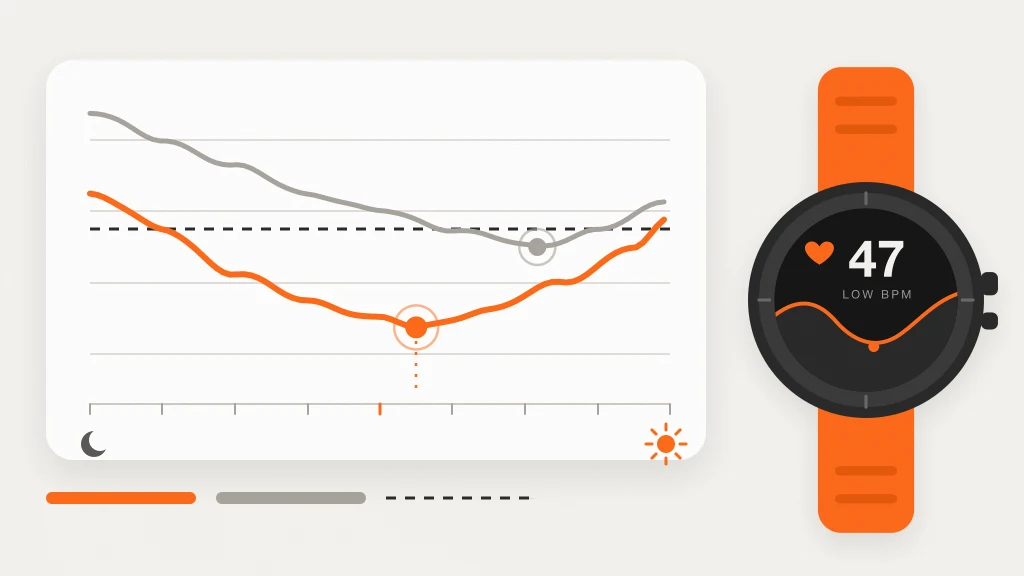
Illustrative scenario. Leo, 34, wears a ring at night. Over a typical fortnight his lowest sleeping heart rate averages 47 bpm, reached around 03:30, and his overnight average is 54 bpm; a seated reading in the afternoon is about 58. After a dinner with three drinks, his low rises to 56 bpm and only arrives at about 05:10, his overnight HRV falls from roughly 58 to 41 ms and his recovery score turns red. Two nights later he is back at 47–48. Figures are illustrative.
Action steps
- Choose one device as your overnight source and wear it snugly every night.
- Read the lowest and average sleeping heart rate as 7-day averages against your own 30–60 day baseline.
- Treat a rise of about 5 bpm or more for two or more nights, especially with falling HRV, as a cue to train easier and check for symptoms.
- See a doctor for sustained rates above 100 bpm, or palpitations, chest pain, dizziness or fainting.
Related guides
- Resting heart rate: normal ranges and what changes it
- Normal heart rate variability (HRV) by age: RMSSD vs SDNN
- Alcohol, HRV and sleep: what your wearable shows the night after
- Sleep stages: light, deep and REM sleep explained
- Your personal baseline: why "normal for you" beats population averages
FAQ
What is a normal sleeping heart rate? For most adults the lowest overnight value is roughly 40–70 bpm, lower in endurance-trained people, with the overnight average several beats higher. Your own baseline matters more than any range.
Why is my heart rate high during sleep? Alcohol, late or large meals, heat, illness, stress, short sleep, hard training and late caffeine are common causes. If it stays high for days with symptoms, or above 100 bpm for long stretches, see a doctor.
Is a sleeping heart rate below 50 bad? It is common in fit people and during sleep, and fine if you feel well. Dizziness, fainting, chest pain or unusual fatigue with a low rate call for medical advice.
References
- Trinder et al. (2001). Autonomic activity during human sleep as a function of time and sleep stage. Journal of Sleep Research. https://doi.org/10.1046/j.1365-2869.2001.00263.x
- Bent et al. (2020). Investigating sources of inaccuracy in wearable optical heart rate sensors. npj Digital Medicine. https://doi.org/10.1038/s41746-020-0226-6
- Pietilä et al. (2018). Acute Effect of Alcohol Intake on Cardiovascular Autonomic Regulation During the First Hours of Sleep in a Large Real-World Sample of Finnish Employees: Observational Study. JMIR Mental Health. https://doi.org/10.2196/mental.9519
For general information only. This is not medical advice — talk to a qualified professional about your health.
Keep reading
Devices & setup
How MoveVitals handles multiple devices: provenance, duplicates and conflicts
5 min read
Metrics explained
Normal heart rate variability (HRV) by age: RMSSD vs SDNN
6 min read
Metrics explained
Resting heart rate: normal ranges and what changes it
4 min read
Recovery & sleep
Sleep hygiene: evidence-based habits for better sleep
4 min read
Devices & setup
WHOOP and MoveVitals: what syncs and how to get the most from it
3 min read
Recovery & sleep
Alcohol, HRV and sleep: what your wearable shows the night after
3 min read