

Recovery & sleep
How to increase deep sleep: what the evidence says (and what your tracker can’t prove)
You cannot switch deep sleep on, but you can protect it. Here is how to increase deep sleep naturally, and why your tracker’s number is only an estimate.
Written by MoveVitals Editorial Collective
Community-authored educational content. Individual clinical review is identified only when a named review is actually recorded.
Editorial standards & corrections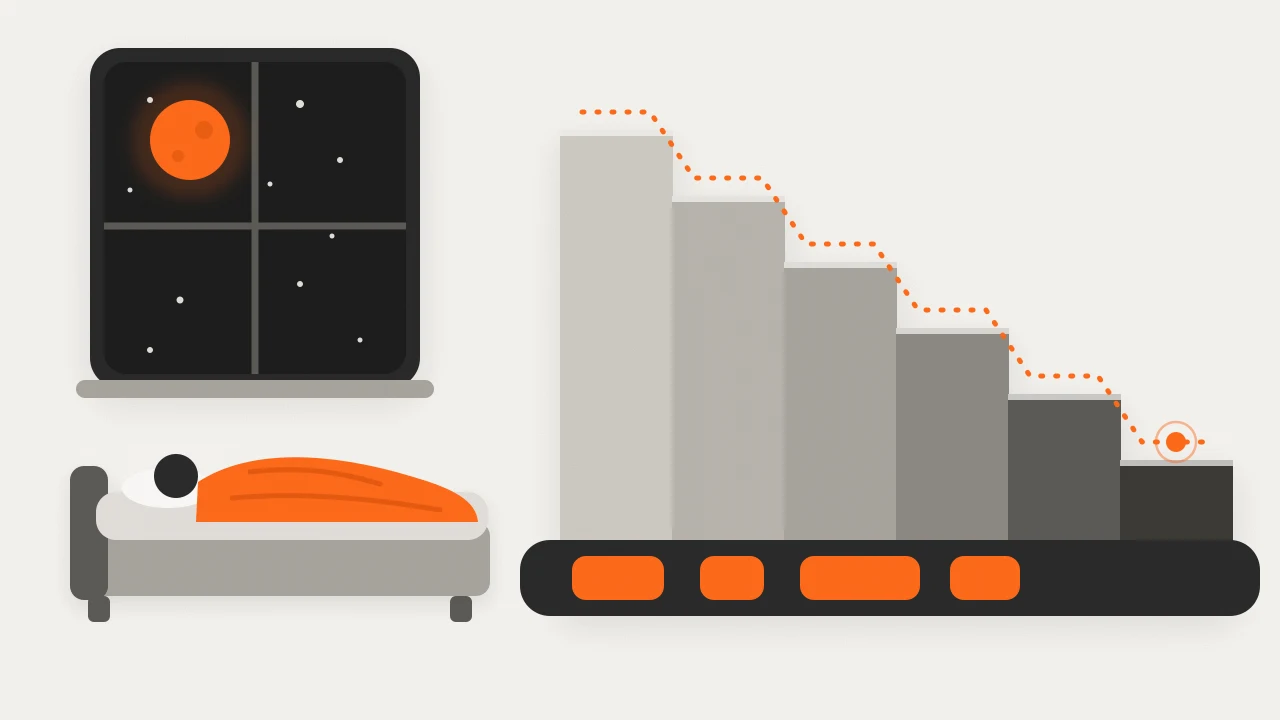
Key takeaways
- Deep sleep is typically about 15–25 % of the night in your 20s and 30s, 10–20 % in your 40s and 50s and 5–15 % at 60 and over, so a lower share with age is expected.
- Different devices can disagree by 20 minutes or more on the same night, so a genuine change shows up in 2–4 week averages from one device, not one night's number.
- Set a caffeine cut-off 6–8 hours before bed, finish alcohol at least 3–4 hours before bed, and keep the bedroom at about 16–19 °C for most people.
- See a clinician if you snore loudly, gasp or stop breathing in your sleep, or feel very sleepy during the day despite enough time in bed.
Deep sleep (slow-wave sleep, stage N3) is the stage in which you are hardest to wake and your heart rate, breathing and brain activity slow the most. It is concentrated in the first half of the night. For the full picture of the stages, see sleep stages.
How much deep sleep do you need? Normal ranges by age
There is no official target. Laboratory studies of healthy sleepers find that deep sleep takes roughly 13–23 % of the night overall, and that it declines across adulthood (Ohayon et al. 2004). As a rough guide:
| Age | Typical share of the night | On a 7.5-hour night |
|---|---|---|
| 20s–30s | about 15–25 % | roughly 70–110 min |
| 40s–50s | about 10–20 % | roughly 45–90 min |
| 60+ | about 5–15 % | roughly 25–70 min |
Deep sleep vs REM: deep sleep dominates early in the night and REM late in the night. Both matter and they do different jobs, so neither is "the good one" to chase. Cutting a night short mainly costs REM.
Low deep sleep: causes and what actually moves it
Deep sleep is set mostly by age, genetics and how long you have been awake. Within that, some levers are better supported than others.
| Lever | What the evidence says | What to do |
|---|---|---|
| Enough total sleep, regular schedule | Strong. After a short night, deep sleep rebounds; irregular timing fragments sleep | Protect time in bed and keep a fixed wake time (sleep consistency) |
| Regular exercise | Reasonable. Reviews link exercise with better sleep and modestly more deep sleep (Kredlow et al. 2015) | Move most days; shift very hard sessions earlier if they delay your sleep |
| Alcohol | Harms sleep overall. It may raise deep sleep early in the night in some lab studies, but it fragments the second half, cuts REM and raises heart rate (Ebrahim et al. 2013) | Skip it, or finish 3–4 h before bed (alcohol, HRV and sleep) |
| Late caffeine | Good. It can reduce sleep even when taken 6 h before bed (Drake et al. 2013) | Set a cut-off 6–8 h before bed (caffeine timing) |
| Cool bedroom, warm bath earlier | Moderate. Core temperature must fall for sleep; a warm bath or shower 1–2 h before bed shortened time to fall asleep in a meta-analysis (Haghayegh et al. 2019) | Aim for about 16–19 °C; see heat and sauna for safety |
| Sleep disorders, pain, some medications | They can fragment sleep and reduce deep sleep | See a clinician; do not stop prescribed medication on your own |
| Supplements and sleep gadgets | Weak or mixed for most consumer products | Nothing is recommended here; ask a clinician or pharmacist, especially if you take medication |
Why your tracker can’t prove it
Polysomnography measures brain waves. Wearables instead infer stages from movement, heart rate, HRV, breathing and sometimes temperature. Studies show consumer devices do well at sleep versus wake and reasonably at total sleep time, while stage-by-stage agreement is only moderate (Chinoy et al. 2021). A few consequences:
- A deep-sleep figure is an estimate, and different devices can disagree by 20 minutes or more on the same night; see how accurate sleep tracking is.
- Night-to-night variation is large. A change of 10–15 minutes on one night is within normal noise.
- A genuine change shows up as a shift in 2–4 week averages from the same device, alongside total sleep and how you feel.
Why chasing the number can backfire
You cannot choose a sleep stage. Staying in bed longer to "earn" deep sleep lowers sleep efficiency, and worry about a low figure can itself delay sleep. Clinicians have described this as orthosomnia (Baron et al. 2017). Use deep sleep as one input, next to total sleep, regular timing and how rested you feel in the daytime. See using health data without obsession.
A four-week experiment with your own data
- Spend two weeks changing nothing. Note your average deep-sleep minutes, total sleep, sleeping heart rate and HRV from one device.
- For the next two weeks change one thing, such as no alcohol on weeknights, a cooler room or an earlier caffeine cut-off.
- Keep what helps. Treat the result as personal, not proof; heart rate and HRV are measured more directly than stage minutes.
When to talk to a doctor
See a clinician if you snore loudly, gasp or stop breathing in your sleep, wake unrefreshed despite enough time in bed, feel very sleepy during the day, act out dreams or sleepwalk as an adult, or have trouble sleeping three or more nights a week for three months or longer. A low deep-sleep number on a tracker is not a diagnosis. CBT-I is the first-line treatment for persistent insomnia; see sleep hygiene.
In MoveVitals
MoveVitals stores sleep stages per source as minutes (light, deep, REM and awake) from WHOOP, Oura, Garmin, Polar, Withings and COROS. When two devices track the same night, both are kept and your priority decides which one is shown; see how conflicts are resolved. Pick one sleep source in Priorities and compare it with itself.
Worked example
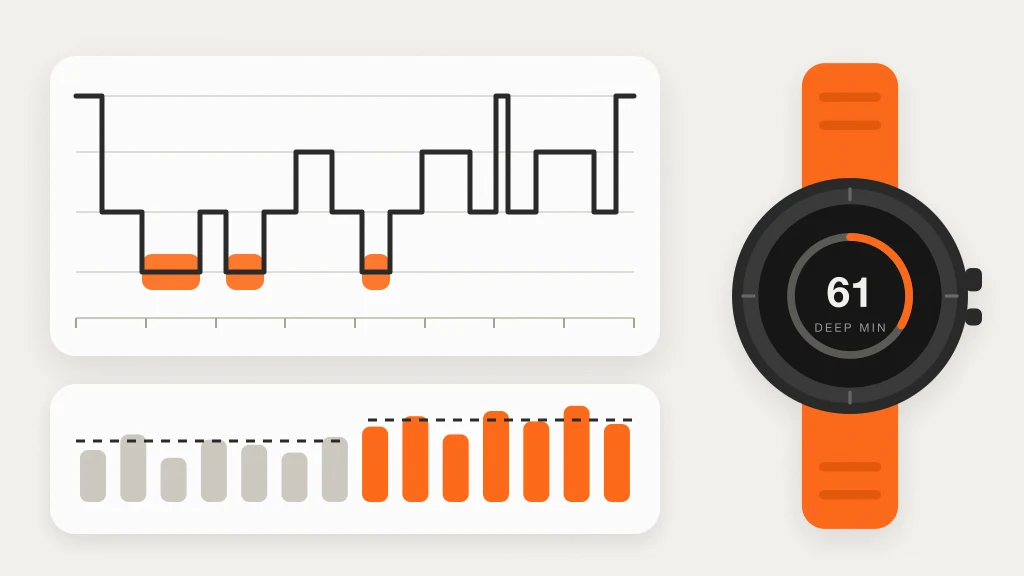
Illustrative scenario. Marta, 38, sees her ring report an average of 52 minutes of deep sleep over two weeks (about 12 % of 7 h 05 min asleep) and worries that it is "too low". Instead of chasing the number she runs a two-week test: no alcohol on weeknights, last coffee before noon and the bedroom cooled to about 18 °C. Her averages move to 61 minutes of deep sleep (about 14 % of 7 h 15 min), total sleep rises by 10 minutes and her overnight resting heart rate falls from 56 to 54 bpm. Figures are illustrative.
Action steps
- Protect total sleep first: keep a fixed wake time and enough time in bed.
- Skip alcohol on key nights, or finish at least 3–4 hours before bed.
- Keep the bedroom cool, dark and quiet, about 16–19 °C for most people.
- Set a caffeine cut-off 6–8 hours before bed and finish large meals 2–3 hours before.
- Exercise regularly, and move very hard sessions earlier in the day if they delay your sleep.
- Judge changes by 2–4 week averages from one device and by how rested you feel, not by one night's deep-sleep number.
Related guides
- Sleep stages: light, deep and REM sleep explained
- Sleep hygiene: evidence-based habits for better sleep
- Alcohol, HRV and sleep: what your wearable shows the night after
- Sleep consistency: why a regular schedule beats a long lie-in
- Using health data without obsession (orthosomnia and data anxiety)
FAQ
How much deep sleep is normal? In healthy adults, roughly 13–23 % of the night, declining with age. Devices estimate it with error, so treat any range as approximate and compare yourself with your own baseline.
Is deep sleep or REM more important? Both matter and do different jobs. Deep sleep is concentrated early in the night and REM late, so short nights mainly cut REM. Neither is a number to maximise.
Does exercise increase deep sleep? Regular exercise is linked with better sleep and, in some studies, modestly more deep sleep. Effects vary between people, and very hard sessions late in the evening delay sleep for some, so check your own data.
Can I trust my watch's deep sleep number? Trust the trend, not the night. Wearables are reasonable for total sleep but only moderately accurate for individual stages, and different devices disagree.
References
- Ohayon et al. (2004). Meta-analysis of quantitative sleep parameters from childhood to old age in healthy individuals: developing normative sleep values across the human lifespan. Sleep. https://doi.org/10.1093/sleep/27.7.1255
- Chinoy et al. (2021). Performance of seven consumer sleep-tracking devices compared with polysomnography. Sleep. https://doi.org/10.1093/sleep/zsaa291
- Ebrahim et al. (2013). Alcohol and sleep I: effects on normal sleep. Alcoholism: Clinical and Experimental Research. https://doi.org/10.1111/acer.12006
- Kredlow et al. (2015). The effects of physical activity on sleep: a meta-analytic review. Journal of Behavioral Medicine. https://doi.org/10.1007/s10865-015-9617-6
- Haghayegh et al. (2019). Before-bedtime passive body heating by warm shower or bath to improve sleep: a systematic review and meta-analysis. Sleep Medicine Reviews. https://doi.org/10.1016/j.smrv.2019.04.008
- Drake et al. (2013). Caffeine Effects on Sleep Taken 0, 3, or 6 Hours before Going to Bed. Journal of Clinical Sleep Medicine. https://doi.org/10.5664/jcsm.3170
- Baron et al. (2017). Orthosomnia: are some patients taking the quantified self too far? Journal of Clinical Sleep Medicine. https://doi.org/10.5664/jcsm.6472
For general information only. This is not medical advice — talk to a qualified professional about your health.
Keep reading
Devices & setup
How MoveVitals handles multiple devices: provenance, duplicates and conflicts
5 min read
Metrics explained
Normal heart rate variability (HRV) by age: RMSSD vs SDNN
6 min read
Recovery & sleep
Sleep hygiene: evidence-based habits for better sleep
4 min read
Metrics explained
Resting heart rate: normal ranges and what changes it
4 min read
Recovery & sleep
Alcohol, HRV and sleep: what your wearable shows the night after
3 min read
Metrics explained
Blood oxygen (SpO2): what wearables measure and when to worry
4 min read