

Recovery & sleep
Caffeine: performance benefits and how timing affects sleep
Caffeine is one of the few supplements with strong evidence for performance. Its long half-life means afternoon coffee can quietly reduce your deep sleep.
Written by MoveVitals Editorial Collective
Community-authored educational content. Individual clinical review is identified only when a named review is actually recorded.
Editorial standards & corrections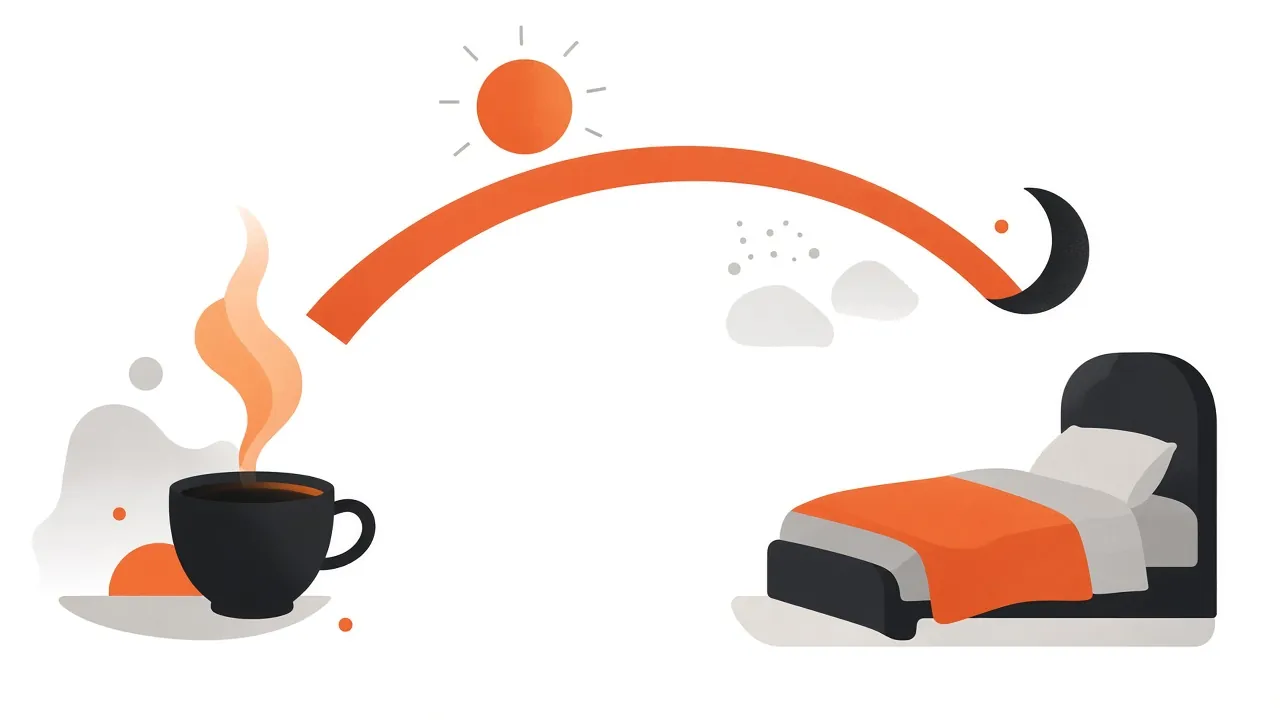
Key takeaways
- About 3 mg of caffeine per kg of body weight, roughly 200 mg for a 70 kg person, taken 30–60 minutes before exercise improves endurance, power and alertness in many people.
- Caffeine's half-life is about 4–6 hours, and studies show caffeine taken even 6 hours before bed can reduce total and deep sleep, often without people noticing.
- A filter coffee (250 ml) holds about 90–150 mg of caffeine and a single espresso 60–80 mg; for most healthy adults, up to about 400 mg a day is generally considered safe.
- Pregnant people and those with heart conditions should follow medical advice on caffeine.
Performance benefits
Moderate caffeine — about 3 mg per kg body weight (≈ 200 mg for a 70 kg person) taken 30–60 minutes before exercise — improves endurance, power and alertness in many studies. Higher doses (6 mg/kg) add little and increase side effects (jitters, gut issues, raised heart rate).
| Source | Approx. caffeine |
|---|---|
| Espresso (single) | 60–80 mg |
| Filter coffee (250 ml) | 90–150 mg |
| Black tea (250 ml) | 40–60 mg |
| Green tea (250 ml) | 25–40 mg |
| Caffeinated gel | 25–100 mg |
| Energy drink (250 ml) | ~80 mg |
Caffeine and sleep
Caffeine's half-life is about 4–6 hours (longer in some people, during pregnancy, or with certain medications). A coffee at 4 p.m. can still have half its caffeine active at 9–10 p.m.
Studies show caffeine taken even 6 hours before bed can reduce total sleep and deep sleep — often without people noticing. Check your own sleep stages and HRV on days with and without afternoon caffeine.
Practical guidelines
- Set a caffeine cut-off about 8 hours before bedtime.
- Delay the first coffee 60–90 minutes after waking if you get an afternoon slump — many people find it helps (evidence is mixed).
- Use caffeine strategically for key sessions and races rather than all day.
- Habitual users still benefit, though the effect may be smaller.
Worked example
Illustrative calculation. Lin weighs 60 kg and wants caffeine for a Saturday 9 am race. The ISSN position stand describes performance benefits at about 3–6 mg/kg, so she plans about 180 mg (3 mg/kg) roughly 60 minutes before the start — a strong coffee or a caffeine gel she has tried in training. On weekdays she used to drink a 150 mg coffee at 4 pm. With a typical half-life of around 5 hours, roughly half of that is still circulating at 9 pm and about a quarter near 2 am. After moving her last coffee to before noon for two weeks, her wearable shows sleep onset about 15 minutes earlier on average; she treats this as her own observation, not proof.
Action steps
- For performance, try about 3 mg/kg body weight 30–60 minutes before key sessions, starting lower if you are sensitive.
- Test caffeine in training before using it in a race.
- Set a personal cut-off at least 6 hours before bed — earlier if your sleep is light.
- Count all sources: coffee, tea, energy drinks, pre-workouts, gels and some painkillers.
- Use your sleep data for two weeks with and without late caffeine to see your own effect.
Related guides
- Sleep hygiene: evidence-based habits for better sleep
- Sleep scores compared: Oura, Garmin, Polar, Withings and WHOOP
- Race pacing: why even splits usually win
- Alcohol, HRV and sleep: what your wearable shows the night after
FAQ
Does caffeine dehydrate? Moderate intake doesn't meaningfully affect hydration in regular users.
Can caffeine raise my resting heart rate reading? Large doses can, and it may raise daytime stress scores.
How much caffeine is too much in a day? For most healthy adults, up to about 400 mg a day is generally considered safe; pregnant people and those with heart conditions should follow medical advice.
Do I need to cut caffeine before a race to feel it more? Research on withdrawal is mixed; many athletes perform well using their usual intake, so avoid big changes right before an event.
References
- Guest et al. (2021). International society of sports nutrition position stand: caffeine and exercise performance. Journal of the International Society of Sports Nutrition. https://doi.org/10.1186/s12970-020-00383-4
- Drake et al. (2013). Caffeine Effects on Sleep Taken 0, 3, or 6 Hours before Going to Bed. Journal of Clinical Sleep Medicine. https://doi.org/10.5664/jcsm.3170
- Irish et al. (2015). The role of sleep hygiene in promoting public health: A review of empirical evidence. Sleep Medicine Reviews. https://doi.org/10.1016/j.smrv.2014.10.001
For general information only. This is not medical advice — talk to a qualified professional about your health.
Keep reading
Recovery & sleep
Your personal baseline: why "normal for you" beats population averages
4 min read
Devices & setup
How MoveVitals handles multiple devices: provenance, duplicates and conflicts
5 min read
Recovery & sleep
Sleep hygiene: evidence-based habits for better sleep
4 min read
Devices & setup
WHOOP and MoveVitals: what syncs and how to get the most from it
3 min read
Recovery & sleep
Overreaching and overtraining: warning signs and what to do
4 min read
Metrics explained
Resting heart rate: normal ranges and what changes it
4 min read