

Training science
Race pacing: why even splits usually win
Most personal bests come from even or slightly negative splits. Starting too fast is the most common and costly racing mistake.
Written by MoveVitals Editorial Collective
Community-authored educational content. Individual clinical review is identified only when a named review is actually recorded.
Editorial standards & corrections
Key takeaways
- Run the first 10–20 % of a race so it feels controlled, even easy, because fatigue builds quickly above lactate threshold.
- For long races, slow down by about 1–3 % for every 5 °C above about 15 °C.
- On hilly courses aim for even effort rather than even pace, and in cycling time trials ride slightly above average power on climbs and into headwinds.
- Do not bank time early in a marathon: if you feel great at halfway, hold steady until the last quarter, then push.
Why pacing matters
Above your lactate threshold, fatigue builds quickly. Time "banked" by starting fast is paid back with interest later. Studies of marathon results show runners who slow most in the second half lose far more time than they gained early.
Pacing strategies
| Strategy | What | Best for |
|---|---|---|
| Even pace | Same pace throughout | Flat road races, time trials |
| Negative split | Second half slightly faster | Half marathon, marathon |
| Even effort | Constant effort, pace varies with hills | Hilly courses, trails, cycling (power) |
| Fast start | Deliberately quick start | Short races with positioning needs (track, crits) |
Practical rules
- First 10–20 % of the race should feel controlled, even easy.
- Use power or effort on hills, not pace — see heart rate vs power.
- In cycling time trials, ride slightly above average power on climbs and into headwinds, slightly below on descents and tailwinds.
- Adjust for heat: slow down about 1–3 % for every 5 °C above ~15 °C for long races.
- Heart rate cap: for marathons, many runners cap the first half at a set heart rate.
Target paces from data
Use a recent race or test to set realistic targets: running pace calculators for runners, FTP percentages for cyclists (e.g. ~95–100 % for a 40 km time trial, ~70–80 % for a long gran fondo).
In MoveVitals
Split analysis uses the full activity stream, so you can see how pace, power and heart rate evolved through the race.
Worked example
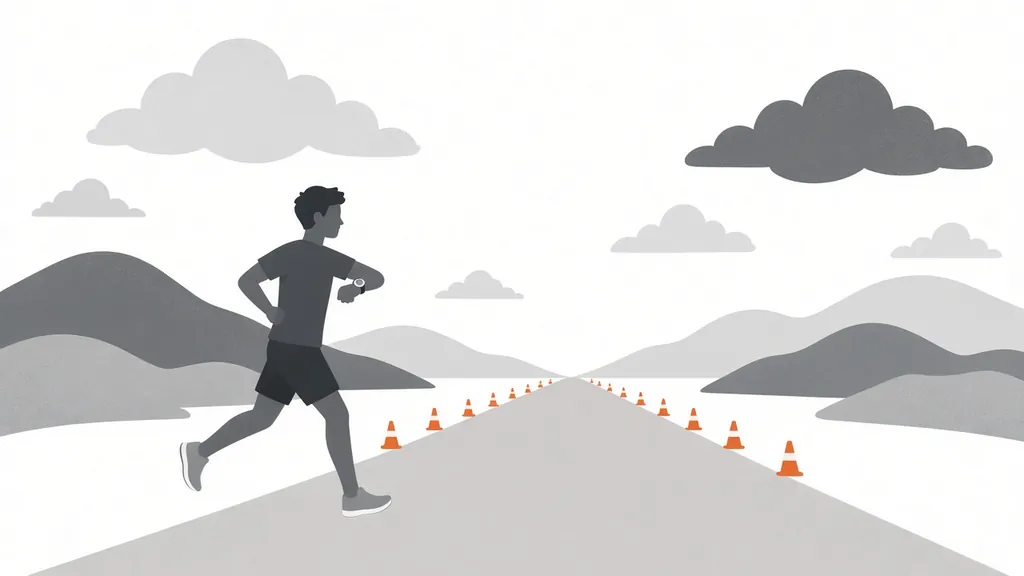
Worked example. A runner targeting a 1:45 half marathon needs 4:59/km on average. In this illustration, starting at 4:45/km for the first 5 km feels easy on race-day adrenaline but banks only about 70 seconds, while raising effort and glycogen use early. A more even plan: 5:02/km for the first 3 km, settle at 4:58–5:00/km through 18 km, then run the last 3 km by feel. Abbiss & Laursen (2008) note that even or slightly negative pacing tends to suit longer events. He also checks his watch's lap pace rather than instant pace, which jumps around near buildings and trees.
Action steps
- Set a realistic goal from a recent race or time trial.
- Plan the first 10–15% of the race a few seconds per km slower than goal pace.
- Use lap or average pace on your watch, not instant pace.
- Adjust targets for heat, wind and hills by effort.
- Review splits afterwards to learn your own tendencies.
Related guides
- Running pace: GPS accuracy, grade-adjusted pace and training paces
- Marathon training: building a plan that gets you to the finish
- Tapering before a race: how to arrive fresh and fit
- Heart rate zones explained: how to set and use them
- 10K training plan: pace, key sessions and how to get faster
- Half marathon training: a 12-week plan built around your own data
FAQ
Should I bank time early in a marathon? No — it almost always backfires.
What if I feel great at halfway? Hold steady until the last quarter, then push.
Is a negative split always best? Not always, but for most runners a near-even or slightly negative split beats a fast start.
How should I pace hills? Aim for even effort: slower uphill, faster downhill, accepting pace changes.
Why is my watch pace different from km markers? GPS error accumulates around turns and tall buildings; manual laps at markers are more accurate.
References
- Abbiss & Laursen (2008). Describing and Understanding Pacing Strategies during Athletic Competition. Sports Medicine. https://doi.org/10.2165/00007256-200838030-00004
- Burke et al. (2011). Carbohydrates for training and competition. Journal of Sports Sciences. https://doi.org/10.1080/02640414.2011.585473
For general information only. This is not medical advice — talk to a qualified professional about your health.
Keep reading
Training science
Zone 2 training: the science and how to do it right
4 min read
Training science
Polarized training (80/20): easy most of the time, hard some of the time
4 min read
Training science
Interval training and HIIT: designing sessions that work
4 min read
Mobility & stretching
Mobility vs flexibility: what's the difference and what do you need?
3 min read
Devices & setup
Strava and MoveVitals: workouts, streams and devices that arrive via Strava
3 min read
Metrics explained
VO2 max: what it means and how to improve it
4 min read