

Training science
10K training plan: pace, key sessions and how to get faster
A good 10K training plan for runners who can already run 5 km puts four ingredients into every week: easy runs, one threshold session, one VO2 max interval session and a long run. Here is a 10-week structure, how to set 10K race pace from a recent result and how to tell it is working.
Written by MoveVitals Editorial Collective
Community-authored educational content. Individual clinical review is identified only when a named review is actually recorded.
Editorial standards & corrections
Key takeaways
- The Riegel formula estimates 10K time as 5K time × 2.08, so a 25:00 5K predicts about 52:07, or 5:13/km.
- A 10-week 10K plan alternates threshold and VO2 max sessions, makes weeks 4 and 8 lighter with roughly 20–30 % less volume, and tapers in week 10.
- Put at least one easy day between quality sessions and the long run, and add no more than about 10 % to weekly volume.
- A faster pace at the same heart rate on one easy route, checked every 2–3 weeks, is real 10K progress; a 5K time trial around week 5 or 6 resets training paces.
Before you start
- This 10K training plan for beginners assumes you can run 5 km without stopping, or about 30 minutes continuously. If not, start with the beginner 5K plan.
- You already run 3–4 times a week, around 15–25 km in total.
- If you have heart, joint or other health concerns, check with a doctor before adding fast running.
Set your paces from a race result
The Riegel formula is a widely used estimator: 10K time ≈ 5K time × 2.08. A 25:00 5K predicts about 52:07 (5:13/km). It works best when your training includes long enough runs; if you mostly run 5K distances, your real 10K may be slower. Use the same logic in reverse to see what a goal asks for:
| 10K goal | Pace per km | Pace per mile | Equivalent 5K |
|---|---|---|---|
| 40:00 | 4:00 | 6:26 | about 19:10 |
| 45:00 | 4:30 | 7:14 | about 21:35 |
| 50:00 | 5:00 | 8:03 | about 24:00 |
| 55:00 | 5:30 | 8:51 | about 26:25 |
| 60:00 | 6:00 | 9:39 | about 28:45 |
Then set training paces from your 5K pace and 10K race pace. These are rules of thumb, and effort matters more than the exact number:
| Session | Effort | Pace guide | Heart rate guide |
|---|---|---|---|
| Easy and long runs | 3–4 out of 10, full sentences | 5K pace + 60–90 s/km, or slower | Mostly zone 2 |
| Threshold | 6–7 out of 10, a few words | Between 10K and half-marathon pace | About 85–90 % of max HR |
| VO2 max intervals | 8–9 out of 10 | About 3–5 km race pace | 90–95 % of max HR late in the reps |
| 10K race pace | 7–8 out of 10 | Your goal pace | Climbs steadily; do not chase it early |
The 10-week structure
Run four days a week: two easy runs, one quality session and one long run. Alternate the quality session between threshold and VO2 max intervals, or do both once you handle five runs a week comfortably. Shorten the plan to 8 weeks by cutting the base phase to two weeks.
| Weeks | Phase | Quality sessions | Long run |
|---|---|---|---|
| 1–3 | Base | Threshold: 3 × 6 min, then 4 × 6, then 5 × 6, with 2 min jog | 60 → 75 min easy |
| 4 | Lighter week | One short session; roughly 20–30 % less volume | 60 min |
| 5–7 | Build | VO2 max: 5 × 3 min, 6 × 3, 5 × 4 with 2–3 min jog. Threshold: 2 × 10 min, 2 × 12, 3 × 10 | 75 → 90 min |
| 8 | Lighter week | One short session; roughly 20–30 % less volume | 60 min |
| 9 | Sharpen | 3 × 2 km at 10K pace with 2 min jog | 75 min |
| 10 | Taper and race | Volume down by about a third to a half, a few short reps at race pace, then race | 40 min easy |
A typical week: Monday rest, Tuesday quality, Wednesday easy 30–40 minutes, Thursday rest, Friday easy 30–40 minutes with 4–6 strides, Saturday rest or cross-training, Sunday long run. Add 1–2 short strength sessions a week. Fit a lighter week every 3–4 weeks.
How to run the key sessions
- Threshold: "comfortably hard", the effort you could hold for about an hour. Start controlled and hold even effort. See tempo runs.
- VO2 max intervals: 3–5 minute repeats at about 3–5 km pace with 2–3 minutes of easy jogging. The classic 4 × 4 minutes at 90–95 % of max heart rate is a good template (interval training). The first rep should feel slightly easy.
- Long run: easy and steady, 60–90 minutes, about a quarter to a third of weekly volume (the long run).
- Wearables: heart rate lags during short reps and wrist sensors can lock onto cadence, so judge reps by lap pace and effort; a chest strap is generally more accurate. Instant GPS pace jumps around (running pace).
How to tell it is working
- Pace at heart rate. Pick one easy route and compare your pace at a similar heart rate every 2–3 weeks. A faster pace at the same heart rate, or the same pace at a lower rate, is real progress. Heat and hills distort single runs (cardiac drift).
- VO2 max trend. Watch estimates move slowly: a rise of a few units over 10 weeks is plenty. Compare the trend from one device only, and see where it sits in the VO2 max by age chart and the VO2 max guide.
- A 5K time trial around week 5 or 6 resets your paces; update them every 6–8 weeks.
Common mistakes
- Over-racing. A tune-up race every weekend is a hard day each time. Keep at most one race or time trial before the goal race and treat it as that week's quality session.
- Back-to-back hard days. Put at least one easy day between quality sessions and the long run.
- Easy runs that are not easy. Slow down until you can talk in full sentences; most gains come from the contrast between easy and hard.
- Raising volume and intensity together. A common guideline is to add no more than about 10 % to weekly volume. If pain worsens as you run, cut back and see a professional (injury prevention).
- Starting the race too fast. Run the first kilometre slightly slower than goal pace (race pacing).
In MoveVitals
Runs from Strava, Garmin, COROS, Polar and Apple Health are combined into one weekly view, deduplicated, with pace trends and time in heart rate zones. You can compare easy-run pace at similar heart rates across weeks. VO2 max estimates are stored with their source and date, so you can follow each device's trend.
Worked example
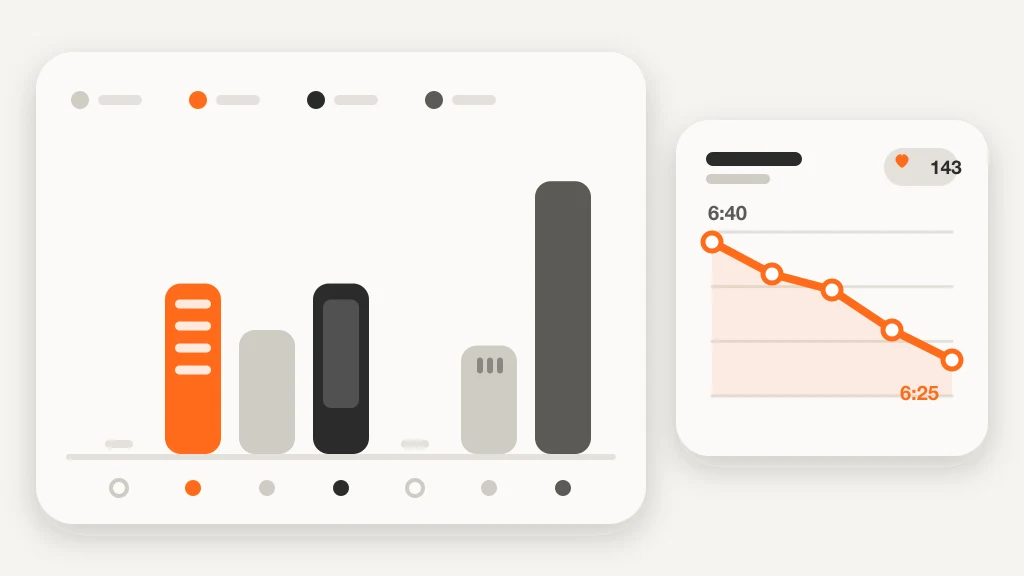
Illustrative scenario. Priya runs a 25:00 5K (5:00/km) and wants to break 50 minutes for 10K. The 2.08 rule predicts 52:07, so she needs about a 4 % improvement. Her paces: easy 6:00–6:30/km, threshold about 5:15–5:30/km, intervals around 5:00/km. She runs four days a week, building from 28 to 38 km, with a Tuesday quality session that alternates between 4 × 6 minutes at threshold and 5 × 3 minutes at 5:00/km, easy Friday runs with strides and a Sunday long run from 9 to 14 km (about 60–90 minutes at 6:30/km). A 5K time trial in week 6 gives 24:20, which predicts about 50:44, and she updates her paces. On her usual easy loop her pace at about 143 bpm improves from 6:40 to 6:25/km and her watch's VO2 max estimate rises from 40 to 42. After a week-10 taper she starts at 5:03/km, settles at 5:01/km and finishes in about 50:10, two minutes faster than predicted; sub-50 becomes the next block. Figures are illustrative.
Action steps
- Use a recent 5K or race to predict your 10K pace, then set your training paces from it.
- Build your week: two easy runs, one quality session, one long run, alternating threshold and VO2 max sessions.
- Keep easy runs easy and keep hard days apart.
- Add a lighter week every 3–4 weeks and taper for about a week.
- Check pace at the same heart rate every 2–3 weeks and retest with a 5K around week 5 or 6.
- Start the race slightly slower than goal pace and finish strong.
Related guides
- Tempo runs: how fast, how long and why they work
- Interval training and HIIT: designing sessions that work
- Race pacing: why even splits usually win
- Running pace: GPS accuracy, grade-adjusted pace and training paces
- Tapering before a race: how to arrive fresh and fit
- Faster 5K: a training plan to break 25, 22 or 20 minutes
FAQ
How many days a week should I run for a 10K? Three to five. Four runs (two easy, one quality, one long) suit most runners who already run 5 km.
Can I follow a 10K training plan for 8 weeks? Yes, if you can already run 5 km: shorten the base phase to two weeks and keep the lighter week, the two quality types and the taper.
What is a good 10K race pace? The one your recent 5K or race predicts, for example about 5:13/km for a 25:00 5K. Starting a few seconds per kilometre slower usually beats starting too fast.
How do I run a faster 10K? Consistent easy volume, one threshold and one interval session a week, enough rest between hard days, and a controlled start. Improvements of a few percent over a 10-week block are common for runners new to structured training, though results vary.
Should I use heart rate or pace in the race? Pace and effort. Heart rate climbs gradually through a 10K and lags at the start, so use it afterwards to review how the effort built.
References
- Seiler (2010). What is Best Practice for Training Intensity and Duration Distribution in Endurance Athletes?. International Journal of Sports Physiology and Performance. https://doi.org/10.1123/ijspp.5.3.276
- Helgerud et al. (2007). Aerobic High-Intensity Intervals Improve V˙O2max More Than Moderate Training. Medicine & Science in Sports & Exercise. https://doi.org/10.1249/mss.0b013e3180304570
- Bosquet et al. (2007). Effects of Tapering on Performance. Medicine & Science in Sports & Exercise. https://doi.org/10.1249/mss.0b013e31806010e0
- Soligard et al. (2016). How much is too much? (Part 1) International Olympic Committee consensus statement on load in sport and risk of injury. British Journal of Sports Medicine. https://doi.org/10.1136/bjsports-2016-096581
For general information only. This is not medical advice — talk to a qualified professional about your health.
Keep reading
Training science
Zone 2 training: the science and how to do it right
4 min read
Devices & setup
Strava and MoveVitals: workouts, streams and devices that arrive via Strava
3 min read
Training science
Polarized training (80/20): easy most of the time, hard some of the time
4 min read
Metrics explained
VO2 max: what it means and how to improve it
4 min read
Training science
Interval training and HIIT: designing sessions that work
4 min read
Metrics explained
Heart rate zones explained: how to set and use them
4 min read