

Training science
Triathlon training plan: sprint to 70.3, balancing swim, bike and run load
A triathlon training plan works when three sports share one weekly budget: pick your distance and weekly hours, give the most time to the bike, keep about 80% of training easy, and add a brick workout and a lighter week every so often.
Written by MoveVitals Editorial Collective
Community-authored educational content. Individual clinical review is identified only when a named review is actually recorded.
Editorial standards & corrections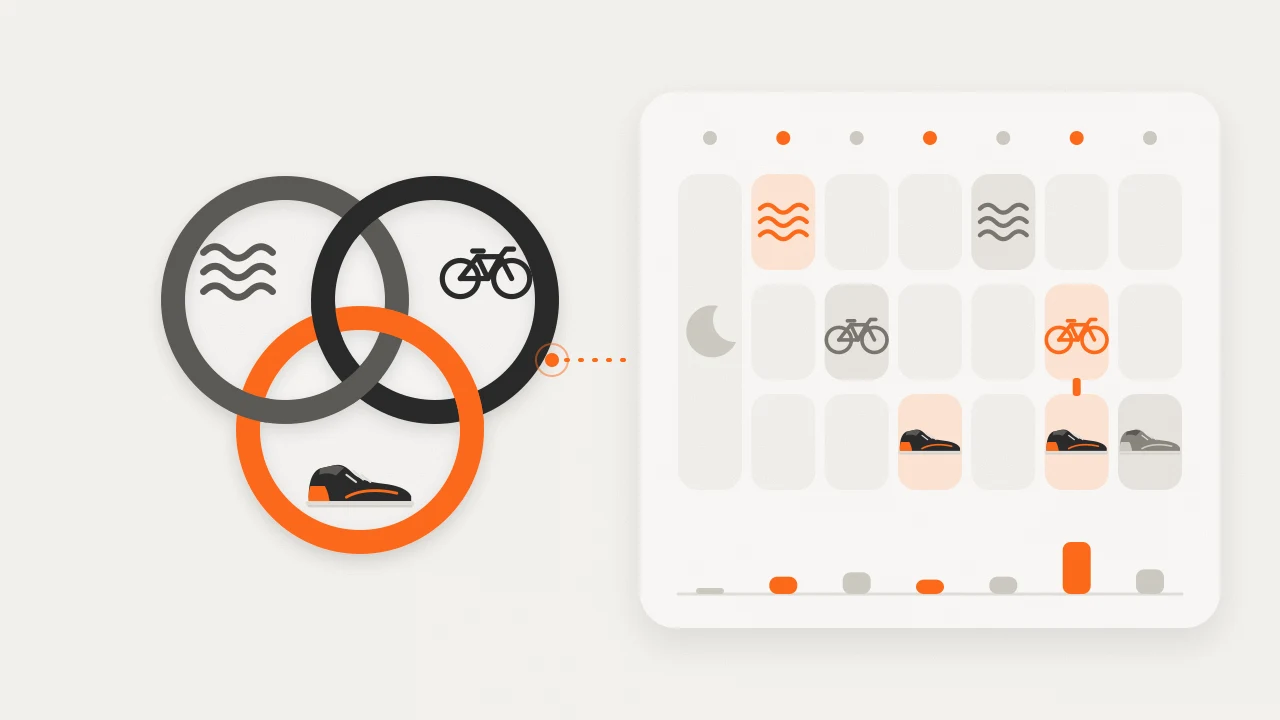
Key takeaways
- Sprint plans typically run 8–12 weeks at 5–7 hours a week, Olympic 12–16 weeks at 7–10 hours and 70.3 16–24 weeks at 9–13 hours.
- Split weekly time about 15–25 % swim, 40–50 % bike and 25–35 % run, and progress the run slowest because it has the highest impact per hour.
- Keep two or three hard sessions in total, brick included, since one hard session in every sport adds up to three or four hard days.
- Do not copy heart rate zones between sports: test each one separately, with CSS in the pool, an FTP or power benchmark on the bike, and run pace and heart rate.
- Taper by cutting volume about 40–60 % over roughly 8–14 days, and fuel with 30–60 g of carbohydrate per hour for efforts of 1–2.5 hours and up to 90 g beyond that if your gut is trained.
Triathlon is three sports sharing one body and one recovery budget. This guide shows how to choose a plan length, split weekly hours, count training load across swim, bike and run, read what a watch can and cannot tell you on each leg, and taper. For the specialist detail see brick workouts, swim pace and CSS and cycling power zones.
Sprint, Olympic or 70.3: pick the distance and the hours
| Distance | Swim / bike / run | Typical plan length | Typical weekly hours | Sessions per week |
|---|---|---|---|---|
| Sprint | 750 m / 20 km / 5 km | 8–12 weeks | 5–7 h | 4–6 |
| Olympic | 1.5 km / 40 km / 10 km | 12–16 weeks | 7–10 h | 5–7 |
| 70.3 (half distance) | 1.9 km / 90 km / 21.1 km | 16–24 weeks | 9–13 h | 6–9 |
Race distances vary a little between events. The plan length assumes a base: you can already swim a few hundred metres without stopping, ride for an hour and run 20–30 minutes. From there a sprint triathlon training plan for beginners of 10–12 weeks is realistic; for a first 70.3, many people race a sprint or Olympic event, or a half marathon, first. Choose the hours you can repeat for months, not the hours of your best week.
How to split the hours across swim, bike and run
The bike is the longest leg, so it takes the most time, and it is also the lowest-impact sport per hour, so it can carry volume. Swimming is limited by technique more than by fitness, so short, frequent sessions beat one long swim. Running costs the most per hour in muscle, tendon and bone.
| Sport | Share of weekly time | Sessions | Why |
|---|---|---|---|
| Swim | about 15–25% | 2–3 | Technique-limited; low impact, so frequency is cheap |
| Bike | about 40–50% | 2–3 | Longest leg; carries the volume with the least impact |
| Run | about 25–35% | 2–3, one of them after the bike | Highest impact per hour; progress it slowest |
These are rule-of-thumb splits. Shift hours toward your weakest leg, and hold the run steady if you are injury-prone. Here is a build week of about 8.5 hours from an Olympic-distance plan:
| Day | Session | Intensity |
|---|---|---|
| Mon | Rest, or 20 min mobility or strength | — |
| Tue | Swim 60 min: technique, then 5 × 200 m at CSS | Hard |
| Wed | Bike 75 min, steady | Easy |
| Thu | Run 50 min with 3 × 8 min at tempo | Hard |
| Fri | Swim 60 min: technique and aerobic | Easy |
| Sat | Brick: bike 2 h 45 min with 3 × 12 min at race effort, then a 15-min run at race pace | Hard |
| Sun | Long run 85 min | Easy |
That adds up to 2 h of swimming, 4 h of cycling and 2 h 30 of running. A swim set at CSS is hard but gentle on the body, which makes it the cheapest hard session of the week.
Counting load across three sports
One hour of swimming is not one hour of running, so use three layers. Hours per sport show volume. One load number, calculated the same way for all three sports, shows stress: training load (TSS, TRIMP, relative effort) or session RPE × minutes (RPE). And each sport has its own limiter:
| Sport | Best intensity anchor | Main limiter | Progress carefully |
|---|---|---|---|
| Swim | Pace per 100 m, CSS, RPE | Technique, shoulders | Hard-set volume, paddle and pull-buoy work |
| Bike | Power if you have a meter; otherwise heart rate and RPE | General fatigue more than impact | Long-ride time |
| Run | Pace and heart rate; RPE on hills | Tendons and bones | Weekly run time and the long run |
Sudden jumps in load are associated with injury more strongly than high load that was built gradually (Gabbett, 2016; Soligard et al., 2016). A common ceiling is a rise of roughly 5–10% a week in total time, with a lighter week about every fourth week (deload weeks); that is a planning habit, not a law. The combined curves in fitness, fatigue and form show whether the sum of three sports is climbing too steeply.
Intensity: mostly easy, a few hard sessions, and zones that differ by sport
Most endurance athletes get the best return from roughly 80% easy work and 20% hard (polarized training, zone 2). For a triathlete that means two or three hard sessions a week across all three sports, and the brick counts as one. Beginners can start with one or two.
Triathlon heart rate zones need care. Heart rate in the water is typically lower than on land at the same effort, and for many people the maximum reached on the bike is several beats (often 5–10 bpm) below the running maximum. One set of zones copied from your run will therefore be too high for the bike and not much use in the pool. Set zones for each sport from its own field test, or steer swims by pace and RPE and rides by power (heart rate zones, maximum heart rate).
What your watch measures on each leg
| Leg | Generally reliable | Less reliable | Tip |
|---|---|---|---|
| Pool swim | Time, lengths and pace once the pool length is set correctly | Wrist heart rate; stroke type during drills | Judge by pace and RPE; check the pool length first |
| Open-water swim | Time; distance roughly | GPS pace (noisy); wrist heart rate | Go by effort; compare similar courses |
| Bike | Power from a meter; speed from a sensor or GPS; heart rate from a chest strap | Wrist heart rate on the handlebars; calories | Pace with power or RPE, not heart rate alone |
| Run | GPS pace; heart rate from a chest strap | Wrist heart rate in intervals and in the cold | Compare pace at a given heart rate over weeks |
Use your watch's multisport or triathlon profile for races and bricks, so that swim, transition, bike and run are recorded as one activity with separate legs, and record ordinary sessions as single-sport workouts. Wrist optical heart rate is generally less accurate than a chest strap during intervals, and some straps are built to record in the water.
Bricks, taper and race-day fuelling
- Bricks. A bike followed straight by a run teaches pacing off the bike. Do one every 1–2 weeks in the build phase (brick workouts).
- Taper. Cut volume by about 40–60% over roughly 8–14 days (nearer 8–10 days for a sprint or Olympic race, closer to two weeks for a 70.3) and keep short race-pace efforts (tapering).
- Fuelling. Typical guidance is 30–60 g of carbohydrate per hour for efforts of 1–2.5 hours and up to 90 g per hour beyond that, if your gut is trained (Burke et al., 2011; Jeukendrup, 2014). Rehearse it on long bricks (carbohydrate fuelling).
Common mistakes
- One hard session in every sport, which adds up to three or four hard days.
- Copying heart rate zones from one sport to another.
- Swimming rarely and long instead of often and short.
- Raising run time as fast as bike time, then picking up a tendon problem.
- Riding the bike leg too hard on race day and walking the run.
- Skipping lighter weeks and ignoring a rising resting heart rate or a falling HRV against your own baseline.
In MoveVitals
Swims, rides and runs from Garmin, Polar, COROS or Suunto watches, from Wahoo and from Strava (including indoor Zwift rides) arrive as separate workouts with their own sport. Multisport recordings, for example from Garmin or COROS, can be split into their legs while the total load counts the session once, and a workout that reaches MoveVitals from both a watch and Strava is merged into one. Time in zone comes from each workout's heart rate stream and training load from deduplicated workouts, so hours, zones and load across the three sports sit side by side. Overnight HRV, resting heart rate and sleep from WHOOP, Oura, Garmin or Polar show how you are absorbing a peak block; compare them with your own baseline rather than with other people (personal baseline).
Worked example
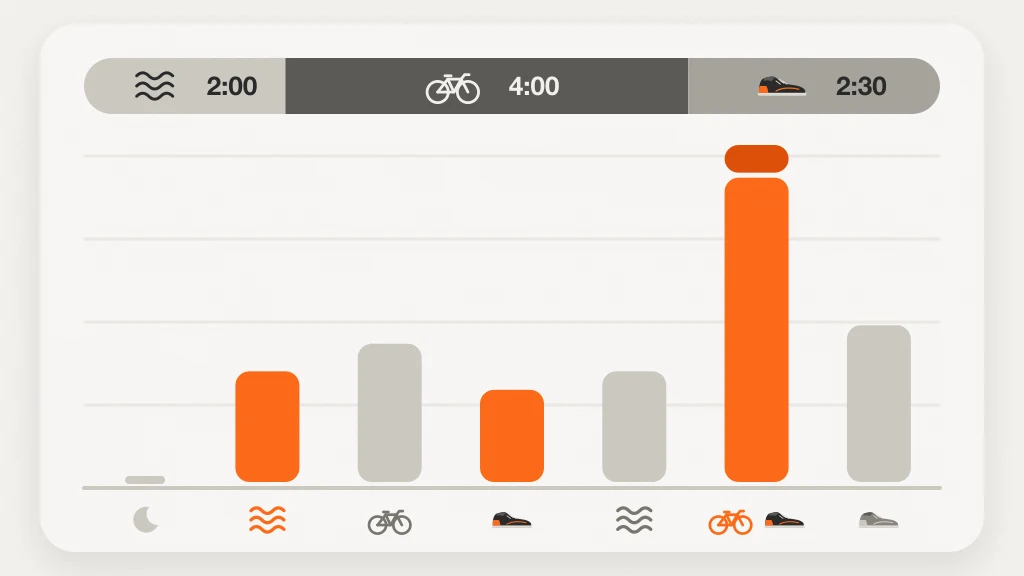
Illustrative scenario. Sam, 38, is a half-marathon runner who wants to race an Olympic-distance triathlon in 14 weeks and can give 6–8 hours a week. A 400 m and 200 m swim test (7:20 and 3:30) gives a CSS of 1:55 per 100 m: (440 − 210) ÷ 2 = 115 s. He starts at 6 hours (swim 1 h 15, bike 2 h 30, run 2 h 15) and builds to the 8.5-hour week above (swim 2 h, bike 4 h, run 2 h 30) by week 7, with a lighter week about 30% shorter every fourth week. Because he already runs, run time grows only 11% while swim and bike time grow about 60%. About 1.5 of the 8.5 hours are at tempo or harder (roughly 18%); the rest is easy. He keeps separate zones for the bike (maximum around 180 bpm) and the run (around 188 bpm) and steers swims by pace. The last 10 days cut volume by about 45% with short race-pace efforts, and he practises 45 g of carbohydrate per hour on his last two long bricks. Figures are illustrative.
Action steps
- Choose the distance and the weekly hours you can repeat for at least 8 weeks, then pick a plan length from the table.
- Start from about 20% swim, 45% bike and 30–35% run, and shift time toward your weakest leg.
- Keep two or three sessions hard in total, brick included, and make everything else easy; count each session with the same load measure.
- Test each sport separately (CSS in the pool, an FTP or power benchmark on the bike, run pace and heart rate) and do not reuse zones between sports.
- Add a brick every 1–2 weeks in the build, a lighter week every 3–4 weeks, and raise run time last and slowest.
- Taper over 8–14 days, rehearse fuelling and transitions, and check HRV and resting heart rate against your own baseline.
Related guides
- Brick workouts: training the bike-to-run transition
- Training load explained: TRIMP, TSS, strain and relative effort
- Swim pace per 100 m, CSS and SWOLF: reading your pool data
- Cycling power zones explained: the 7 zones from FTP and how to train in them
- Tapering before a race: how to arrive fresh and fit
- Open-water swimming with a watch: GPS tracks, sighting, cold water and safety
FAQ
How many hours a week do I need to train for a sprint triathlon? Most plans use about 5–7 hours over 4–6 sessions. Beginners who just want to finish often manage on less, as long as the weeks are consistent and include some swimming, riding and running each week.
How long does it take to prepare for a 70.3? Usually 16–24 weeks from a base of regular training, with peak weeks of about 9–13 hours. Many people race a sprint or Olympic event first.
Which sport should I train most? The bike gets the most time because it is the longest leg and the easiest on the body. The weakest leg deserves extra frequency, and the run deserves the most careful progression.
Are my triathlon heart rate zones the same for swimming, cycling and running? No. Heart rate is typically lower in the water, and many people reach a lower maximum on the bike than when running, so set zones per sport, or use pace, power and RPE instead.
Do I need a power meter or a triathlon watch? Not for a first sprint. A watch with pool and multisport modes is useful; a power meter helps pace the bike, and RPE works well for everything else.
References
- Millet & Vleck (2000). Physiological and biomechanical adaptations to the cycle to run transition in Olympic triathlon: review and practical recommendations for training. British Journal of Sports Medicine. https://doi.org/10.1136/bjsm.34.5.384
- Bentley et al. (2002). Specific aspects of contemporary triathlon: implications for physiological analysis and performance. Sports Medicine. https://doi.org/10.2165/00007256-200232060-00001
- Gabbett (2016). The training—injury prevention paradox: should athletes be training smarter and harder? British Journal of Sports Medicine. https://doi.org/10.1136/bjsports-2015-095788
- Soligard et al. (2016). How much is too much? (Part 1) International Olympic Committee consensus statement on load in sport and risk of injury. British Journal of Sports Medicine. https://doi.org/10.1136/bjsports-2016-096581
- Seiler (2010). What is Best Practice for Training Intensity and Duration Distribution in Endurance Athletes?. International Journal of Sports Physiology and Performance. https://doi.org/10.1123/ijspp.5.3.276
- Bosquet et al. (2007). Effects of Tapering on Performance. Medicine & Science in Sports & Exercise. https://doi.org/10.1249/mss.0b013e31806010e0
- Burke et al. (2011). Carbohydrates for training and competition. Journal of Sports Sciences. https://doi.org/10.1080/02640414.2011.585473
- Jeukendrup (2014). A step towards personalized sports nutrition: carbohydrate intake during exercise. Sports Medicine. https://doi.org/10.1007/s40279-014-0148-z
For general information only. This is not medical advice — talk to a qualified professional about your health.
Keep reading
Devices & setup
Strava and MoveVitals: workouts, streams and devices that arrive via Strava
3 min read
Metrics explained
VO2 max: what it means and how to improve it
4 min read
Metrics explained
Heart rate zones explained: how to set and use them
4 min read
Training science
Zone 2 training: the science and how to do it right
4 min read
Training science
Polarized training (80/20): easy most of the time, hard some of the time
4 min read
Training science
Interval training and HIIT: designing sessions that work
4 min read