

Training science
HIIT vs steady-state cardio: which is better for fat loss, fitness and recovery?
HIIT vs steady-state cardio is less a contest than a question of dose: HIIT saves time and lifts VO2 max a little faster, steady-state cardio is easier to repeat and recover from, and for fat loss the two work about equally when total energy use is similar. Most people do best with mostly easy sessions plus one or two hard ones a week.
Written by MoveVitals Editorial Collective
Community-authored educational content. Individual clinical review is identified only when a named review is actually recorded.
Editorial standards & corrections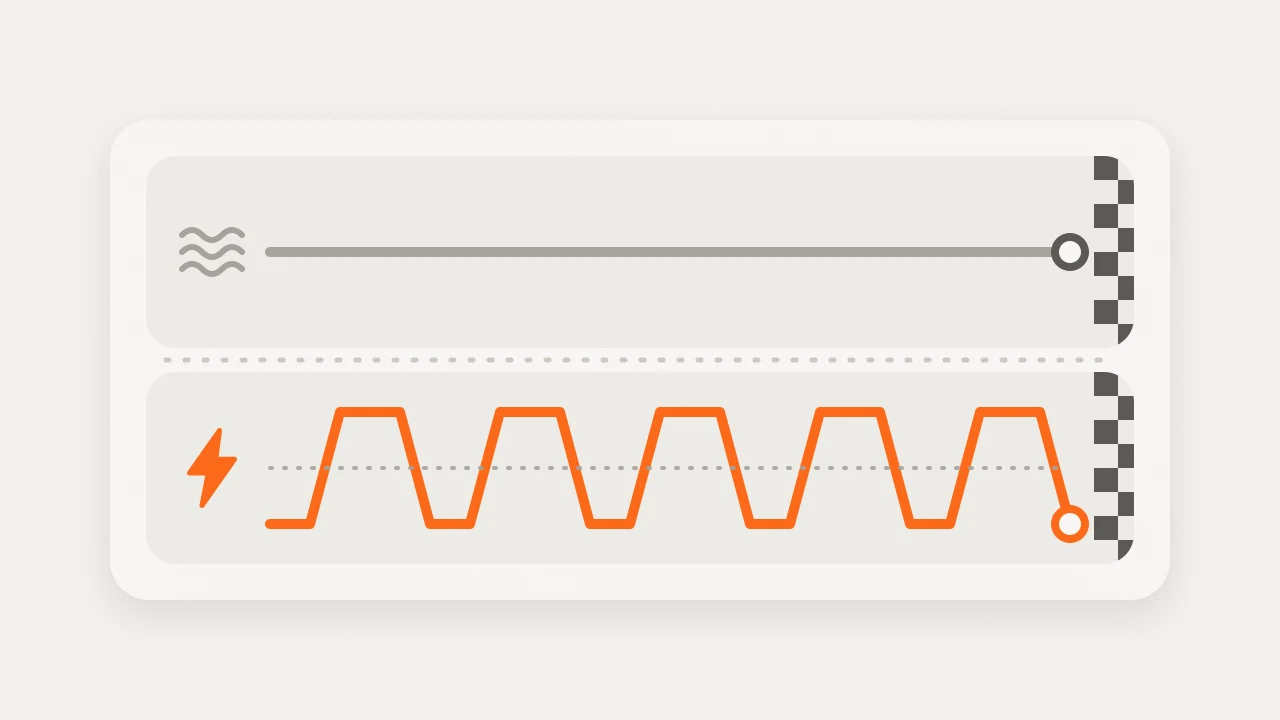
Key takeaways
- A HIIT session takes 15–30 minutes including warm-up, with hard efforts of 30 seconds to 4 minutes at about 85–95% of max heart rate, and needs 24–48 hours before the next hard session.
- Fat oxidation peaks at moderate intensity, roughly 45–65% of VO2 max, but per session the calories of the two modes are close and fat loss is similar at equal energy use.
- The afterburn after hard exercise is real but small, typically tens of calories rather than hundreds.
- A regular exerciser can combine 2–4 steady sessions of 30–60 minutes with one or two HIIT sessions of 20–30 minutes a week, 48 hours apart.
Most advice on this question picks a winner. A better framing is a decision: what is your goal, how much time do you have and how well do you recover? This guide compares calories, fat burning, VO2 max, injury risk and recovery cost, shows what each looks like in your HRV and resting heart rate, and ends with a combined week. For how to design a HIIT session, see interval training and HIIT.
The short answer: HIIT or steady-state cardio, side by side
| HIIT | Steady-state (zone 2 or moderate) | |
|---|---|---|
| Typical session | 15–30 min including warm-up; hard efforts of 30 s to 4 min at about 85–95% of max heart rate (effort 8–9 out of 10) | 30–90 min at about 60–75% of max heart rate (effort 3–5) |
| Calories per minute | Higher | Lower |
| Calories per session | Often similar or lower, because it is shorter | Often similar or higher, because it is longer |
| Fat oxidation during the session | Lower share of energy from fat | Highest share of energy from fat |
| Fat loss over weeks | Similar at equal energy use | Similar at equal energy use |
| VO2 max | Slightly larger gain on average | Good gain for beginners; builds the base |
| Injury and overuse risk | Higher per session (speed, impact, fatigue) | Lower per session |
| Recovery cost | 24–48 h before the next hard session | Low; can be repeated most days |
| Time needed | About 40% less in one body-composition review | More minutes for a similar result |
Is HIIT or cardio better for fat loss? Calories, fat oxidation and the afterburn
- Fat loss needs a sustained energy deficit, and neither mode is special. In a review of 13 trials in overweight and obese adults aged 18–45, HIIT and moderate continuous training both reduced whole-body fat mass with no significant difference between them, and HIIT needed about 40% less time (Wewege et al., 2017).
- The rate of fat oxidation peaks at moderate intensity, roughly 45–65% of VO2 max depending on training status (Achten et al., 2002), which is why zone 2 is sometimes called the fat-burning zone. The share of fuel from fat during one session matters far less than total energy use over the week (the fat-burning heart rate zone).
- The "afterburn" (excess post-exercise oxygen consumption) is real but small, typically tens of calories rather than hundreds (Børsheim and Bahr, 2003). It is not a reason to choose HIIT.
- Per minute HIIT burns more; per session the two are close. For a 75 kg person, 45 minutes on a stationary bike at 100 W (about 5.5 METs) is roughly 310 kcal, while 25 minutes of HIIT averaging about 7.5 METs is roughly 235 kcal (calories burned by activity). Both are rough estimates.
Fitness: VO2 max, aerobic base and heart health
- HIIT is an efficient way to raise VO2 max. Meta-analyses found slightly larger gains than continuous endurance training in healthy adults, with wide variation between individuals and between studies (Milanović et al., 2015; Bacon et al., 2013), and low-volume HIIT also improves other health markers in little time (Gibala et al., 2012).
- Steady-state work builds the aerobic base: more capillaries and mitochondria, better fat use and the ability to do a lot of training at low stress (zone 2 training). Elite endurance athletes do roughly 80% of sessions at low intensity and the rest hard (Seiler, 2010; Stöggl and Sperlich, 2014; polarized training).
- For general health the WHO recommends 150–300 minutes of moderate or 75–150 minutes of vigorous activity a week (a vigorous minute counts roughly as two moderate ones), plus strength work on two days (Bull et al., 2020). HIIT counts toward the vigorous minutes. More on VO2 max.
Injury risk, adherence and recovery cost
Hard efforts load muscles, tendons and the nervous system more per minute, and running intervals more than cycling or rowing. Beginners do well to build a few weeks of regular easy exercise before adding intervals, and to choose low-impact options (bike, rower, incline walking) if joints are a concern. If you have heart disease, uncontrolled high blood pressure or symptoms on exertion, check with a clinician before vigorous training, and stop and seek advice for chest pain, faintness or palpitations with dizziness.
Adherence is mixed: HIIT is short but unpleasant for some people, and long steady sessions are easy but dull for others. The best plan is the one you will repeat for months. Hard sessions also cost recovery, so leave 24–48 hours before the next one and do not stack them on consecutive days.
How each shows up in HRV and resting heart rate
After a hard session, overnight HRV is often lower and resting heart rate higher than your baseline for a day or two, especially when sleep is short or hard days are stacked. After easy steady sessions the change is usually small. Values bounce from night to night, so look at a 7-day average against your own baseline rather than at one reading (Plews et al., 2013; Stanley et al., 2013; personal baseline).
If HRV stays well below baseline and resting heart rate stays elevated for several days, swap the next HIIT session for an easy one; persistent patterns are covered in overreaching and overtraining. Brands calculate HRV differently, so compare each device only with itself.
HIIT heart rate zones and what your watch shows
Work intervals of a minute or longer are usually run at about 85–95% of maximum heart rate (zones 4–5, effort 8–9 out of 10), with recoveries back toward 60–70%. In very short efforts heart rate cannot keep up, so judge those by effort. Wrist optical sensors can lag behind a sudden effort and can be thrown off by gripping, wrist flexion (push-ups, burpees) and rapid changes, so use a chest strap if the numbers matter and RPE otherwise (heart rate zones). Calories in HIIT classes can be off in either direction (Shcherbina et al., 2017), so compare weeks rather than trusting one figure.
A combined week: how much of each
| Who | Easy or steady sessions | HIIT sessions | Notes |
|---|---|---|---|
| New to exercise | 3 × 20–40 min walking or easy cycling | None for about 4 weeks, then one short (10–15 min) | Build the habit first |
| Regular exerciser (fat loss or general fitness) | 2–4 × 30–60 min | 1, sometimes 2 × 20–30 min | 48 h between hard sessions |
| Short on time | 2 × 30 min plus daily walks | 2 × 15–20 min | Not on consecutive days |
| Endurance athlete | 3–5 easy sessions | 1–2 | About 80% easy, 20% hard |
Most studies used two or three HIIT sessions a week for 4–12 weeks; in everyday life one or two, with the rest easy, is usually enough. If fat loss is the goal, lean on steady sessions and walking, one HIIT session and your food. If you are short on time, two brief HIIT sessions work. For VO2 max and performance, add one or two HIIT sessions on top of a zone 2 base. If sleep is poor or stress is high, trim the HIIT first.
In MoveVitals
HIIT workouts from Garmin, Polar, COROS or Suunto watches, and from Strava (including Apple Watch workouts that reach Strava), arrive with duration, heart rate and, where recorded, laps; activities your device labels HIIT, interval, circuit or bootcamp are filed under the HIIT sport. Time in zone comes from each workout's heart rate stream, so you can see how many minutes of the week were easy and how many were hard, and whether you are near 80/20. Overnight HRV, resting heart rate and sleep from WHOOP, Oura, Garmin or Polar sit next to your training, so you can see how a hard day shows up the next morning against your own baseline.
Worked example
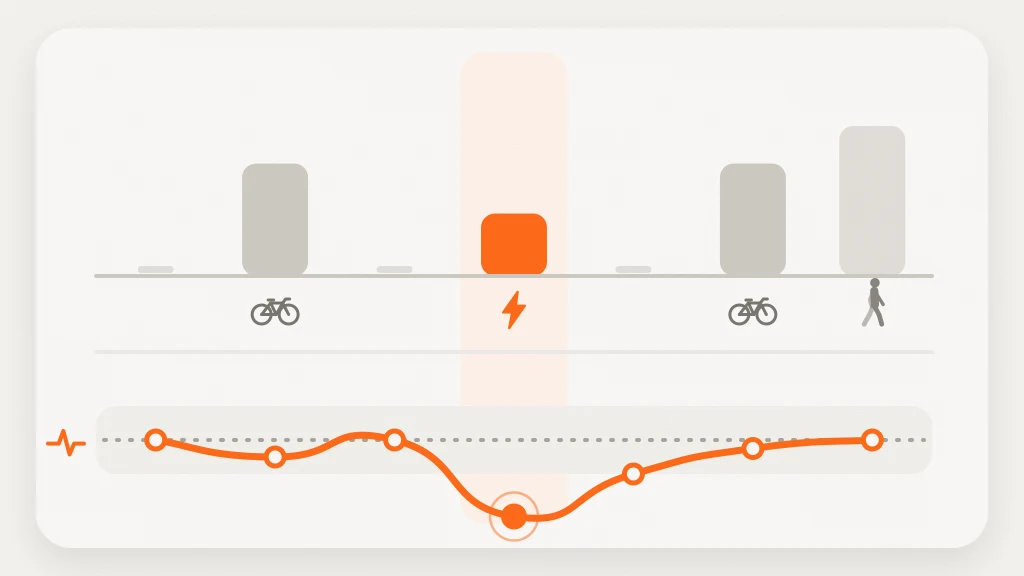
Illustrative scenario. Jamie, 35, weighs 75 kg and has about three hours a week. He starts with three 25-minute HIIT sessions on non-consecutive days. After two weeks his 7-day HRV average has fallen from 62 to 50 ms (about 19%), his resting heart rate is up about 5 bpm and he feels flat. He moves to the week in the image: Tuesday 45 minutes of zone 2 on the bike, Thursday 25 minutes of HIIT (5 minutes of warm-up, then 5 × 2 minutes hard at effort 8–9 with 2 minutes easy between), Saturday 45 minutes of zone 2, plus a 60-minute walk on Sunday. The three sessions cost about 310, 235 and 310 kcal. His HRV dips to 52–55 ms the night after the HIIT session and is back near 62 by the second night, and his resting heart rate rises 3–4 bpm for one night; within ten days both 7-day averages return to baseline. After eight weeks he rides about 2 km/h faster at the same zone 2 heart rate. Figures are illustrative.
Action steps
- Choose by goal and time: most people do best with mostly easy steady sessions and one or two HIIT sessions, and very busy weeks can lean on two short HIIT sessions.
- Keep easy days easy (about 60–70% of max heart rate, effort 3–5, full sentences) and leave at least 48 hours between hard sessions.
- Aim work intervals at effort 8–9 (about 85–95% of max heart rate for efforts of a minute or longer), recover toward 60–70%, and trust effort over the wrist reading in very short intervals.
- Track 7-day average HRV and resting heart rate against your own baseline; if both stay off for several days, make the next HIIT session an easy one.
- Review every 4–6 weeks: pace or power at a fixed heart rate, resting heart rate, sleep and how you feel, not just the calories on the watch.
Related guides
- Interval training and HIIT: designing sessions that work
- Zone 2 training: the science and how to do it right
- Polarized training (80/20): easy most of the time, hard some of the time
- VO2 max: what it means and how to improve it
- Normal heart rate variability (HRV) by age: RMSSD vs SDNN
FAQ
Is HIIT or cardio better for fat loss? Neither clearly wins. With similar total energy use, both reduce fat mass about equally, and HIIT needs less time (Wewege et al., 2017). Pick the one you will actually do, and pay attention to food and sleep.
How many times a week should I do HIIT? One or two sessions is enough for most people, with at least 48 hours between them. Studies often used two or three for a few weeks, but more hard days raise fatigue and injury risk without a matching gain.
HIIT vs zone 2: which raises VO2 max? HIIT usually raises it faster for the time spent, while zone 2 builds the aerobic base that supports it. People who train a lot do best with both, mostly easy and some hard (polarized training).
What heart rate should HIIT reach? Work intervals of a minute or longer typically reach about 85–95% of your maximum, with recoveries around 60–70%. Very short efforts will not show up fully on a watch, so go by effort (maximum heart rate).
Can I do HIIT at home? Yes. Bodyweight circuits, a stationary bike, a jump-free routine or a short hill all work. Warm up first, keep the hard efforts hard but controlled, and stop if you feel chest pain, faintness or unusual breathlessness.
References
- Wewege et al. (2017). The effects of high-intensity interval training vs. moderate-intensity continuous training on body composition in overweight and obese adults: a systematic review and meta-analysis. Obesity Reviews. https://doi.org/10.1111/obr.12532
- Milanović et al. (2015). Effectiveness of high-intensity interval training (HIT) and continuous endurance training for VO2max improvements: a systematic review and meta-analysis of controlled trials. Sports Medicine. https://doi.org/10.1007/s40279-015-0365-0
- Bacon et al. (2013). VO2max trainability and high intensity interval training in humans: a meta-analysis. PLoS ONE. https://doi.org/10.1371/journal.pone.0073182
- Gibala et al. (2012). Physiological adaptations to low-volume, high-intensity interval training in health and disease. The Journal of Physiology. https://doi.org/10.1113/jphysiol.2011.224725
- Achten et al. (2002). Determination of the exercise intensity that elicits maximal fat oxidation. Medicine & Science in Sports & Exercise. https://doi.org/10.1097/00005768-200201000-00015
- Børsheim & Bahr (2003). Effect of exercise intensity, duration and mode on post-exercise oxygen consumption. Sports Medicine. https://doi.org/10.2165/00007256-200333140-00002
- Bull et al. (2020). World Health Organization 2020 guidelines on physical activity and sedentary behaviour. British Journal of Sports Medicine. https://doi.org/10.1136/bjsports-2020-102955
- Seiler (2010). What is Best Practice for Training Intensity and Duration Distribution in Endurance Athletes?. International Journal of Sports Physiology and Performance. https://doi.org/10.1123/ijspp.5.3.276
- Stöggl & Sperlich (2014). Polarized training has greater impact on key endurance variables than threshold, high intensity, or high volume training. Frontiers in Physiology. https://doi.org/10.3389/fphys.2014.00033
- Plews et al. (2013). Training adaptation and heart rate variability in elite endurance athletes: opening the door to effective monitoring. Sports Medicine. https://doi.org/10.1007/s40279-013-0071-8
- Stanley et al. (2013). Cardiac parasympathetic reactivation following exercise: implications for training prescription. Sports Medicine. https://doi.org/10.1007/s40279-013-0083-4
- Shcherbina et al. (2017). Accuracy in wrist-worn, sensor-based measurements of heart rate and energy expenditure in a diverse cohort. Journal of Personalized Medicine. https://doi.org/10.3390/jpm7020003
For general information only. This is not medical advice — talk to a qualified professional about your health.
Keep reading
Recovery & sleep
Overreaching and overtraining: warning signs and what to do
4 min read
Metrics explained
Resting heart rate: normal ranges and what changes it
4 min read
Recovery & sleep
Deload weeks: why planned easy weeks make you fitter
3 min read
Training science
Interval training and HIIT: designing sessions that work
4 min read
Devices & setup
How MoveVitals handles multiple devices: provenance, duplicates and conflicts
5 min read
Recovery & sleep
Your personal baseline: why "normal for you" beats population averages
4 min read