

Training science
Running for weight loss: how often, how fast and what your watch can (and can't) tell you
Running for weight loss works through energy balance: three or four mostly easy runs a week (about 150–250 minutes of activity once walking is included) plus modest changes to eating beat the occasional all-out session. Your watch is good for volume, easy-pace fitness and trends, and weak at exact calories.
Written by MoveVitals Editorial Collective
Community-authored educational content. Individual clinical review is identified only when a named review is actually recorded.
Editorial standards & corrections
Key takeaways
- Running costs roughly 1 kcal per kilogram of body weight per kilometre, so a 75 kg runner burns about 375 kcal over 5 km, gross of resting energy.
- Per hour, running burns roughly 2.5–3 times as many calories as easy walking; per kilometre it is closer to 1.5–2 times.
- Body weight swings by 0.5–1.5 kg from day to day because of water, glycogen and food, so the scale usually needs 3–4 weeks to show a trend.
- Start with 3 non-consecutive days of 20–30 minutes of run-walk and add weekly time by roughly 10 % at a time.
- You cannot pick where fat comes off, and a 350 kcal run is roughly one large snack, so do not eat back every calorie your watch reports.
Running suits weight loss because it costs a lot of energy per minute, needs no equipment and can begin as walking with short jogs. It is rarely fast, though, and what you eat, how consistently you train and how you read your data matter as much as the runs. This guide covers how often to run, how fast, why the scale lags and which numbers on your watch are worth trusting. For the heart-rate question see the fat-burning heart rate zone; for a first plan see the beginner 5K plan.
How running creates a calorie gap
Running costs roughly 1 kcal per kilogram of body weight per kilometre (about 1.6 kcal per kg per mile) at easy to moderate speeds. Going faster burns more per hour but not much more per kilometre, so distance, or time at a steady effort, is the simplest way to estimate the cost.
| Body weight | 5 km (3.1 mi) | 10 km (6.2 mi) |
|---|---|---|
| 60 kg (132 lb) | about 300 kcal | about 600 kcal |
| 75 kg (165 lb) | about 375 kcal | about 750 kcal |
| 90 kg (198 lb) | about 450 kcal | about 900 kcal |
These are gross figures that include the energy you would have used at rest; the per-hour values in calories burned by activity use the same logic. Three 5 km runs at 75 kg come to roughly 1,100 kcal a week, about 160 kcal a day. By the old rule of thumb of about 7,700 kcal per kg of body fat, that alone is around 0.15 kg a week. Adding a modest, steady cut in food, say 250–300 kcal a day, more than doubles the effect on paper (about 0.4 kg a week). Real results are usually slower than this arithmetic, because the rule overestimates as the body adapts (Hall 2011) and many people eat a little more or move a little less after exercise.
That fits the research on exercise and weight. The American College of Sports Medicine found that about 150–250 minutes a week of moderate activity gives only modest weight loss on its own, while more than 250 minutes a week was associated with clinically significant loss, and results are better alongside moderate diet changes (Donnelly 2009). Volume and consistency count, and running is one way to build both.
How often and how fast
| Your starting point | Runs per week | Each session | Effort |
|---|---|---|---|
| New or returning, no regular running | 3, non-consecutive days | 20–30 min run-walk, for example 1 min jog and 90 s walk, as in the beginner 5K plan | Full sentences, RPE 3–4 |
| Building, can jog 20–30 min | 3–4 | 25–40 min, one a little longer | Mostly easy |
| Established | 4–5 | 30–60 min, plus one optional faster session | Easy (zone 2), one tempo or interval run |
Easy means you can speak in full sentences, usually zone 2 (see heart rate zones for how the numbers differ by method), and many beginners need walking breaks to stay there. That is the answer to the "how fast" question: slower than you think. Running easy lets you accumulate more minutes with fewer injuries, and minutes are what add up. One faster session a week is optional. A meta-analysis in overweight adults found that high-intensity intervals and moderate continuous training changed fat mass and waist circumference similarly, with intervals taking about 40 % less time (Wewege 2017), so choose what you will actually repeat.
Running or walking? Per hour, running burns roughly 2.5–3 times as many calories as easy walking; per kilometre it is closer to 1.5–2 times. Walking is gentler and easy to extend, so a run-walk mix (see walking for fitness) is a legitimate way to build volume if impact is a problem. The better plan is the one you can repeat for months.
Why the scale lags
Body weight swings by 0.5–1.5 kg from day to day for reasons that have nothing to do with fat:
- Water and glycogen. Carbohydrate is stored in muscle and liver together with several grams of water per gram, so starting to run, or a hard week, can add fluid for a while.
- Salt and food in the gut. A salty dinner or a high-fibre day shows up overnight.
- Muscle repair. Longer or harder runs cause small fluid shifts that can hold the scale up for a day or two.
- Menstrual cycle and hydration. Both move water around.
That is why beginners often see no change, or a small rise, in the first two weeks. Weigh at the same time under the same conditions a few mornings a week and read the 7-day average (body weight). A sustainable pace for many people is about 0.25–0.5 kg (0.5–1 lb) a week, which makes one month only 1–2 kg and explains why one-month results so often disappoint. Waist size and how clothes fit add context. You cannot choose where fat comes off: running does not target the belly, though total fat and waist usually fall together over time.
What your watch can (and can't) tell you
| Signal | Use it for | Caution |
|---|---|---|
| Weekly minutes and number of runs | Consistency, the best predictor you control | Count walking minutes too |
| Share of running time in zone 1–2 | Keeping most runs easy | Zone limits depend on your maximum heart rate and the method |
| Pace at a fixed heart rate | Aerobic fitness trend | Heat, poor sleep and caffeine raise heart rate |
| Resting heart rate and HRV trend | Spotting fatigue or a ramp that is too steep | Single days are noisy |
| Weight trend from a smart scale | The outcome | Same time, same conditions |
| Calories per run | Rough planning only | Large errors; "fat-burn minutes" are a zone label |
Wrist heart rate is usually fine on steady runs but can lag or lock onto cadence early in a run; a chest strap is more reliable for intervals (wrist heart rate accuracy). In the best-known validation of seven wrist devices, heart rate was measured reasonably well but none estimated energy expenditure with less than 20 % error (Shcherbina 2017). Do not eat back every calorie your watch reports.
Fuelling, injury and common mistakes
- Eating too little. Running more while cutting food hard can leave you tired, injured and often ill. In its extreme form the IOC calls this relative energy deficiency in sport (RED-S), which can affect hormones, bone health and performance (Mountjoy 2018). Persistent fatigue, frequent illness, stalled or worsening runs, changes in your period or a growing preoccupation with food and weight are reasons to talk to a doctor or dietitian. Protein and two strength sessions a week help you keep muscle (protein for recovery).
- Ramping up too fast. Large jumps in weekly running distance have been linked to more injuries in novice runners (Nielsen 2014). A rise of about 10 % a week is a common guard-rail rather than a proven limit. Add a lighter week every 3–4 weeks and see injury prevention for runners. Heavier runners load their joints more with every step, so run-walk intervals, softer surfaces and cycling or walking days help.
- Making every run hard. It adds fatigue and injury risk without much extra energy per kilometre.
- Eating back the run. A 350 kcal run is roughly one large snack.
- Chasing "fat-burn" minutes or one-month results.
This is general information, not medical advice. If you have heart or joint problems, are pregnant or take medication, check with your doctor before starting a new programme.
In MoveVitals
Runs from Garmin, Polar, COROS, Suunto, WHOOP, Wahoo and Strava, plus Apple Watch workouts that arrive through Apple Health or Strava, are combined into one weekly view with duplicates removed, so weekly running time and distance are easy to follow. Weigh-ins from Withings, Garmin, WHOOP and Apple Health sit alongside them, and resting heart rate and HRV come from your wearable. Calories stay with the source that reported them and are never added together across devices. MoveVitals does not estimate how much fat you lose; the outcome to watch is your weight trend against your weekly running time.
Worked example
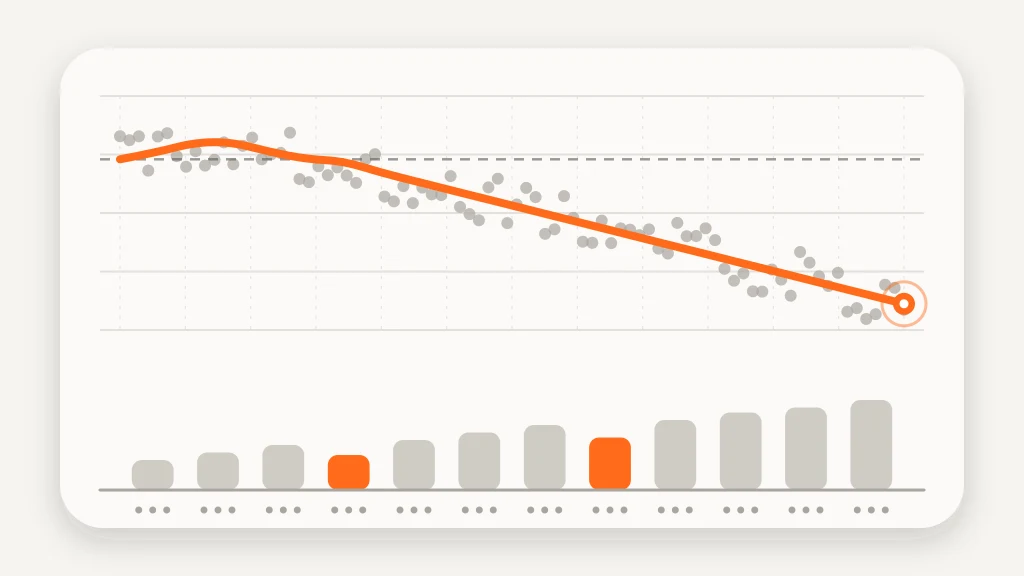
Illustrative scenario. Priya, 36, weighs 82 kg and starts with three run-walk sessions a week. By week 6 she jogs 5 km in about 36 minutes (7:12/km, 11:35/mile) three times a week and walks on weekends. By the rule of thumb each run costs about 410 kcal (82 kg × 5 km); her watch says 350–380. That is about 1,230 kcal a week, so she also trims roughly 100 kcal a day from food. In weeks 3–4 her 7-day average sits flat at 82.3 kg because she has been adding a 300 kcal recovery snack after each run; she swaps it for a piece of fruit. Her daily weigh-ins swing between 81.2 and 83.0 kg, and her first two weeks average 82.4 kg, up 0.4 kg from the start, mostly water. By week 12 the 7-day average is 79.0 kg, about 3 kg lower or 0.25 kg a week, which is in the range her weekly gap of about 1,900 kcal predicts on paper (23,100 kcal over 12 weeks at 7,700 kcal per kg). At the same 145 bpm her easy pace improves from 7:50/km in week 4 to 7:05/km in week 12, and her resting heart rate falls from 64 to 60 bpm. Figures are illustrative.
Action steps
- Choose three non-consecutive days and start with run-walk sessions of 20–30 minutes at a conversational effort.
- Add total weekly time by roughly 10 % at a time, with a lighter week every 3–4 weeks.
- Make a small, steady change to eating rather than a crash diet, and do not eat back every calorie your watch reports.
- Weigh yourself at the same time a few mornings a week and read the 7-day average over 3–4 weeks.
- Track weekly minutes, pace at a fixed heart rate and resting heart rate; ignore "fat-burn" minutes.
- Add two strength sessions and enough protein, and ease off or get advice if you feel run down or something hurts.
Related guides
- From zero to 5K: a beginner's running plan
- Zone 2 training: the science and how to do it right
- The fat-burning heart rate zone: myth, maths and what actually burns fat
- Calories burned by activity: MET values, per-hour tables and how wearables estimate them
- Body weight: why daily numbers jump and how to read the trend
FAQ
How many times a week should I run to lose weight? Three or four mostly easy runs, plus walking, adding up to roughly 150–250 minutes of activity a week is a sensible target for most beginners. More runs only help if you recover well and stay injury-free.
How long until running shows results? The scale usually needs 3–4 weeks to show a trend, and the first weeks can even show a small rise from water. A common sustainable rate is 0.25–0.5 kg a week, so one month is typically 1–2 kg. Fitness markers such as pace at a fixed heart rate often improve sooner.
Is running or walking better for weight loss? Running burns more per hour, while walking is gentler and easier to do for longer. The best choice is the one you can keep doing; a run-walk mix is a good start.
Can I run to lose belly fat? You cannot pick where fat comes off. Regular running plus a modest calorie gap lowers total body fat, and waist size usually follows over weeks and months.
What heart rate should I run at to lose weight? Easy enough to speak in full sentences, usually zone 2. There is no heart rate that burns far more fat in a way that decides the result; total weekly minutes and energy balance matter more (see the fat-burning heart rate zone).
References
- Donnelly et al. (2009). Appropriate Physical Activity Intervention Strategies for Weight Loss and Prevention of Weight Regain for Adults. Medicine & Science in Sports & Exercise. https://doi.org/10.1249/MSS.0b013e3181949333
- Wewege et al. (2017). The effects of high-intensity interval training vs. moderate-intensity continuous training on body composition in overweight and obese adults: a systematic review and meta-analysis. Obesity Reviews. https://doi.org/10.1111/obr.12532
- Hall et al. (2011). Quantification of the effect of energy imbalance on bodyweight. The Lancet. https://doi.org/10.1016/S0140-6736(11)60812-X
- Shcherbina et al. (2017). Accuracy in Wrist-Worn, Sensor-Based Measurements of Heart Rate and Energy Expenditure in a Diverse Cohort. Journal of Personalized Medicine. https://doi.org/10.3390/jpm7020003
- Mountjoy et al. (2018). IOC consensus statement on relative energy deficiency in sport (RED-S): 2018 update. British Journal of Sports Medicine. https://doi.org/10.1136/bjsports-2018-099193
- Nielsen et al. (2014). Excessive Progression in Weekly Running Distance and Risk of Running-Related Injuries: An Association Which Varies According to Type of Injury. Journal of Orthopaedic & Sports Physical Therapy. https://doi.org/10.2519/jospt.2014.5164
- Herrmann et al. (2024). 2024 Adult Compendium of Physical Activities: A third update of the energy costs of human activities. Journal of Sport and Health Science. https://doi.org/10.1016/j.jshs.2023.10.010
For general information only. This is not medical advice — talk to a qualified professional about your health.
Keep reading
Training science
Zone 2 training: the science and how to do it right
4 min read
Training science
Polarized training (80/20): easy most of the time, hard some of the time
4 min read
Training science
Interval training and HIIT: designing sessions that work
4 min read
Sports
Trail running with a watch: heart rate, climbs and pacing by effort
7 min read
Sports
Walking for fitness and weight loss: pace, heart rate zones and how much is enough
9 min read
Mobility & stretching
Mobility vs flexibility: what's the difference and what do you need?
3 min read