

Metrics explained
Swim pace per 100 m, CSS and SWOLF: reading your pool data
Swim pace per 100 m, stroke rate and SWOLF turn a pool session into numbers you can act on. Here is what a good swim pace looks like at each level, how to run a critical swim speed (CSS) test, and where your watch goes wrong.
Written by MoveVitals Editorial Collective
Community-authored educational content. Individual clinical review is identified only when a named review is actually recorded.
Editorial standards & corrections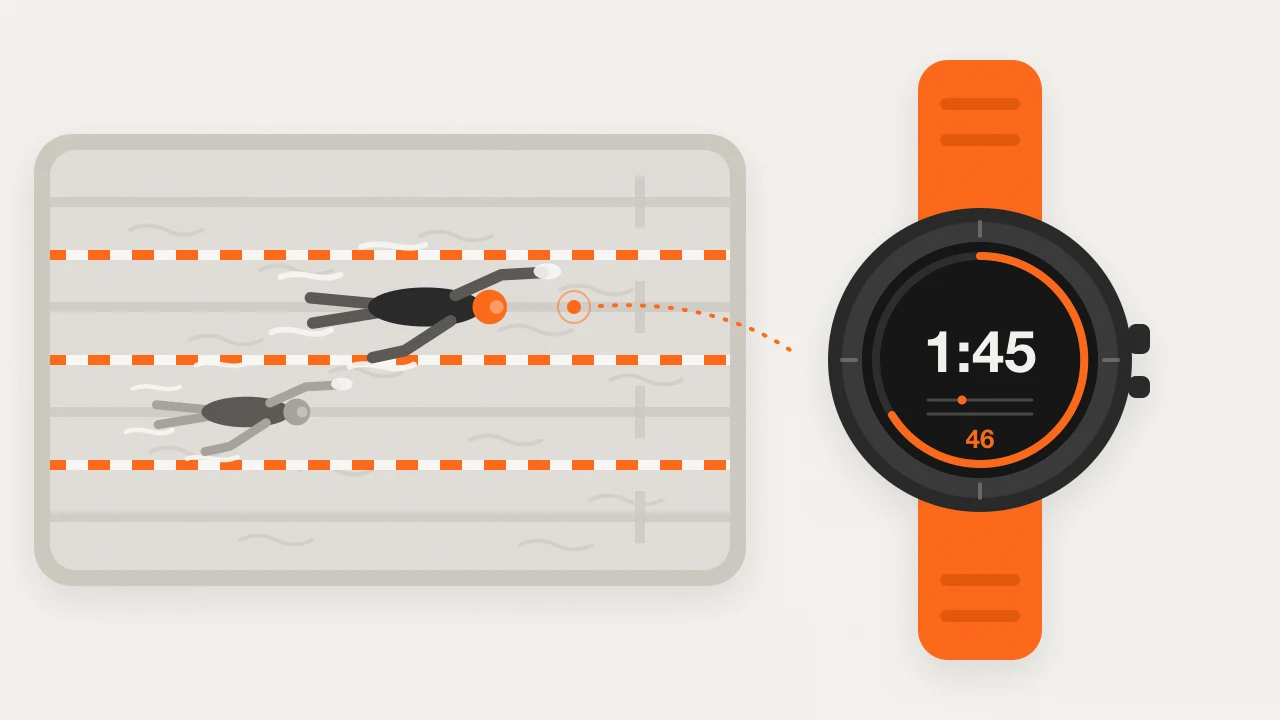
Key takeaways
- Steady freestyle per 100 m runs about 2:30 or slower for beginners, 1:40–2:00 for fit recreational swimmers, 1:20–1:40 for strong club swimmers and faster than 1:20 for competitive swimmers.
- CSS pace per 100 m = (T400 − T200) ÷ 2, so 6:40 for 400 m and 3:05 for 200 m give about 1:48 per 100 m.
- SWOLF is the seconds for a length plus the strokes in it, so lower is better at a given pace, and only comparisons within one stroke and pool mean anything.
- Threshold sets sit at CSS ± 2 s per 100 m, such as 8 × 100 m with 10–15 s rest, while easy and technique work is CSS + 10 s or slower.
- Set the pool length before you swim and repeat the CSS test every 6–8 weeks, because a wrong length makes every pace and SWOLF number wrong.
What a watch measures in the pool
In a pool your watch does not use GPS. Its accelerometer and gyroscope detect push-offs and turns to count lengths, distance is lengths × the pool length you set, and stroke count and stroke type come from the motion of the arm wearing the watch. Pace is simply time ÷ distance × 100.
Pace, time and distance are generally reliable when the pool length is right and you turn cleanly. Stroke type and stroke count are less reliable during drills, kick sets and mixed strokes. Wrist optical heart rate is generally less reliable in water and standard chest straps often lose signal, so judge swim intensity by pace and RPE as much as by heart rate.
The key metrics
| Metric | What it is | How to use it |
|---|---|---|
| Pace per 100 m | Time ÷ distance × 100 | Your headline speed; pace per 100 yd is about 0.91 × the per-100 m value (1:45 per 100 m ≈ 1:36 per 100 yd) |
| Stroke count | Strokes per length; many watches count only the watch arm, so one full cycle is one stroke | Compare only within the same device, stroke and pool |
| Stroke rate | Strokes per minute | Steady freestyle is roughly 30–40 full cycles per minute (60–80 if each arm is counted), and 45–55 or more when racing 100–200 m |
| Distance per stroke | Pool length ÷ stroke count | Longer at the same speed means more efficient |
| SWOLF | Seconds for a length + strokes in that length | Lower is better at a given pace; compare only the same stroke, pool and speed |
Speed is stroke rate × distance per stroke. Swimming faster usually raises the rate and shortens each stroke a little, so efficiency work is about keeping distance per stroke as the rate rises (compare cadence in running and cycling). SWOLF puts that trade-off into one number: 28 s + 18 strokes = 46, while 25 s + 20 strokes = 45. The second swimmer is 12 s per 100 m faster with a slightly lower SWOLF, but takes more strokes per length.
What is a good swim pace per 100 m?
| Level | Pace per 100 m (steady freestyle, 400 m or more) | SWOLF (25 m pool, freestyle) |
|---|---|---|
| Beginner | 2:30 or slower | 60 or more |
| Improver | 2:00–2:30 | 50–60 |
| Fit recreational | 1:40–2:00 | 42–50 |
| Strong club or triathlete | 1:20–1:40 | 35–42 |
| Competitive | Faster than 1:20 | Below 35 |
These are rough benchmarks for a 25 m pool without fins or a pull buoy. Breaststroke, backstroke and butterfly are slower, a 50 m pool is typically a few seconds per 100 m slower because there are fewer push-offs, and open water is slower still. SWOLF depends on how your watch counts strokes. Your own trend over weeks tells you more than any table.
Run a CSS test (400 m + 200 m)
Critical swim speed (CSS) is a field estimate of a threshold-like pace you can hold for a long, hard swim. It is related to, but not the same as, lactate threshold, and it needs only a pool and a watch.
- Warm up for 400–600 m easy, with some drills and a few 50 m builds.
- Swim 400 m as fast as you can hold evenly, and record the time (T400).
- Rest 5–10 minutes with easy swimming or floating, long enough to feel fresh.
- Swim 200 m the same way, and record the time (T200).
- Cool down for 200 m or more.
CSS pace per 100 m = (T400 − T200) ÷ 2. For example, 6:40 for 400 m (400 s) and 3:05 for 200 m (185 s) give (400 − 185) ÷ 2 = 107.5 s, or about 1:48 per 100 m.
Use the same pool length, push off the wall rather than dive, and repeat the test every 6–8 weeks under similar conditions. It is a hard test: do it only when healthy and rested, ideally with someone watching, and stop for chest pain, dizziness or unusual breathlessness.
Set intervals from your CSS
| Purpose | Pace per 100 m | Example at CSS 1:48 | Example set |
|---|---|---|---|
| Easy and technique | CSS + 10 s or slower | 1:58 or slower | 6 × 200 m easy, 20 s rest, counting strokes |
| Aerobic endurance | CSS + 4–8 s | 1:52–1:56 | 3 × 500 m, 30 s rest |
| Threshold | CSS ± 2 s | 1:46–1:50 | 8 × 100 m, 10–15 s rest |
| Hard | CSS − 3 to 6 s | 1:42–1:45 | 12 × 50 m, 20 s rest |
To use a send-off interval, add the rest to the pace: 100 m at 1:48 with 15 s rest means leaving every 2:03. Keep most of your swimming below CSS and a minority at or above it, as in polarized training, and see interval training and HIIT for how to structure the hard sets.
Lap-counting and pool-length errors
- Pool length: set it before you swim (25 m, 25 yd, 50 m or custom). A 25-yard pool entered as 25 m overstates distance by about 9%. As a check, 400 m should read 16 lengths in a 25 m pool.
- Missed or extra lengths: stopping mid-length, hanging at the wall without a turn, lane traffic and very slow stop-and-go swimming can confuse length detection. Look at the length list after the swim and correct it if your app allows.
- Drills and kick sets: use your watch's drill or rest mode, because kicking with a board or pulling with a buoy often confuses stroke detection.
- Stroke counts: these are most dependable in freestyle, and they differ between watches that count one arm and those that count both.
- Open water: GPS pace is much noisier than pool pace because the watch spends part of each stroke underwater.
Common mistakes
- Chasing a low SWOLF by gliding too long or by spinning your arms; it is a ratio, and pace still matters.
- Comparing SWOLF across strokes, pools or speeds.
- Testing CSS in a different pool length, starting the 400 m too fast or resting too little.
- Doing every set at CSS, so there are no easy swims.
In MoveVitals
Swim workouts recorded on Garmin, COROS, Suunto or Polar watches, or relayed by Strava, arrive as swim activities with the duration, distance and heart rate that the source provides, and the same swim from two sources is merged. Stroke-level metrics such as SWOLF and stroke rate are calculated in each maker's own app, so check them there; you can work out average pace per 100 m yourself from distance and time. Swims are deduplicated like any other workout before load is calculated — see training load.
Worked example
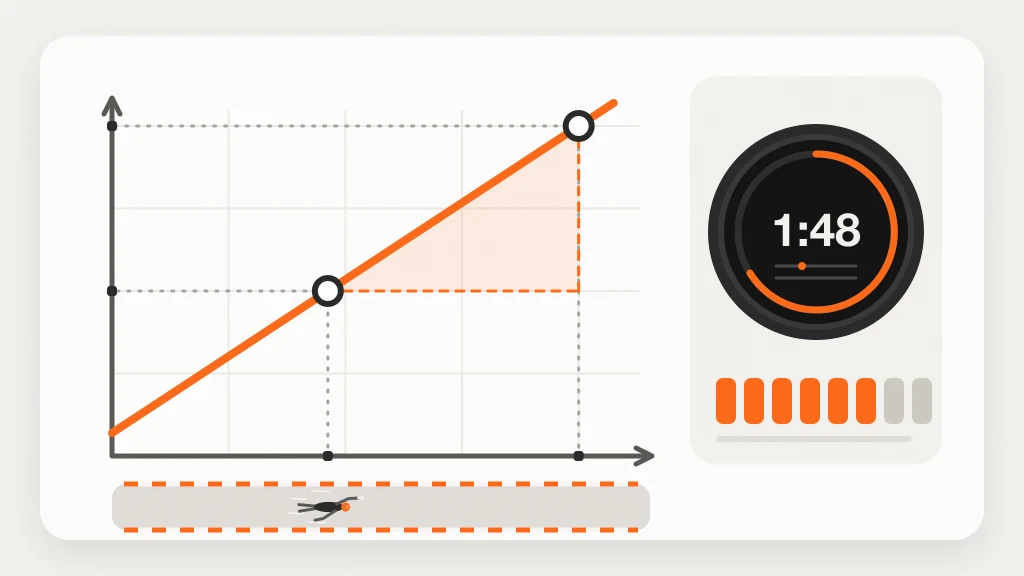
Illustrative scenario. Priya, a triathlete who swims in a 25 m pool, first checks that her watch is set to 25 m. She swims 400 m in 6:40, rests five minutes, then swims 200 m in 3:05. Her CSS is (400 − 185) ÷ 2 = 107.5 s, about 1:48 per 100 m. She plans threshold sets of 8 × 100 m at 1:48 leaving every 2:03, aerobic sets of 3 × 400 m at about 1:54, and easy drill swims at 1:58 or slower. At 1:48 pace her SWOLF sits near 47 (27 s + 20 strokes). After eight weeks of drill and catch work, the same pace costs 17 strokes (SWOLF 44), and a retest of 6:30 and 3:02 gives (390 − 182) ÷ 2 = 104 s, or 1:44 per 100 m. Figures are illustrative.
Action steps
- Set the pool length on your watch and verify it with a 400 m swim (16 lengths in a 25 m pool).
- Record a baseline: average pace per 100 m, strokes per length and SWOLF for a steady 400–800 m.
- Run a CSS test (400 m, then 200 m) and calculate CSS pace = (T400 − T200) ÷ 2.
- Build sets around CSS: mostly aerobic and technique work, with a smaller share at or above threshold.
- Retest every 6–8 weeks and track pace against effort (RPE) as well as the clock.
Related guides
- Interval training and HIIT: designing sessions that work
- RPE (rate of perceived exertion): the sensor you always carry
- Lactate threshold: the most trainable marker of endurance
- Training load explained: TRIMP, TSS, strain and relative effort
- Cadence in running and cycling: is there an ideal number?
- Open-water swimming with a watch: GPS tracks, sighting, cold water and safety
- Triathlon training plan: sprint to 70.3, balancing swim, bike and run load
FAQ
What is a good swim pace per 100 m? It depends on level, stroke and pool. For steady freestyle in a 25 m pool, 2:30 or slower is typical for beginners, 1:40–2:00 for fit recreational swimmers and under 1:20 for competitive swimmers. Track your own trend.
What is SWOLF and what is a good score? SWOLF is the seconds for a length plus the strokes in it, so lower is better at a given pace. In a 25 m pool roughly 60 or more is common for beginners and 35–45 for strong swimmers. Compare only the same stroke, pool and speed.
Why does my watch miscount lengths? Stopping mid-length, drills, mixed strokes, lane traffic or the wrong pool length are the usual causes. Set the pool length first and review the length list after the swim.
Does stroke rate matter? Yes, because speed is stroke rate × distance per stroke, but there is no single ideal number. Work on efficiency first, then raise the rate when you need to go faster.
References
- Wakayoshi et al. (1992). A simple method for determining critical speed as swimming fatigue threshold in competitive swimming. International Journal of Sports Medicine. https://doi.org/10.1055/s-2007-1021282
- Seiler (2010). What is Best Practice for Training Intensity and Duration Distribution in Endurance Athletes?. International Journal of Sports Physiology and Performance. https://doi.org/10.1123/ijspp.5.3.276
For general information only. This is not medical advice — talk to a qualified professional about your health.
Keep reading
Sports
Trail running with a watch: heart rate, climbs and pacing by effort
7 min read
Sports
Hiking and trekking: heart rate on climbs, pacing and how to train for it
8 min read
Metrics explained
VO2 max: what it means and how to improve it
4 min read
Metrics explained
Heart rate zones explained: how to set and use them
4 min read
Metrics explained
Maximum heart rate: formulas, field tests and why age-based estimates fail
4 min read
Devices & setup
How MoveVitals handles multiple devices: provenance, duplicates and conflicts
5 min read