

Metrics explained
Walking after meals: what it does to blood sugar and how a CGM shows it
A short walk after eating usually lowers the post-meal rise in blood sugar, and a continuous glucose monitor (CGM) shows it on your own curve. Here is what research on walking after meals and blood sugar says, and how to try it.
Written by MoveVitals Editorial Collective
Community-authored educational content. Individual clinical review is identified only when a named review is actually recorded.
Editorial standards & corrections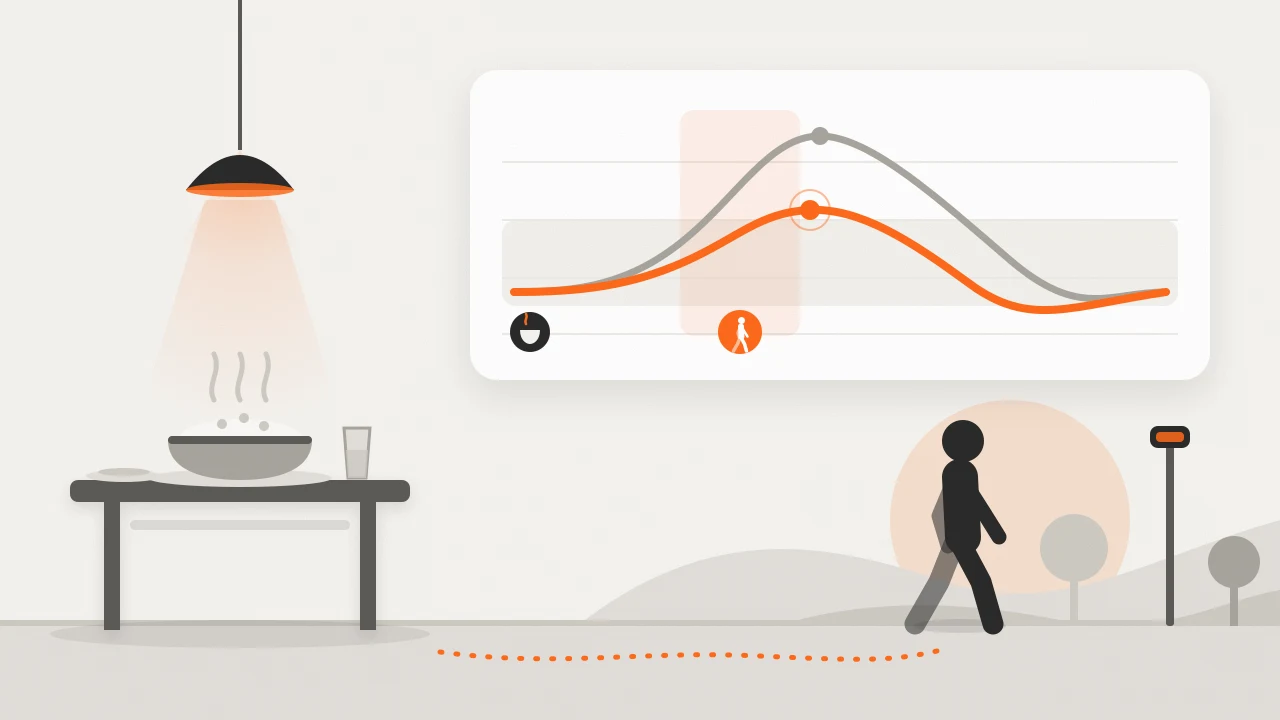
Key takeaways
- Start within about 30 minutes of finishing and walk 10–15 minutes at an easy to brisk pace, and when you cannot leave your desk, 2–5 minutes still helps.
- In 41 adults with type 2 diabetes, a 10-minute walk after each meal gave about a 12 % lower 3-hour glucose rise than 30 minutes of walking at any time, and about 22 % after the evening meal.
- Glucose usually peaks 30–90 minutes after you start eating, and a CGM lags blood glucose by about 5–15 minutes, so peaks appear slightly late.
- Compare the same meal with and without a walk over several days, because the trials are small and sleep, stress and fibre all move the curve.
- A CGM curve does not diagnose diabetes, and anyone with diabetes or on glucose-lowering medicine should agree any change with their clinician first.
Why a walk changes the curve
After a meal, glucose from digested carbohydrate enters the blood, usually peaks 30–90 minutes after you start eating, and then falls as insulin moves it into tissues. Contracting muscle takes up glucose largely independently of insulin, so a walk gives glucose somewhere to go while it is at its highest. That is why timing matters: a systematic review of eight crossover trials found that exercise after a meal lowered the glucose rise more than exercise before it, and a shorter gap between meal and exercise tended to help more.
What the evidence shows
| Study | Who | What was compared | Finding |
|---|---|---|---|
| Dunstan 2012 | 19 overweight or obese adults | 2-minute light or moderate walks every 20 minutes vs sitting | Lower glucose and insulin responses to a test drink |
| DiPietro 2013 | 10 inactive adults aged 60+ at risk of type 2 diabetes | Three 15-minute walks after meals vs one 45-minute walk at another time | After-meal walks improved 24-hour glucose and lowered post-dinner glucose more |
| Reynolds 2016 | 41 adults with type 2 diabetes | 10-minute walk after each meal vs 30 minutes of walking at any time | About 12% lower 3-hour glucose rise overall, about 22% after the evening meal |
| Engeroff 2023 | 8 crossover trials, 116 adults | Exercise before vs after a meal | After-meal exercise lowered the glucose rise more than pre-meal exercise or none |
These trials are small and short, and most measure single meals or a few days. They show a consistent direction, not a guaranteed size, and they say little about long-term outcomes such as HbA1c. Many participants had diabetes, excess weight or were older, so effects in healthy younger adults are less studied, although the physiology is the same. The American Diabetes Association already advises breaking up long periods of sitting at least every 30 minutes.
How long, when and how fast
| Variable | A sensible default | Notes |
|---|---|---|
| Start | Within about 30 minutes of finishing | Sooner tends to blunt the peak more; ease into the pace after a big meal |
| Duration | 10–15 minutes | 2–5 minutes still helps when you cannot leave your desk |
| Pace | Easy to brisk: you can talk; about 100 steps/min is a common marker of moderate pace | Very hard efforts can push glucose up for a while through stress hormones |
| Which meal | The largest or most carbohydrate-rich, often dinner | Reynolds saw the biggest effect after the evening meal |
A walk does not cancel a meal. Food choices, meal order and sleep still matter — see blood glucose and CGMs.
How it shows up on a CGM and in your steps
Compare the same meal on days with and without a walk. Four things usually change: the peak is a little lower, it comes a little earlier, glucose returns to baseline sooner, and the area under the curve is smaller. In your step data, a 10-minute walk shows up as roughly 1,000–1,200 extra steps in the hour after the meal.
Read the trace with some caution:
- A CGM reads fluid under the skin and lags blood glucose by about 5–15 minutes, so peaks appear slightly late.
- Sleep, stress, fibre, protein, fat, earlier exercise and illness all move the curve. One comparison is noise; repeat it three to five times.
- A moderate rise after eating is normal physiology, not a failure, and a CGM curve does not diagnose diabetes. If you track time in range, use the targets your care team gives you.
Routines that work
- Dinner loop: 10–15 minutes right after the evening meal.
- Lunch lap: take a call or run an errand on foot after lunch.
- Desk breaks: stand or walk for 2–5 minutes after every 30 minutes of sitting.
- Bad weather: walk indoors, take the stairs or do light chores.
Common mistakes are judging one meal, going out too hard, waiting two hours, treating every rise as a problem and changing medication on your own. If you use insulin or other medicine that can lower glucose, activity after meals can add to that effect, so talk to your care team about adjustments. Seek urgent care for confusion, fainting or chest pain.
In MoveVitals
Dexcom connects through its official API. Readings arrive about every 5 minutes of sensor time but reach MoveVitals with a delay of typically 1–3 hours, so they are for looking back, not for live alerts; use the Dexcom app or receiver for real-time readings and treatment decisions. MoveVitals calculates daily average glucose and time in range.
Daily steps from Garmin, COROS or Polar, and walking workouts from those devices and from Strava, arrive as well. Steps are stored per source and one priority gives your daily total, so they are never added together. A walk recorded as a workout sits next to your glucose readings; a stroll you did not record only adds to your daily steps, so start a walking activity on your watch if you want it timestamped. See Dexcom and MoveVitals.
Worked example
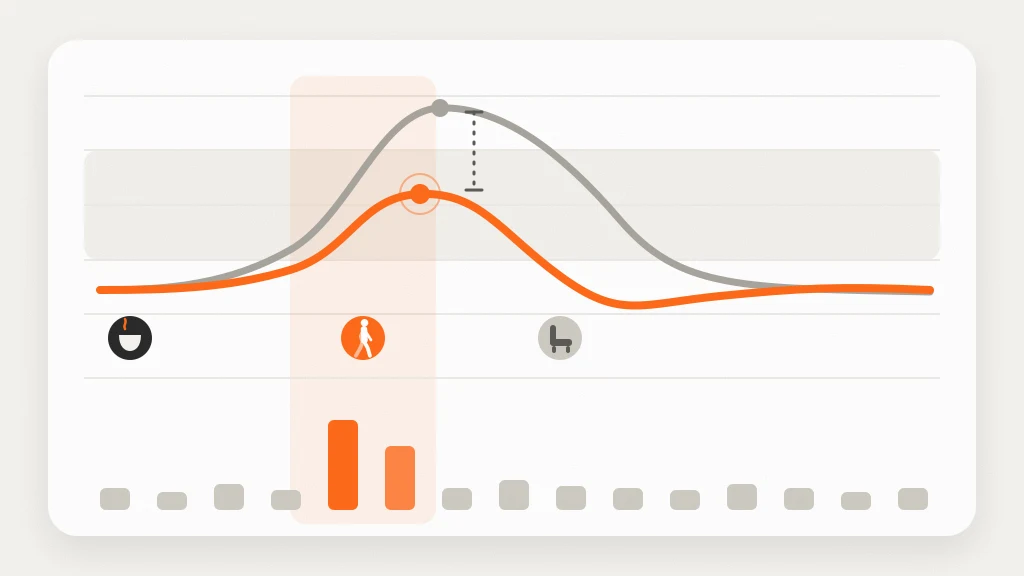
Illustrative scenario. Mei, 38, does not have diabetes and wears a CGM for two weeks out of curiosity. She eats the same noodle dinner on four evenings. On two evenings she sits on the sofa: glucose rises from about 5.2 mmol/L (94 mg/dL) to a peak near 8.9 mmol/L (160 mg/dL) after roughly 55 minutes and takes about 2 h 40 min to return to baseline. On the other two she starts a 12-minute walk about 20 minutes after finishing: the peak is 7.6 mmol/L (137 mg/dL) around 40 minutes, baseline is back in about 1 h 45 min, and her watch logs roughly 1,300 extra steps. The difference is about 1.3 mmol/L (23 mg/dL). She treats it as information about her own routine, not a diagnosis, and keeps walking after her biggest meal. Numbers are illustrative.
Action steps
- Pick the one or two meals where you rise most or can walk most easily; for many people that is dinner.
- Start within about 30 minutes of finishing and walk 10–15 minutes at an easy to brisk pace.
- When you cannot walk, stand or move for 2–5 minutes, and repeat every 30 minutes if you are sitting.
- If you wear a CGM, compare the same meal with and without a walk over several days and note sleep and stress.
- Start a walking activity on your watch so the walk lines up with the glucose curve, and keep an eye on your daily steps.
- If you have diabetes or take glucose-lowering medicine, agree changes with your clinician first.
Related guides
- Blood glucose and CGMs: reading your glucose curve
- Glucose time in range (TIR): the CGM metric that matters most
- Dexcom CGM and MoveVitals: glucose next to your training and sleep
- Daily steps: is 10,000 really the target?
- HbA1c, fasting glucose and fasting insulin: reading your metabolic health
FAQ
Does a 10-minute walk after eating really lower blood sugar? In small controlled trials, usually yes: the post-meal peak is lower and settles sooner. The size varies with the meal, the person and the timing, so treat it as a tendency to test on your own curve.
How soon after eating should I walk? Within about 30 minutes works well in the studies, and the sooner the walk starts, the larger the effect tended to be. You do not need to rush: an easy start is fine after a big meal.
Why did my glucose go up when I walked fast? Hard effort releases stress hormones that can raise glucose for a while. Slow to a pace where you can talk.
Do people without diabetes need to worry about post-meal spikes? A moderate rise after eating is normal. Use CGM data as information, not a diagnosis, and ask a clinician about persistently high fasting readings.
References
- Reynolds et al. (2016). Advice to walk after meals is more effective for lowering postprandial glycaemia in type 2 diabetes mellitus than advice that does not specify timing: a randomised crossover study. Diabetologia. https://doi.org/10.1007/s00125-016-4085-2
- DiPietro et al. (2013). Three 15-min bouts of moderate postmeal walking significantly improves 24-h glycemic control in older people at risk for impaired glucose tolerance. Diabetes Care. https://doi.org/10.2337/dc13-0084
- Dunstan et al. (2012). Breaking up prolonged sitting reduces postprandial glucose and insulin responses. Diabetes Care. https://doi.org/10.2337/dc11-1931
- Engeroff et al. (2023). After Dinner Rest a While, After Supper Walk a Mile? A Systematic Review with Meta-analysis on the Acute Postprandial Glycemic Response to Exercise Before and After Meal Ingestion in Healthy Subjects and Patients with Impaired Glucose Tolerance. Sports Medicine. https://doi.org/10.1007/s40279-022-01808-7
- Colberg et al. (2016). Physical Activity/Exercise and Diabetes: A Position Statement of the American Diabetes Association. Diabetes Care. https://doi.org/10.2337/dc16-1728
For general information only. This is not medical advice — talk to a qualified professional about your health.
Keep reading
Metrics explained
Blood glucose and CGMs: reading your glucose curve
4 min read
Devices & setup
Dexcom CGM and MoveVitals: glucose next to your training and sleep
3 min read
Metrics explained
Glucose time in range (TIR): the CGM metric that matters most
3 min read
Sports
Walking for fitness and weight loss: pace, heart rate zones and how much is enough
9 min read
Devices & setup
How MoveVitals handles multiple devices: provenance, duplicates and conflicts
5 min read
Sports
Japanese interval walking: the 3-minute fast / 3-minute slow method, step by step
8 min read