

Metrics explained
Blood glucose and CGMs: reading your glucose curve
A continuous glucose monitor (CGM) shows how your blood sugar responds to food, exercise, sleep and stress. Used well, it is a powerful feedback tool — for people with and without diabetes.
Written by MoveVitals Editorial Collective
Community-authored educational content. Individual clinical review is identified only when a named review is actually recorded.
Editorial standards & corrections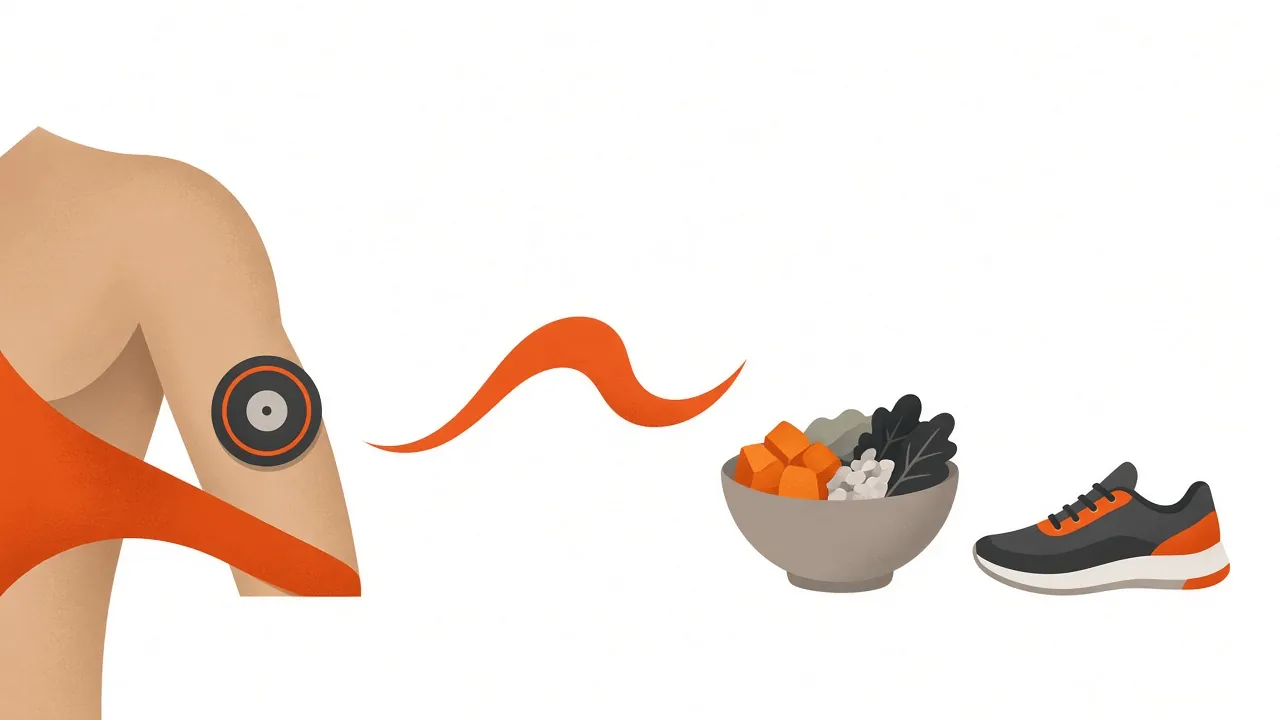
Key takeaways
- Fasting glucose of 70–99 mg/dL (3.9–5.5 mmol/L) is normal, 100–125 mg/dL is prediabetes and 126 mg/dL (7.0 mmol/L) or higher is in the diabetes range; diagnosis requires laboratory tests, not CGM data alone.
- CGMs measure interstitial fluid, which lags blood glucose by about 5–15 minutes.
- A 10–20 minute walk after eating lowers the post-meal peak, and vegetables and protein before carbohydrates often flatten the curve.
- Wear a sensor for at least 10–14 days to see patterns rather than single spikes, and discuss persistently high fasting values with a clinician.
Blood glucose is the concentration of sugar in your blood. A continuous glucose monitor (CGM) such as Dexcom measures glucose in the fluid under the skin every few minutes and builds a 24-hour curve.
Reference ranges
| Situation | mg/dL | mmol/L |
|---|---|---|
| Fasting, normal | 70–99 | 3.9–5.5 |
| Fasting, prediabetes | 100–125 | 5.6–6.9 |
| Fasting, diabetes | ≥ 126 | ≥ 7.0 |
| 2 h after a standardized 75 g OGTT, normal | < 140 | < 7.8 |
| Low (hypoglycaemia) | < 70 | < 3.9 |
Diagnosis requires laboratory tests (fasting glucose, HbA1c or glucose tolerance test), not CGM data alone.
The < 140 mg/dL (< 7.8 mmol/L) two-hour cutoff refers to a standardized 75 g oral glucose tolerance test (OGTT) in nonpregnant adults. It is not a universal normal target after an ordinary meal or a diagnostic cutoff for a CGM curve. Pregnancy uses different criteria. NIDDK testing guidance.
What moves your glucose
- Meals: refined carbohydrates cause bigger, faster spikes; fibre, protein and fat slow them.
- Order of eating: vegetables and protein before carbs often flatten the curve.
- Movement: a 10–20 minute walk after eating lowers the post-meal peak.
- Exercise: steady exercise usually lowers glucose; very hard efforts can temporarily raise it (stress hormones).
- Sleep and stress: a bad night or high stress raises glucose and insulin resistance the next day.
- Dawn phenomenon: glucose often rises in the early morning before waking.
CGM accuracy
CGMs measure interstitial fluid, which lags blood glucose by about 5–15 minutes. Accuracy is typically within 8–10 % (MARD) for current Dexcom sensors. Pressure on the sensor at night ("compression lows") can create false lows.
How to use the data
- Look at patterns, not single spikes.
- Focus on time in range and average glucose.
- Run small experiments: same meal with and without a walk afterwards.
- Don't fear every rise — a moderate post-meal rise is normal physiology.
In MoveVitals
Dexcom readings sync on a schedule through the official API. Glucose is stored in mg/dL and shown in mmol/L where you prefer.
Worked example
Illustrative scenario. Ken wears a CGM for two weeks out of curiosity. A white-rice lunch eaten alone pushes glucose from about 5.2 to 9.0 mmol/L (94 → 162 mg/dL); the same rice after a salad and chicken, followed by a 10-minute walk, peaks near 7.3 mmol/L. During a hard interval session his glucose rises despite no food — a normal stress-hormone response, not a problem. He uses the data to adjust meal order, not to avoid carbohydrates around training.
Action steps
- Wear the sensor at least 10–14 days to see patterns, not single spikes.
- Log meals, training and sleep alongside readings.
- Test one change at a time (meal order, post-meal walk).
- Expect readings to lag finger-prick values by 5–15 minutes.
- Discuss persistently high fasting values with a clinician.
Related guides
- Glucose time in range (TIR): the CGM metric that matters most
- HbA1c, fasting glucose and fasting insulin: reading your metabolic health
- Dexcom CGM and MoveVitals: glucose next to your training and sleep
- Carbohydrate fuelling for training and racing
- Walking after meals: what it does to blood sugar and how a CGM shows it
FAQ
Is a spike to 160 mg/dL after pasta bad? Occasional moderate spikes are normal; frequent high spikes and slow returns are worth discussing with a professional.
Should athletes use a CGM? It can help with fuelling strategy, but interpret it with care — exercise changes the rules.
Why does my glucose rise during exercise? Hard efforts release stress hormones that raise glucose temporarily; it usually falls again afterwards.
Do I need a CGM if I don't have diabetes? Not necessarily; evidence for benefits in people without diabetes is limited, so it's optional curiosity, not a requirement.
References
- Battelino et al. (2019). Clinical Targets for Continuous Glucose Monitoring Data Interpretation: Recommendations From the International Consensus on Time in Range. Diabetes Care. https://doi.org/10.2337/dci19-0028
- Riddell et al. (2017). Exercise management in type 1 diabetes: a consensus statement. The Lancet Diabetes & Endocrinology. https://doi.org/10.1016/S2213-8587%2817%2930014-1
- NIDDK. Diabetes Tests & Diagnosis. https://www.niddk.nih.gov/health-information/diabetes/overview/tests-diagnosis
- NIDDK. Diabetes & Prediabetes Tests: standardized 75 g oral glucose tolerance testing. https://www.niddk.nih.gov/health-information/professionals/clinical-tools-patient-management/diabetes/diabetes-prediabetes
For general information only. This is not medical advice — talk to a qualified professional about your health.
Keep reading
Devices & setup
Dexcom CGM and MoveVitals: glucose next to your training and sleep
3 min read
Metrics explained
Glucose time in range (TIR): the CGM metric that matters most
3 min read
Metrics explained
HbA1c, fasting glucose and fasting insulin: reading your metabolic health
3 min read
Devices & setup
How MoveVitals handles multiple devices: provenance, duplicates and conflicts
5 min read
Sports
Walking for fitness and weight loss: pace, heart rate zones and how much is enough
9 min read
Devices & setup
Oura Ring and MoveVitals: sleep, readiness and temperature in one place
3 min read