

Metrics explained
Cadence in running and cycling: is there an ideal number?
Cadence is your step rate when running or pedal rate when cycling. There is no magic number, but a moderate increase often makes running smoother and pedalling more efficient.
Written by MoveVitals Editorial Collective
Community-authored educational content. Individual clinical review is identified only when a named review is actually recorded.
Editorial standards & corrections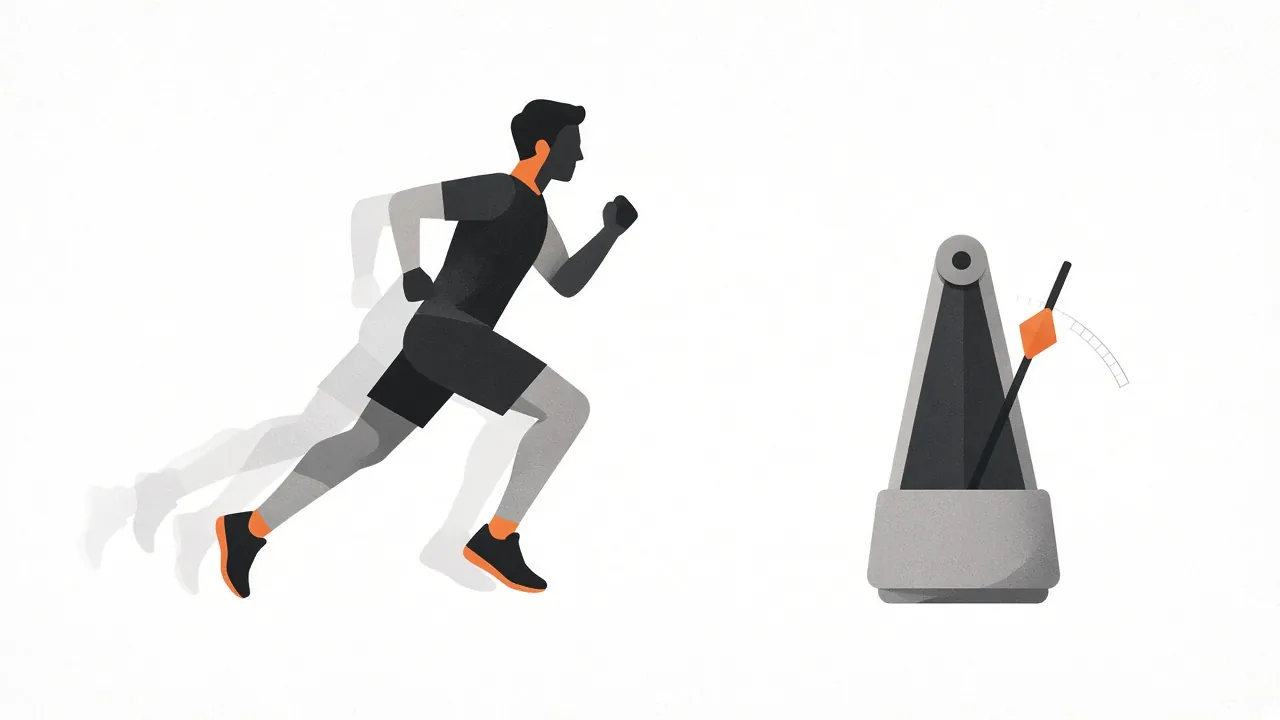
Key takeaways
- The famous 180 steps per minute comes from elite race speeds, and cadence naturally rises with speed, so it is not a universal target.
- To change running cadence, use a metronome set 5 % above your current cadence for short segments a few times a week, and review the trend after 4–6 weeks.
- Typical cycling cadence is 80–95 rpm for endurance riding, 70–85 rpm for climbing and 85–100 rpm for a time trial.
- A watch showing 85 may be reporting cadence per leg, so double it to get steps per minute.
Running cadence
Running cadence is steps per minute (spm), counted by your watch or foot pod. Typical recreational runners sit at 150–170 spm; elite distance runners usually run 175–190 spm at race pace.
The famous "180 spm" comes from observations at elite race speeds — cadence naturally rises with speed, so it isn't a universal target. However, research shows that increasing cadence by 5–10 % from your natural rate:
- shortens stride and reduces overstriding,
- lowers impact forces at the knee and hip,
- may reduce injury risk for some runners.
How to change it: run with a metronome set 5 % above your current cadence for short segments, a few times a week, and progress over weeks.
Cycling cadence
Cycling cadence is pedal revolutions per minute (rpm), measured by a sensor or smart trainer such as the Magene T600.
| Situation | Typical cadence |
|---|---|
| Endurance riding | 80–95 rpm |
| Climbing | 70–85 rpm |
| Time trial | 85–100 rpm |
| Sprint | 100–130 rpm |
Higher cadences shift load from muscles to the cardiovascular system; lower cadences feel stronger but fatigue legs faster. Most riders find their most efficient cadence through practice. Drills such as high-cadence spin-ups and single-leg pedalling improve smoothness — see cadence drills.
In MoveVitals
Cadence streams from Garmin, COROS, Polar, Strava and Magene are stored second by second. Running cadence is shown in steps per minute (not per leg), so values are comparable across brands.
Worked example
Illustrative scenario. Sara's watch shows an average easy-run cadence of 158 spm at 6:15/km and 172 spm at 5:00/km — cadence naturally rises with speed, so comparing runs at different paces is misleading. She compares only easy runs and tries a 5% increase to around 166 spm at the same pace, which shortens her stride slightly. On the bike she notices her cadence drops to 70 rpm on climbs; shifting to an easier gear to stay around 80–85 rpm feels less taxing on her legs over a 2-hour ride. Neither change is about hitting a universal "ideal" number.
Action steps
- Compare cadence only between runs at similar pace and terrain.
- If you over-stride or have knee pain, try a 5–10% cadence increase at the same speed.
- Use a metronome or watch alert for a few short sections per run.
- On the bike, shift gears to keep cadence in a comfortable band (often 80–95 rpm) on climbs and flats.
- Review the trend after 4–6 weeks rather than session to session.
Related guides
- Cadence drills for cyclists and runners
- Running dynamics: ground contact time, vertical oscillation and stride length
- Running pace: GPS accuracy, grade-adjusted pace and training paces
- Injury prevention for runners: load, strength and listening early
FAQ
My watch shows 85 — is that bad? Some platforms report cadence per leg; double it for steps per minute.
Should beginners force 180 spm? No — small increases from your natural cadence are safer.
Does taller height mean lower cadence? Often slightly, because longer legs produce longer strides, which is another reason there is no single ideal number.
Is high cycling cadence always better? No. Higher cadence reduces force per pedal stroke but raises oxygen cost; the most efficient cadence differs between riders and situations.
References
- Heiderscheit et al. (2011). Effects of Step Rate Manipulation on Joint Mechanics during Running. Medicine & Science in Sports & Exercise. https://doi.org/10.1249/mss.0b013e3181ebedf4
For general information only. This is not medical advice — talk to a qualified professional about your health.
Keep reading
Devices & setup
Strava and MoveVitals: workouts, streams and devices that arrive via Strava
3 min read
Metrics explained
VO2 max: what it means and how to improve it
4 min read
Metrics explained
Heart rate zones explained: how to set and use them
4 min read
Devices & setup
How MoveVitals handles multiple devices: provenance, duplicates and conflicts
5 min read
Training science
Zone 2 training: the science and how to do it right
4 min read
Sports
Trail running with a watch: heart rate, climbs and pacing by effort
7 min read